What does ISO 27001 A.7.11 require for power and other utilities?
ISO 27001 A.7.11 covers protection from failures in power and other utilities supporting information systems. Review the supplies your services depend on and how they should respond to an interruption. When the equipment or load changes, check whether the existing protection still meets those needs.
A backup test can become outdated without any equipment breaking. Add more devices to the supply, and the same backup may run for less time. The review needs to establish whether that time is still sufficient for the response agreed with the service owner.
Utility dependencies
Utility protection starts with the services that would stop if a supply failed. Trace their power, cooling and communications to the equipment and supplies they use. Include dependencies outside the server room; a service can depend on equipment in more than one location.
IT may operate the service while facilities maintains its power supply and a provider manages another dependency. Record these responsibilities against the affected equipment. When a check fails, the reviewer can then reach the people who can investigate it and decide what to change.
Outage response
The required response determines how much backup capacity a service needs. Some systems must continue operating; others need enough time for an orderly shutdown or a transfer to alternate power. Agree the intended response before judging whether an existing backup arrangement is sufficient.
An uninterruptible power supply, or UPS, provides temporary power when the main supply fails. NIST's emergency power guidance connects that supply to shutdown or transfer. Use the service's requirements to define a testable outcome, including the load and response the assessment must cover.
Equipment changes
Added equipment can invalidate a successful backup test. The test record may still be accurate about the day it was made. If more equipment now draws power from that supply, however, the result no longer establishes how long the present load can run.
An equipment list helps the reviewer find these changes before relying on an earlier result. Check moves as well as additions. A relocated device may draw the same power as before but use a different supply, outside the arrangement covered by the previous assessment.
Maintenance and capacity
Maintenance and capacity checks answer different questions about the same equipment. Maintenance records explain its condition and the work completed on it. A capacity assessment explains whether the arrangement can support the present load for the intended response when the main utility fails.
Keep both records linked to the equipment they describe. A completed service visit may resolve a maintenance issue while leaving a capacity question open. The reviewer needs the findings, any corrective work and the conditions checked before deciding that the service has adequate protection.
Cooling dependencies
A service can lose protection while its power supply continues to work. Additional equipment increases the heat that cooling must remove from the room. The review therefore needs to consider what keeps the equipment within its operating conditions as well as what keeps it powered.
NIST's environmental controls guidance addresses acceptable environmental levels and monitoring. Use the conditions relevant to the affected equipment when reviewing the observations. A temperature record from before the equipment was added may leave the same unanswered question as an old backup test.
Alarm response
An alarm protects a service only if someone can respond in time. For utility arrangements that use warnings, identify who receives them and what action follows. The response needs to fit the period during which the equipment can continue operating safely.
Include the notification route in a controlled check of the response. A warning that reaches an unattended mailbox can leave an equipment problem unresolved. Record whether the responsible person received the warning, understood the affected service and could initiate the agreed action.
Provider responsibilities
Cloud hosting changes who operates the utilities and who supplies the evidence. The provider's assurance material needs to cover the hosting arrangement actually in use. Read it alongside the agreement so that the review distinguishes the provider's work from responsibilities retained by the organization.
Production may run elsewhere while the response to an interruption still depends on local equipment or connectivity. Keep those dependencies in the review when they support the agreed response. For each one, identify who maintains it and where the reviewer can obtain current evidence.
Approved repairs
A utility repair needs agreement between the service owner and the people responsible for the equipment. Facilities or the provider assesses the physical work. The service owner decides whether its operational effect is acceptable, including any interruption needed to carry out the repair.
The approval should describe the proposed correction and any temporary arrangement while work is underway. Agree the result needed for closure at this stage. Ordering a replacement or scheduling work leaves the gap open until the required protection has been restored and checked.
Verification under current conditions
Verification must show that the repaired arrangement supports the current service demand. A result is easier to assess when it identifies the equipment connected during the check. Facilities, IT or the provider should also record the load and method used, together with what happened.
Plan tests with the people responsible for operating the equipment and service, including any interruption the test could cause. Describe unchecked dependencies in the result. The reviewer can then distinguish the protection demonstrated by the assessment from the parts that still require further work.
Repair records
A useful record lets a reviewer follow the utility gap from the original requirement to the checked result. ZeroTB's Verified Control Record connects the commitment, before-and-after state, action, approval and verification. For a physical utility, the supporting observations come from the responsible facilities or provider team.
Keep the dated assessment with the approved work and the equipment list used for the check. At the next review, these records show which load the result covered and help the reviewer decide whether later changes require another assessment.
Utility evidence
Match each record to the service, utility and operating conditions it covers.
| Requirement | What an auditor asks for | Where it comes from |
|---|---|---|
| Defined dependencies | Services, utilities and responsibilities included in the control | Service inventory, dependency records and provider agreements |
| Sufficient capacity | Current load and the response backup arrangements must support | Equipment inventory and dated capacity assessments |
| Maintained equipment | Inspection findings, maintenance work and outstanding defects | Facilities records or provider maintenance reports |
| Effective response | Results of checks on outage procedures and relevant warnings | Test records, notification results and service procedures |
| Verified repair | Approved correction and evidence that the required protection was restored | Change approval and facilities or provider verification records |
Related framework requirements
| Framework | Control | What it covers |
|---|---|---|
| ISO 27001 | A.7.11 | Protection of information systems against interruptions caused by failures in supporting utilities |
| SOC 2 | CC9.1 | Measures to manage risks from potential disruptions to business operations |
| HIPAA | 164.308(a)(7) | Plans for emergencies affecting systems containing electronic protected health information |
Example of restoring backup runtime
In this example, added equipment has reduced the backup runtime available in a room. The service needs enough power to complete its agreed shutdown. Facilities corrects the arrangement, then tests it with the current load before the reviewer closes the gap.
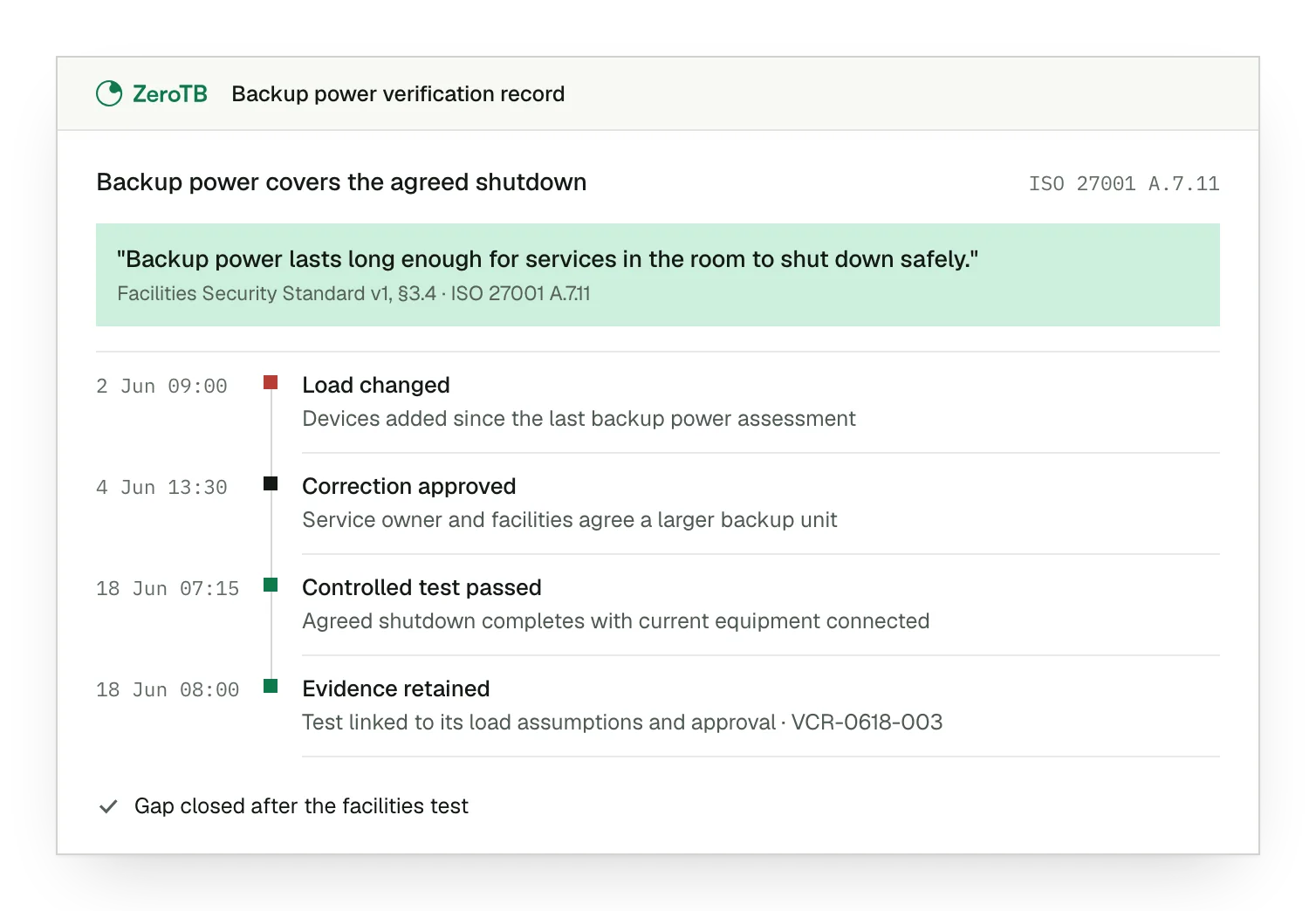
Changed load. The current equipment list includes devices added since the last assessment of backup power.
Approved correction. The service owner and facilities agree the change needed to support the connected equipment.
Completed verification. The shutdown completes during the controlled test, with the equipment now in use connected.
Retained evidence. The reviewer can trace the test result to its load assumptions and approved repair.
Utility review checklist
Connect each affected service to its utilities, operating responsibilities and agreed response to an interruption.
Compare connected equipment and current load with the conditions covered by the most recent assessment.
Have facilities or the provider assess the correction, with the service owner approving its operational effect.
Verify the repaired arrangement against the agreed response and record any conditions that remain untested.
Keep the approval, equipment scope and dated result together, with responsibility assigned for reviewing later changes.
Sources
- ISO/IEC, ISO/IEC 27002:2022 standard overview, 2022.
- NIST, SP 800-53 Rev. 5, PE-11 and PE-14, 2020, practical references for emergency power and environmental controls.
- HHS, Summary of the HIPAA Security Rule, accessed November 2026.
- ZeroTB, How it works, 2026.
Related pages
Physical controls
Continue through the Annex A guides for facilities, equipment and the physical protections around them.
ISO 27001
Read about the wider ISO 27001 program and the role of controls within that program.
Compliance frameworks
Find the SOC 2, ISO 27001 and HIPAA libraries, with guidance for their individual requirements.
Start with the Pilot
Talk with our team about the gaps that recur between audits. In the eight-week Pilot, we map up to 25 commitments and take two real control gaps through approved correction and verified restoration. You receive evidence of the completed work.