What does ISO 27001 A.7.9 require for assets taken off site?
ISO 27001 A.7.9 covers the protection of assets taken off site, including their travel, storage and use away from the office. Know who has the equipment or media and which safeguards apply. When a gap appears, establish what changed and check that the approved correction restores the required custody and protection.
A name in the asset register is a starting point for a custody check. The person may have returned the laptop or passed the drive to a colleague. The review needs to follow what happened next and establish who now has the item.
Off-site asset scope
An off-site asset record should let someone locate the item and contact the person responsible for it. Equipment used at home belongs in that record, as does media sent to another office. Use an identifier that remains with the item when its assignment changes.
An asset can stay at the same address for months and still need review. Its user may change, or it may begin to hold different information. Decide which changes affect the approved arrangement and who can authorize continued use under the new conditions.
Permission to take assets away
Permission needs to cover the way an asset will be used away from the office. Routine home working may fall under a standing agreement. Sending the same equipment to another location may need a separate approval, depending on the conditions already agreed.
Those conditions give the owner a basis for deciding whether a later move is acceptable. They should cover the person taking the asset, its destination and the protection required there. If the proposed use falls outside them, the owner decides whether to approve it or request return.
Protection during travel and use
An asset needs suitable protection at each place where it travels, waits or is used. A device carried by an employee and equipment sent through a courier follow different routes. Choose safeguards for the route, destination and information involved, including periods when nobody is using the equipment.
The off-site rules should explain where assets can be left, how they should be stored and how staff report loss or damage. Staff need to be able to follow those rules during the trip. A person who discovers a missing item needs a reporting route they can reach immediately.
Custody between people
The sender can establish that an asset left, but the receiving person must confirm that it arrived. Match those accounts using the asset identifier. This gives the reviewer both sides of a transfer and a date for the change in responsibility.
NIST's media transport guidance supports tracking movements and limiting transport to authorized handlers. Keep receipt and dispatch details together. When an assignment needs correction, retain the earlier entries; replacing them would remove information that could explain a gap in custody.
Encryption and physical protection
Encryption protects information on a device, while custody records establish who is responsible for the device itself. An encrypted laptop can still be lost, damaged or unavailable when work depends on it. Its encryption status answers only part of the off-site protection question.
Assess the information and service affected by the loss as well as the device's technical safeguards. The owner needs to know what was stored there and which protections applied. That context helps the incident team decide what to investigate and which actions require approval.
Fresh evidence from devices
The date of a device check matters when equipment spends a long time away. A report may show encryption enabled at its last observation, with no later reading available. That tells the reviewer what was checked then; the present state still needs evidence.
Records from device management can establish endpoint protection, and confirmation from a recipient can establish custody. Use each for the question it can answer. When a required device observation is missing, assign someone to obtain it and leave that protection check unresolved.
Missing assets and incident response
An unexplained custody gap needs investigation while the asset's status remains open. Establish the last confirmed holder, location and movement, then ask the expected recipient to check receipt. If the asset is lost, follow the incident process and preserve the information collected during the search.
Finding the item resolves its location, but the incident team may still need to assess possible exposure or damage. Keep those questions attached to the same asset. A return receipt establishes possession at that time; it does not explain everything that happened while custody was unclear.
Approval of corrective work
The responsible owner decides how to correct the gap without losing the information needed to understand it. An undocumented transfer may need confirmation and a corrected assignment. A lost device may require protective action under the incident process, with decisions based on the information at risk.
Describe the proposed action and its expected result before seeking approval. The owner can then assess its effect on the asset, information and ongoing work. Preserve the approval with the action taken, including any work left open for the incident team or device administrator.
Verification before closure
Check the result against the original off-site protection rule before closing a gap. A transfer needs confirmation that the intended recipient has the right asset at the approved destination. If the rule also requires device safeguards, their current state needs suitable evidence as well.
The reviewer should be able to follow the decision from the rule to the check result. ZeroTB's Verified Control Record retains the commitment, action, approval and resulting evidence. Record any incident work that continues after the custody correction, with its own status and responsibility.
Checks on return
Returning equipment completes a movement only when someone accepts the identified item and checks its condition. Confirm the relevant protections before it goes to another custodian. If it is returned to an office store, record who received it there and who now holds responsibility.
Preserve the history of its time away, including incident records and the checks made on return. An item awaiting repair or investigation should carry that status into the next assignment decision. The next custodian then has a reason for any delay or restriction on use.
Evidence for off-site assets
An asset identifier lets the reviewer connect the permission, movement history and check results for the same item.
| Requirement | What an auditor asks for | Where it comes from |
|---|---|---|
| Defined asset scope | A list of covered equipment and media, each identified and assigned to a responsible person | Asset inventory and the approved off-site policy |
| Permitted movement | Approval for off-site use, with the conditions the custodian must follow | Standing permissions, movement approvals and recorded exceptions |
| Traceable custody | Dispatch and receipt details showing when each person held responsibility for the item | Dispatch records, receipt confirmations and custody history |
| Effective protection | Dated checks of the safeguards that apply to the asset while it is away | Device observations and checks by the responsible custodian or administrator |
| Verified correction | A record of the gap, the approved correction and the check supporting closure | Change records, incident records and retained verification results |
Related framework requirements
| Framework | Control | What it covers |
|---|---|---|
| ISO 27001 | A.7.9 | Protection of equipment and other assets during their time away from the organization's premises |
| SOC 2 | CC6.7 | Protection when information is transmitted, moved or removed, within the scope of the control |
| HIPAA | 45 CFR 164.310(d)(1) | Receipt, removal and movement of hardware and electronic media containing electronic protected health information |
Example of restoring a drive's custody
In this example, drive D-104 is with a colleague who received it after a trip. The register still assigns it to the sender. To resolve the discrepancy, the owner approves the assignment, the recipient confirms the drive and an administrator checks its required encryption.
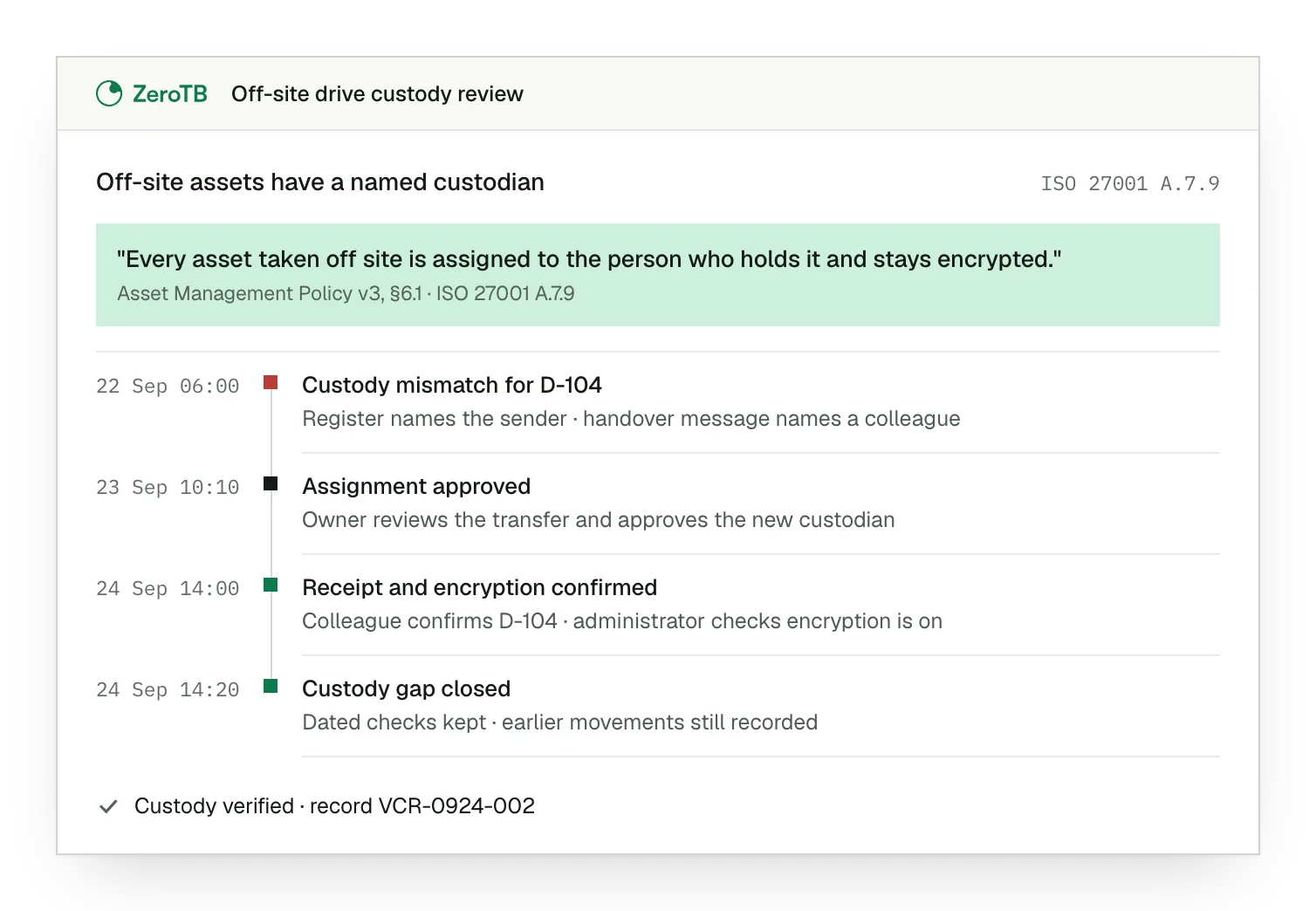
Custody mismatch. The sender remains responsible in the register, although the handover message names another recipient.
Approved assignment. The owner approves updating the assignment after reviewing the transfer to the receiving colleague.
Confirmed protection. The colleague confirms receipt of D-104, and an administrator checks that its required encryption is enabled.
Verified custody. The dated checks support closure of the custody gap, with the earlier movements still recorded.
Off-site asset review checklist
Select the off-site protection rule and identify the assets, locations and movements that fall within its scope.
Match the registered custodian to the most recent handover and receipt, using the asset's identifier.
Establish which required safeguards have current evidence and route missing assets through the incident process.
Give the responsible owner the proposed correction, expected result and any effect on information or ongoing work.
Confirm custody and relevant protections after the action, then retain the approval and dated results with unresolved work visible.
Sources
- ISO/IEC, ISO/IEC 27002:2022 overview, 2022.
- NIST, SP 800-53 Rev. 5, Media transport, MP-5, 2020.
- HHS, HIPAA audit protocol, device and media controls, 2018 update.
- ZeroTB, Continuous control monitoring, 2026.
Related pages
Physical controls
Review the other ISO 27001 controls covering equipment, premises and physical protection.
ISO 27001
See how individual controls contribute to the wider information security management system.
Compliance frameworks
Explore the framework guides and related controls that apply to the same systems.
Start with the Pilot
The eight-week Pilot maps up to 25 commitments and takes two real control gaps through approved correction and verified restoration. Talk with our team about the gaps you need to resolve and the evidence you need to retain.