How does ISO 27001 A.7.8 guide placing and protecting equipment?
ISO 27001 A.7.8 covers equipment placement and the protection a location provides. Damage, interference, unauthorized physical access and visible information all matter when assessing a position. Check the equipment in its current surroundings, and inspect any corrective move before deciding that the exposure has been resolved.
The computer has not moved, but the room has changed around it. Visitors now wait opposite a screen that used to face an empty wall. An accurate equipment inventory will not reveal that exposure. Someone needs to look at the room in use.
Equipment and location
A placement decision starts with what the equipment does and the information it handles. The approved commitment defines the scope of the review. For each device in that scope, the location and owner help establish where to inspect and who can approve a change.
A public information display and a workstation handling confidential records can share a room but need different protection. Their positions must suit those uses. Describing the work at each position gives the reviewer a reason to accept the arrangement or identify a specific exposure.
Physical hazards
Equipment needs a location that protects it from the hazards identified for that space. Consider nearby sources of heat or water, interference and accidental damage. A convenient position beside a service area may leave equipment exposed during cleaning, maintenance or normal movement through the room.
NIST's guidance on equipment location connects placement with physical hazards and opportunities for unauthorized access. Apply that reasoning to the actual space. The assessment should explain which conditions matter there and why the proposed protection addresses them.
Visibility and reach
A controlled office can still expose equipment or displayed information to people without permission. A visitor may stay within an approved waiting area and still read a nearby screen. Inspect the view from places where visitors stand, sit or pass during normal use.
Viewing and physical access need separate attention. Turning a display may protect its contents while leaving the keyboard within reach. A barrier may restrict access while leaving the display visible. The review should identify which exposure remains so the chosen correction addresses the whole problem.
Changes to the room
A room can change the risk around equipment even when the equipment stays in place. Moving a waiting area, removing a partition or changing a visitor route can alter who comes near a device. Those changes can invalidate the reason its location was accepted.
A location record alone will miss this kind of drift. Compare the current arrangement with the conditions recorded at the last review. A useful inspection includes the surroundings and how people use them, so an unchanged asset entry does not conceal a new exposure.
Responsibility for the correction
Facilities, IT and the service owner need to agree on a correction that they can carry out. Facilities knows the space available, IT knows the device, and the service owner understands the work. Their decisions meet at the proposed equipment position.
Assign one owner to coordinate the correction and retain the approvals. The proposal needs enough detail for each team to assess the exposure and the intended result. If a building operator or another team must act first, record the work that is waiting and who will arrange it.
Choice of protection
The best correction removes the identified exposure while keeping the equipment usable. Depending on the hazard, the proposal may move the device, change its orientation or add suitable protection. Evaluate the proposed arrangement against the same risk that prompted the review.
A move can also introduce another problem. Equipment placed inside an enclosure still needs suitable ventilation; a relocated workstation still needs safe power and connections. Facilities and IT should assess these conditions before approving a position that appears secure but interferes with normal operation.
Temporary arrangements
A temporary position needs a protection decision for the time it remains in use. An office refurbishment may leave equipment in an interim location for longer than expected. The responsible owner should decide what protection makes that arrangement acceptable and when to review it again.
Record the temporary safeguards and the condition that ends the arrangement, such as completing the permanent move. If those safeguards leave an exposure unresolved, keep it visible in the control record. Until the permanent move, the owner needs to know whether those safeguards provide adequate protection.
Inspection after the change
The reviewer needs to see the changed arrangement in use before closing the gap. For a screen exposed to visitors, this means checking the relevant views with representative content displayed. Test content allows the check without exposing confidential information to the people taking part.
The operator must also be able to continue working at the new position. The inspection covers that use, together with power, connections and ventilation. Record the results against the conditions agreed for closure. A failed check or missing observation leaves the gap open for further work.
Records of the result
A useful record explains which exposure the correction removed and how the reviewer checked it. Identify the equipment and location, retain the approval, and describe the condition before and after the change. A dated inspection links the completed work to the result accepted for closure.
Photographs or a room plan can help explain the position when they capture the relevant view. Pair them with the inspection result and protect any sensitive information they contain. A receipt for moving equipment shows that work occurred; the inspection explains whether it achieved the intended protection.
Continued protection
The next layout change should prompt a review of the protection that the current position provides. Assign responsibility for recognizing those changes and arranging the next inspection. This keeps the placement decision connected to the room's use as people, equipment and activities change.
The same inspection can support related framework reviews when its scope fits. Physical access evidence may support SOC 2 CC6.4; workstation safeguards may support HIPAA where electronic protected health information is involved. Assess each requirement separately before using one record to support several conclusions.
Evidence for equipment protection
The evidence should connect the placement decision to the condition observed after the correction.
| Requirement | What an auditor asks for | Where it comes from |
|---|---|---|
| Equipment in scope | The devices, locations and activities covered by the placement commitment | The approved commitment and equipment inventory |
| Assessed exposure | The physical hazards, viewing positions and access risks considered for the equipment | The site assessment, room plan and relevant inspection observations |
| Approved correction | The chosen protection, responsible owner and decision to proceed | The change proposal and approval from the relevant owners |
| Verified protection | The observed result, inspection date and confirmation that necessary operation remains possible | The on-site check and supporting evidence linked to the completed change |
| Continuing responsibility | The owner and conditions that trigger another review of the placement | The control record and arrangements for reviewing room or equipment changes |
Related framework requirements
| Framework | Control | What it covers |
|---|---|---|
| ISO 27001 | A.7.8 | Where equipment is placed and how it is protected from the physical risks in scope |
| SOC 2 | CC6.4 | Who can physically access the facilities and information assets covered by the control |
| HIPAA | 45 CFR 164.310(c) | Physical protection of workstations accessing electronic protected health information, with access limited to authorized users |
Example of protecting a reception workstation
A screen move is complete when the new position protects the display during normal use. In this example, a changed waiting area exposes a workstation screen. The record follows the approved repositioning through an on-site check of visibility and continued operation.
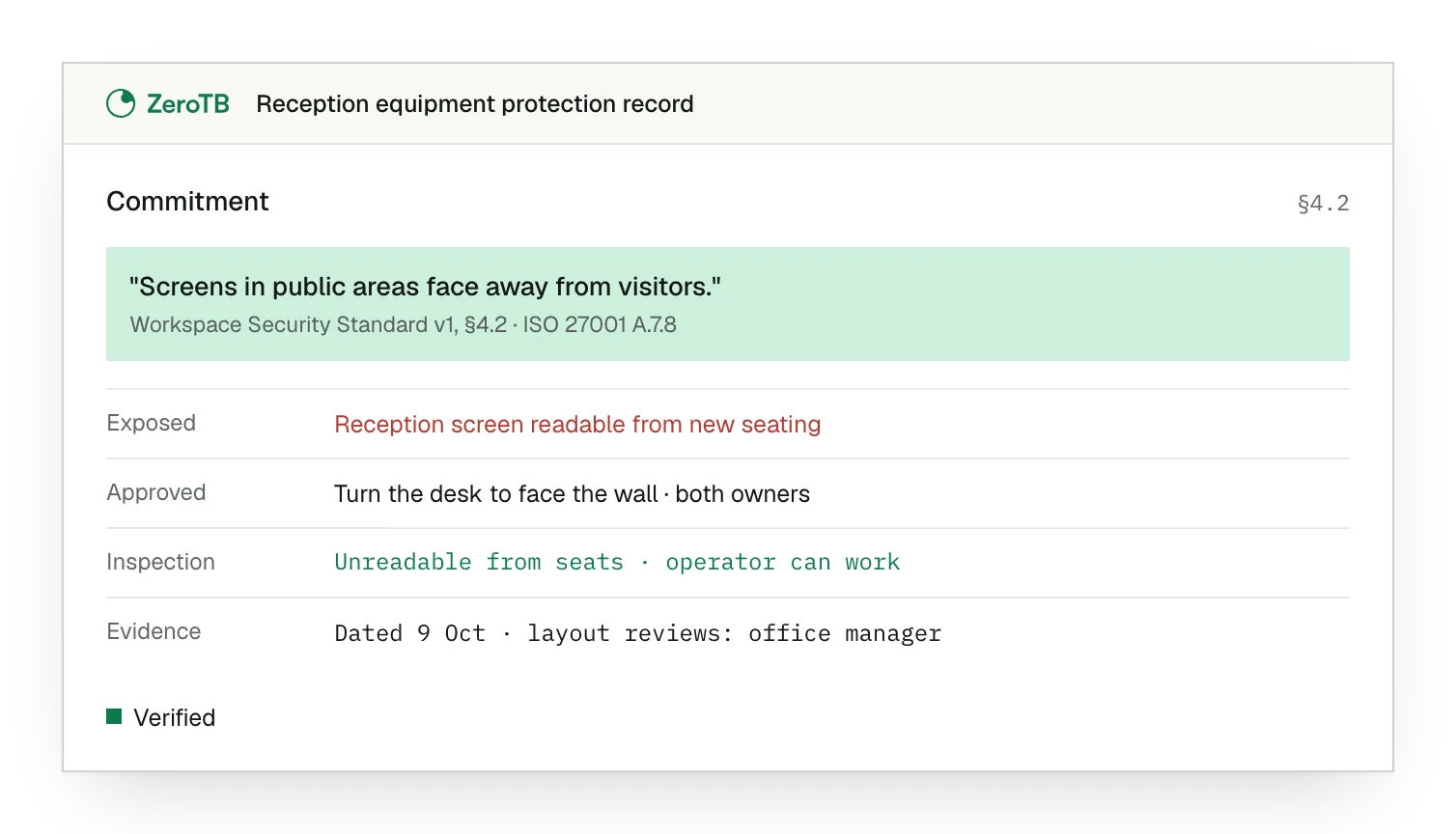
Exposed display. The changed waiting area lets seated visitors read information on the workstation screen.
Approved repositioning. The equipment and facilities owners approve a position that faces away from the waiting area.
Inspection result. An on-site check confirms visitors cannot read the display and the operator can still work.
Retained evidence. The dated result links to the approval, with an owner responsible for later layout reviews.
Equipment placement checklist
Identify the device covered by the commitment, its location and the work or information that needs protection.
Check the places where people can see or reach the device, alongside the hazards in its immediate surroundings.
Obtain the relevant owners' decision on the proposed protection and the conditions needed for the device to remain usable.
Inspect the equipment in its changed position, checking both the identified exposure and the work the operator must perform.
Save the dated result with the approval and assign responsibility for reviewing the position when the room changes.
Sources
- ISO/IEC, ISO/IEC 27002:2022 overview, 2022.
- NIST, SP 800-53 Rev. 5, PE-18 and PE-5, 2020, updated December 2020.
- HHS, HIPAA audit protocol, workstation security, 2018 update.
- ZeroTB, Continuous control monitoring, 2026.
Related pages
ISO 27001
See how equipment protection fits into the wider set of information security controls.
Compliance frameworks
Explore the requirements that connect equipment, access and evidence across different compliance programs.
How it works
Follow the process that connects a control commitment to an approved correction and verified result.
Start with the Pilot
Our team uses the eight-week Pilot to map up to 25 commitments and take two real control gaps through verified restoration. We can discuss where controls need attention and how records of the approved corrections would support ongoing reviews.