What does ISO 27001 A.7.6 require for working in secure areas?
ISO 27001 A.7.6 addresses working in secure areas, where the organization sets rules for the activities allowed inside. Those rules cover such matters as supervision, equipment use and recording. Check the arrangements for each visit against the area's rules, and use an on-site inspection to verify the conditions after a correction.
A contractor can arrive with permission to enter a room while the person assigned to supervise the repair is unavailable. The booking still exists, but a condition of the work is missing. This guide covers that gap between entry and activity within physical security.
Work inside the boundary
Permission to enter a secure area does not settle what someone may do inside it. A worker may have permission to repair one item while other equipment or information remains restricted. The working rules need to make those limits clear before the activity begins.
An entry log can establish who arrived and when. It may say little about the task, its supervision or the equipment used. Review those conditions together when assessing a visit. This makes it possible to distinguish an authorized arrival from work that followed the approved arrangements.
Area-specific rules
Working rules need to describe the activities and information protected in each secure area. Consider what a worker could see, handle or record while completing the task. That gives the owner a practical basis for choosing restrictions suited to the room and its contents.
Building-wide instructions may already cover part of the visit. Add the conditions specific to the area, such as the permitted equipment or the person who can approve recording. Someone organizing the work should be able to use these instructions without guessing which restrictions apply.
Responsibility for each visit
An area owner needs authority to approve the work and resolve changes to its conditions. The person booking a contractor, the receptionist admitting them and the person supervising the task may have different responsibilities. Each person needs the approved task and restrictions when they take responsibility for the visit.
The work authorization should identify the location, permitted task and relevant restrictions. Where supervision is required, identify who will provide it and who can arrange cover. This gives the people involved a clear route for resolving a missing supervisor or a task that exceeds the approved scope.
Supervision during work
Required supervision must cover the period when the activity takes place. Meeting a visitor at reception does not establish that someone supervised the work inside the secure area. The arrangements need to explain when supervision starts, how it continues and when it can end.
For a longer visit, a change of supervisor should include a handover of the task and its restrictions. If cover becomes unavailable, refer the affected work to the area owner. The owner can decide how to proceed safely under the area's rules and the task's safety requirements.
Equipment and recording
Equipment permissions should explain what workers may bring into the area and how they may use it. A device needed for diagnostics may also record images or sound. Approval to use that device should address the functions relevant to the work and the information nearby.
Where recording is restricted, agree any necessary exception before recording begins. For example, a repair may need a photograph of a component. The owner can define the permitted subject and handling of that image, so the repair record does not unnecessarily expose other equipment or sensitive information.
Changes to planned work
A change in the task can make the original working arrangements inadequate. A repair may take longer, need another worker or extend to equipment outside the approved area. These changes can affect who must supervise the work and which activities remain within the original permission.
The person responsible for the visit should refer the changed conditions to the area owner before the additional activity proceeds. The owner can approve revised arrangements or defer that part of the task. Record the decision with the visit so later reviewers can understand why its scope changed.
Gaps between visits
Comparing recent visits with the approved rules can reveal where the control has drifted. Look for differences between planned and actual supervision, equipment use or task scope. Repeated exceptions can show that the normal arrangements no longer fit the work being carried out in the area.
Missing evidence leaves a question to resolve. An entry record without a supervision record does not establish whether the worker was alone. Ask the responsible owner what can still be verified, record the result and address any remaining gap. Avoid treating an unanswered question as a successful check.
Approved corrections
A correction needs to restore the working condition that failed. If a visit lacks required supervision, the area owner needs to arrange appropriate cover or decide when the affected activity can proceed. Updating the work order alone leaves the original operational problem unresolved.
Before approving the correction, agree what observation will establish success and who can make it. That might mean confirming supervision for the remaining work and inspecting the area afterward. The reviewer then knows what to check when the responsible person reports completion.
Inspection before closure
Someone at the location must verify the physical conditions that a completion record cannot show. After work finishes, the responsible facilities, IT or service owner should inspect the affected area. The check should address the conditions relevant to the task, including temporary equipment and remaining access needs.
Record what the person inspected, when they inspected it and what remains unresolved. A completed repair and a restored security condition are separate findings. Keep the control gap open when the required inspection is missing or identifies a remaining problem, even if the maintenance task itself is complete.
Evidence over time
A useful control record connects each decision to the visit and condition it covered. A reviewer should be able to follow the task from approval to the observed result. Keep sensitive room or equipment details accessible only to people who need them for that review.
Look across visits as well as at individual repairs. If replacement contractors repeatedly arrive without supervision, the booking arrangements may need to change. The control operating process assigns that follow-up work to an owner and tracks whether the revised arrangement holds on later visits.
Evidence for secure-area work
For a particular visit, the records below explain the work allowed, the conditions applied and the result of the final check.
| Requirement | What an auditor asks for | Where it comes from |
|---|---|---|
| Defined working conditions | The rules that applied to the activity under review | Area instructions and the policy they implement |
| Authorized work | The task and location approved for the visit, with any exceptions | The approved work order and later changes to its scope |
| Required supervision | The period covered by each supervisor assigned to the work | Visit records and observations from the people supervising |
| Controlled equipment use | Permission to use particular tools or make a recording | The equipment list and the owner's decision on any recording |
| Verified correction | The observed result after the working conditions were corrected | The gap record, approved action and dated completion inspection |
Related framework requirements
| Framework | Control | What it covers |
|---|---|---|
| ISO 27001 | A.7.6 | Activities inside secure areas and the rules under which people carry them out |
| SOC 2 | CC6.4 | Restrictions on physical access to facilities and protected assets; the access portion of a visit record can support this review |
| HIPAA | 45 CFR 164.310(a)(1) | Protection of facilities where electronic protected health information is in scope, including provision for authorized physical access |
Example of restoring supervised maintenance
A maintenance visit can resume once the area owner restores the required supervision. This example follows a repair that was held until another supervisor became available. The record separates the permission to restart from the observations made during work and at the final inspection.
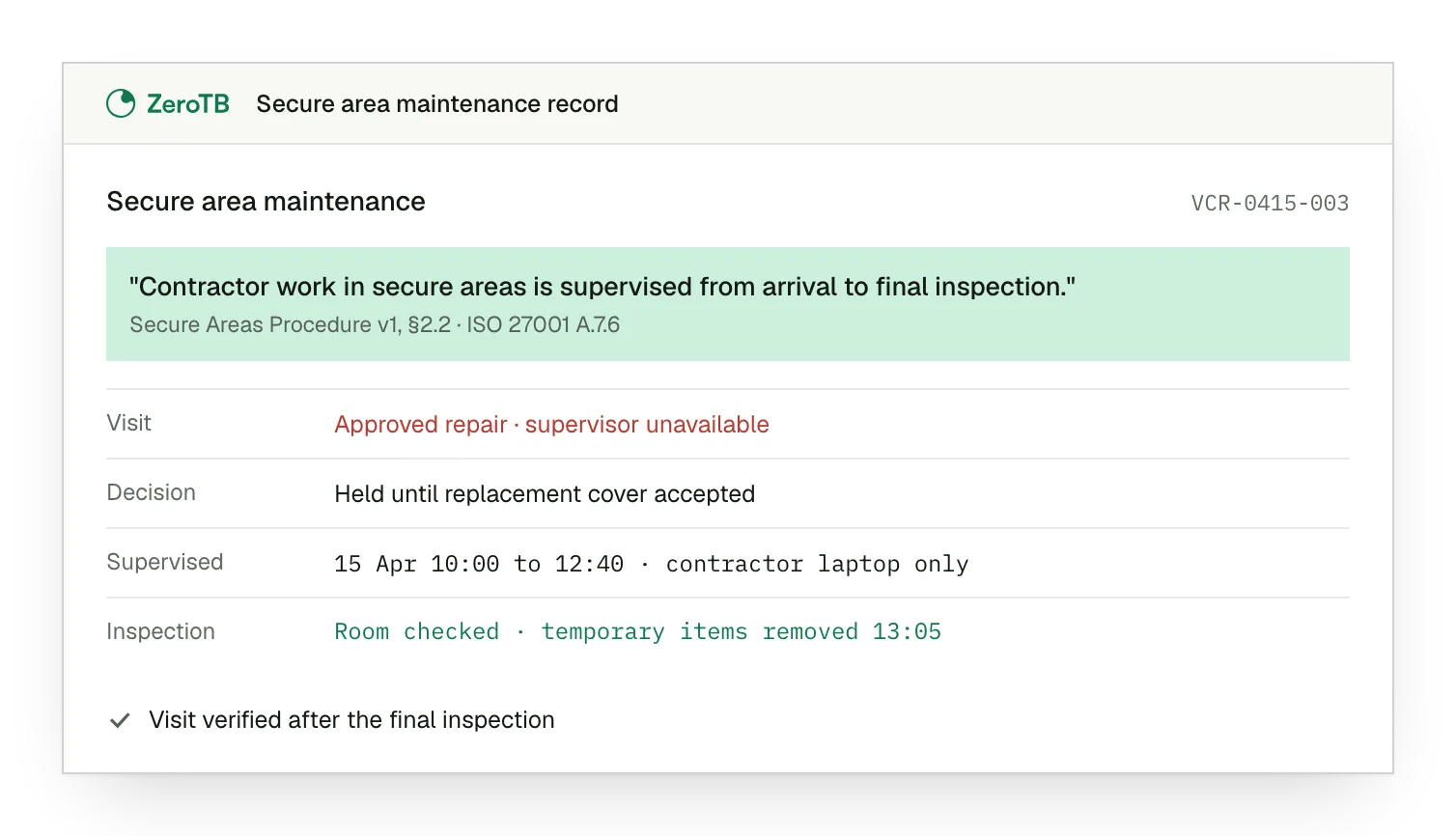
Missing supervision. The contractor has arrived for the approved repair, and the assigned supervisor is unavailable.
Owner's decision. The owner holds the repair until a replacement accepts responsibility for supervision under the existing restrictions.
Supervised work. The supervisor records the period covered and confirms which equipment the contractor used during the repair.
Final inspection. The facilities owner inspects the room, accounts for temporary equipment and dates the completed check.
Secure-area review checklist
Compare the area's instructions with the work actually performed there, including supervision, equipment use and recording permissions.
Trace a recent visit from its authorization to the person responsible for supervising the approved activity.
Inspect how the owner handled a change in the task, workers or visit duration, including any revised restrictions.
Check that the completion inspection identifies what was observed, when it was checked and any unresolved condition.
Decide whether repeated supervision or permission gaps require changes to the standing arrangements and who will verify those changes.
Sources
- ISO/IEC, ISO/IEC 27002:2022, information security controls, 2022. Implementation guidance for information security controls.
- NIST, SP 800-53 Rev. 5, physical access control and visitor access records, 2020, PE-3 and PE-8. See PE-3 for visitor supervision and PE-8 for visit records.
- HHS, Summary of the HIPAA Security Rule, accessed November 4, 2026. See the section on physical safeguards.
- ZeroTB, Continuous control monitoring guide, 2026. An explanation of control checks, assigned work and verification.
Related pages
Physical controls
Explore the other ISO 27001 controls that protect premises, equipment and work within secure areas.
ISO 27001
Read how physical controls fit within the wider information security management system and its requirements.
Compliance frameworks
Explore guidance for the related requirements across SOC 2, ISO 27001 and HIPAA.
Start with the Pilot
Talk with our team about the controls that need attention between audits. The eight-week Pilot maps up to 25 commitments and takes two real control gaps through approved correction and verified restoration, with records showing what changed and how it was checked.