What does ISO 27001 A.7.4 require for physical security monitoring?
ISO 27001 A.7.4 addresses physical security monitoring of premises for unauthorized access. The monitoring needs to help a responsible person detect an event, assess it and respond. Start with the locations and protection in the approved control, then test whether events reach the people expected to handle them.
A working door sensor can send alerts to a mailbox nobody reads. The device passes its checks, but the team responsible for the premises hears nothing. An A.7.4 review needs to establish whether the whole arrangement still provides the protection promised in the control.
That review often crosses several teams. Facilities may maintain the sensor, IT may manage the mailbox, and a security provider may handle the response. Following an event across those handoffs reveals where responsibility ends without someone else taking it on.
Monitoring scope
Physical security monitoring needs a defined area to protect. Use the approved commitment to identify the premises where unexpected entry could expose information or interrupt its use. An office entrance, restricted room and provider-operated facility may each need different coverage and evidence.
Consider the hours when each area is occupied as well as its location. Staff at an entrance may handle an event that needs a different response after they leave. The reviewer needs to understand those arrangements before judging whether the devices and records provide enough coverage.
Detection and response
A monitoring arrangement must give the responsible team enough information to assess unexpected entry and respond. Alarms, access records and cameras can contribute different information. Select their use around the event the team needs to detect and what it must do when that event occurs.
Recorded activity can help an investigation, while an alert can support a response as the event happens. The team needs to decide which events require a response as they happen. A recipient should be able to identify the affected location and understand what requires attention without searching through unrelated activity.
Shared premises
Equipment operated by a landlord or security provider still needs to serve the protection your company has committed to. The arrangement should identify the monitored areas, the alert recipients and the response to an event in the space your company uses.
The provider may also hold the event records or control when a physical test can take place. Establish how the reviewer can obtain those results. The agreement identifies who is responsible; dated observations show whether the monitoring and response worked at the premises.
Monitoring drift
Monitoring changes when a sensor fails, an entrance moves or the person receiving alerts leaves. The effect depends on where the change occurs. A sensor failure can remove the event itself; an obsolete recipient can leave an event recorded but unanswered.
That distinction matters when checking the result. A healthy sensor does not tell the reviewer whether someone received the alert. Follow the part affected by the change through to its expected outcome, and retain the new observation with the earlier record of how monitoring worked.
Alert ownership
The response needs an owner who knows what to do with the alert. A mailbox address tells the reviewer where a message goes, but leaves out who reads it. Cover the relevant hours, absence arrangements and the next recipient when an alert goes unanswered.
Access-record reviews need the same connection to action. NIST PE-6 describes physical monitoring, review of access logs and coordination with incident response. Use it as supporting guidance when deciding when records need review and where a finding should go for investigation.
Safe event tests
A planned event test can reveal failures that a configuration review misses. Before the exercise, the facilities or service owner should agree the event, affected location and expected handling. The people managing the alarm must know how the test will be distinguished from a real incident.
Follow the event through detection, notification and acknowledgement, then confirm the agreed response. Capture the relevant observations as the exercise proceeds. This keeps the result tied to the same event and makes it easier to locate the failure if one part of the route breaks.
Approved corrections
A correction needs an owner's approval based on the protection it will restore. Describe the failed part and the expected result before choosing the action. Replacing a recipient in a notification rule is different work from repairing the sensor that should produce the event.
The decision also needs to cover any interruption during the repair. Facilities or the service owner can arrange temporary protection and preserve other working alerts. With those decisions recorded, the person checking the completed work has a clear result to test against.
Verification and closure
Closure depends on a repeat test of the signal and response that failed. Have the responsible facilities, IT or service owner check the result at the affected location. The record needs to identify the event, its recipient and what that person did in response.
A completed repair task can still leave the notification broken. Keep the gap open if the test fails or no result is available. Retain the period without effective coverage alongside the retest result, so the record explains both the interruption and the later restoration.
Monitoring records
The evidence should explain what failed, what changed and how the team established that monitoring worked afterward. Keep the location, test time, approved action and observed result together. A reviewer can then follow the correction without reconstructing it from separate facilities and IT conversations.
Footage and access records can contain sensitive information. Restrict access and retain only the material the review needs, according to the organization's retention decisions. ZeroTB's Verified Control Record brings the commitment, action, approval and verification together; a physical test still needs evidence from the responsible person at the premises.
Continuing coverage
A change to the premises can invalidate the coverage established by an earlier test. A moved entrance may fall outside the monitored area. A changed contact list may send the event elsewhere. Someone needs to recognize these changes and arrange the relevant checks within the monitoring schedule.
Keep the scope clear when using that evidence elsewhere. The test may help a SOC 2 or HIPAA review if it concerns the facilities and protection that review covers. The related controls below address different requirements, so the reviewer must decide what the observation establishes for each.
Audit evidence
An auditor should be able to trace the monitoring commitment to the current coverage, response arrangements and tested correction.
| Requirement | What an auditor asks for | Where it comes from |
|---|---|---|
| Defined coverage | Locations, coverage periods and the events the monitoring is intended to detect | Approved physical security arrangements and the relevant premises inventory |
| Working monitoring | Evidence that the selected devices or monitoring arrangements operate at the affected location | Equipment checks, event records and observations from facilities or the service provider |
| Assigned response | Alert recipients, escalation arrangements and evidence that relevant events receive attention | Contact assignments, notification records and incident or exercise records |
| Verified correction | The failed route, approved change and repeat test demonstrating the expected response | Repair or change records linked to dated detection, receipt and response observations |
| Protected records | Access and retention decisions for the monitoring evidence used in the review | Monitoring procedures, record permissions and the relevant retention settings or records |
Related framework controls
| Framework | Control | What it covers |
|---|---|---|
| ISO 27001 | A.7.4 | Physical monitoring of the premises covered by the organization's control |
| SOC 2 | CC6.4 | Protection of facilities and information assets through restrictions on physical access |
| HIPAA | 164.310(a)(1) | Safeguards that limit physical access to electronic information systems while allowing authorized access |
Example of restoring an alarm route
This example follows a door alert that the duty team never receives. The sensor records the event, but the notification reaches an unattended mailbox. After the facilities owner approves a recipient change, another test establishes that the team receives and handles the alert.
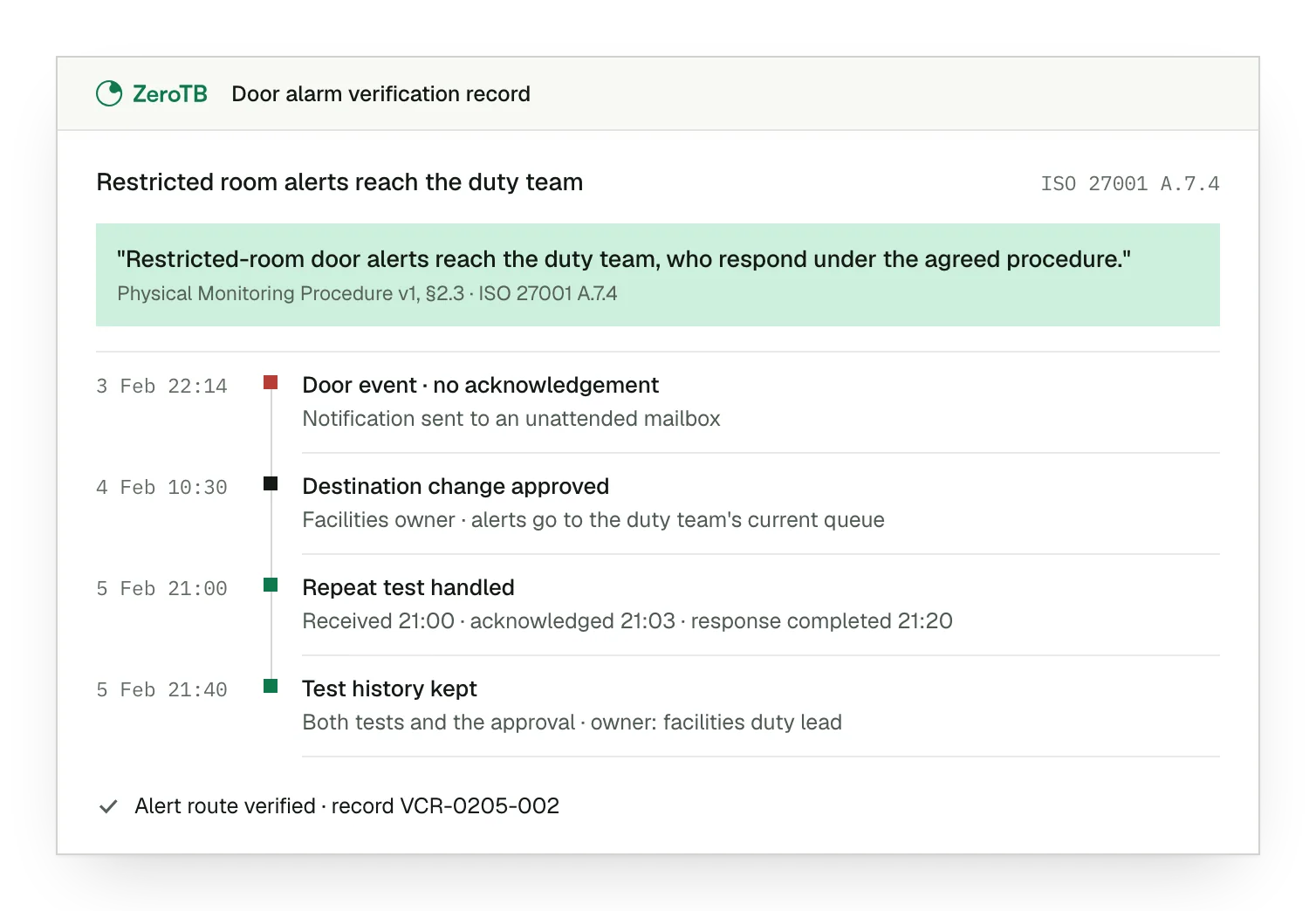
Missing alert. The sensor records an event at the restricted room while the duty team receives nothing.
Recipient change. The facilities owner approves sending the notification to the team's current alert destination.
Observed response. A second test produces an alert that the team acknowledges and handles through the agreed procedure.
Test history. The record keeps both tests and the approval beside the owner assigned to future checks.
Physical monitoring checklist
Identify the premises, events and coverage periods in the approved commitment, including any responsibilities assigned to a building provider.
Have the responsible team coordinate a planned event test covering detection, notification, acknowledgement and response.
Identify the failed part and obtain the owner's decision on the change and protection needed while it proceeds.
Repeat the test after the change. Keep the gap open until the expected signal and response are observed.
Keep dated results with the action and approval, and identify who arranges further checks when coverage changes.
Sources
- ISO/IEC, ISO/IEC 27002:2022 overview, 2022. Control framework and implementation guidance.
- NIST, SP 800-53 Rev. 5, PE-6, 2020, with 2025 release updates. Supporting guidance on physical monitoring and incident response.
- HHS, HIPAA audit protocol, updated 2018. Facility access controls and audit evidence.
- ZeroTB, Continuous control monitoring, 2026. Control ownership, correction and verification.
Related pages
Physical controls
Read the companion guides on protecting premises, equipment and the information held within them.
ISO 27001
See where physical monitoring belongs in the wider ISO 27001 information security program.
Compliance frameworks
Browse control guidance for the frameworks that apply to the systems your company operates.
How it works
See how ZeroTB handles an approved commitment and records the work needed to restore it.
Start with the Pilot
The eight-week Pilot covers up to 25 commitments and takes two real control gaps through approved correction and verified restoration. Talk with our team about where controls need attention and how the Pilot would fit your program.