What does ISO 27001 A.7.12 require for protecting cables?
ISO 27001 A.7.12 covers the protection of power and information cables from damage, interference and unauthorized access. Start with the routes serving the systems in scope, including their connection points. After building or maintenance work, check that the physical protection is intact and the affected connections still work.
A network can keep running after someone removes a protective panel. That leaves two questions for the review: does the service work, and is the connection protected? Both matter when checking the physical controls that support an ISO 27001 program.
Protected routes
Define the route before deciding whether its cables are protected. The review needs to connect the equipment at each end with the spaces and connection points between them. A route reference gives facilities and IT a common place to start the inspection.
For example, "office network" says little about which cabinet someone checked. A location and route reference makes the observation usable by the next reviewer. Keep that reference with the result and revise the diagram if later work moves the cable.
Physical hazards
Choose protection according to what could damage or disturb the cable at its location. Consider maintenance and refurbishment as well as ordinary use of the space. A route that was protected before work began may be exposed once a panel or enclosure is removed.
Power cables and data connections need measures suited to their risks. NIST discusses barriers around transmission lines in PE-4 and protection of power cabling in PE-9. Its guidance gives a practical reference for choosing safeguards once the site assessment has identified the exposure.
Access to connections
An open cabinet changes who can reach the cables inside it. Look for that change when inspecting a route after maintenance, even if no cable appears damaged. The condition of the enclosure matters because it controls access to the connections.
Check the cabinet against the protection agreed for that location. If protection depends on restricted entry to the room, include that access restriction in the review. Network settings address logical access; inspecting the room and enclosure establishes whether the physical safeguard still works.
Shared responsibilities
A repair can stall when facilities controls the space and IT controls the connected equipment. Identify who can authorize access and who understands the service before arranging the work. Those people need a shared description of the route and proposed repair.
A building manager may hold responsibility for part of a route in shared premises. Agree who will ask for the inspection and receive its result. The internal owner can then follow the repair to completion without assuming another team has checked it.
Changes after the audit
Building work can remove cable protection without interrupting the service. The earlier audit evidence may describe an enclosure that no longer exists or a route that contractors have since moved. Inspect the changed area even if users report no problem.
Include protection of the affected route in the completion criteria for the work. The person accepting the work needs to know which safeguards must be restored. Otherwise, a finished refurbishment and an available network can obscure a cable route that remains exposed.
Inspection and monitoring
A physical inspection answers questions that a connection test leaves open. It can establish whether the protective panel is present, the enclosure is secure and the altered route has the intended protection. Record what was observed and where the inspection stopped.
Service monitoring adds a different observation: whether the connection supports its intended operation. Keep the two results identifiable so a reviewer can judge each one. If part of the route was inaccessible, record that limit and arrange the missing inspection before accepting that part as protected.
Repair decisions
A repair needs an agreed result before work starts. Describe the exposed route, the protection to restore and the service that could be affected. Facilities and IT can then agree who performs the work and who can approve the proposed change.
The plan should account for any interruption needed to reach or repair the cable. It should also identify the checks that will follow the work. This lets the owner judge the repair against its intended result, with the service impact considered before the work proceeds.
Verification before closure
Accept the repair after checking both the protection and the connection. At the repaired location, the inspection must establish that the agreed safeguard is in place. The service test then shows whether work on the route has left the connection usable.
Keep both results with the work order so the reviewer can assess them before closing the gap. If a panel remains missing, a connection fails or an inspection is outstanding, the record should retain that issue. Reporting the repair as finished does not resolve it.
Checks after later work
Later maintenance can undo a correctly completed repair. Tie further checks to work that affects the route, cabinet or enclosure, alongside the inspection schedule agreed for the site. These triggers help the owner arrange an inspection when the protection may have changed.
A repeat defect also calls for a review of how work is accepted. If protective panels repeatedly remain off after maintenance, include their replacement in the handover check. That change addresses the recurring cause and gives the person accepting the work a specific condition to inspect.
Evidence for the next review
Keep enough detail for someone who missed the repair to review its result. They need to locate the route, understand the original defect and see what the owner approved. Dated inspection and test results explain why the completed work was accepted.
Route diagrams and photographs may reveal sensitive connections, so restrict their access while keeping them available to the relevant reviewers. The Verified Control Record connects the requirement and approved action with the observed result. For a physical repair, that result depends on the inspection evidence.
Evidence of cable protection
Use these records to trace a repair from the affected route to the checks that accepted it.
| Requirement | What an auditor asks for | Where it comes from |
|---|---|---|
| Defined route scope | Which route was checked, including its connections and the systems it serves | Current route diagrams and equipment references linked to the approved control scope |
| Suitable protection | What protection the route needs and which conditions informed that decision | The site assessment, protection specification and dated observations from the affected location |
| Assigned responsibility | Who has access to inspect the route and authority to approve the repair | Facilities and IT responsibilities, including arrangements for areas managed by another party |
| Approved repair | What was wrong, what repair was proposed and who approved that work | The inspection finding and work order with the responsible owner's recorded approval |
| Verified result | How the owner established that protection was restored and the connection still worked | The dated inspection and connection test linked to the completed repair record |
Related controls
| Framework | Control | What it covers |
|---|---|---|
| ISO 27001 | A.7.12 | Cables supplying power or carrying information, and the safeguards protecting them along their routes |
| SOC 2 | CC6.4 | Physical entry to facilities and access to hardware within the scope of the system |
| HIPAA | 164.310(a)(1) | Facility access that protects systems handling electronic protected health information and permits authorized use |
Example of restoring a protected route
In this example, the network works after refurbishment, but an inspection finds a missing panel over a connection. Facilities approves replacing it. The reviewer accepts the repair after seeing the panel in place and the connection test result, with both recorded against the same route.
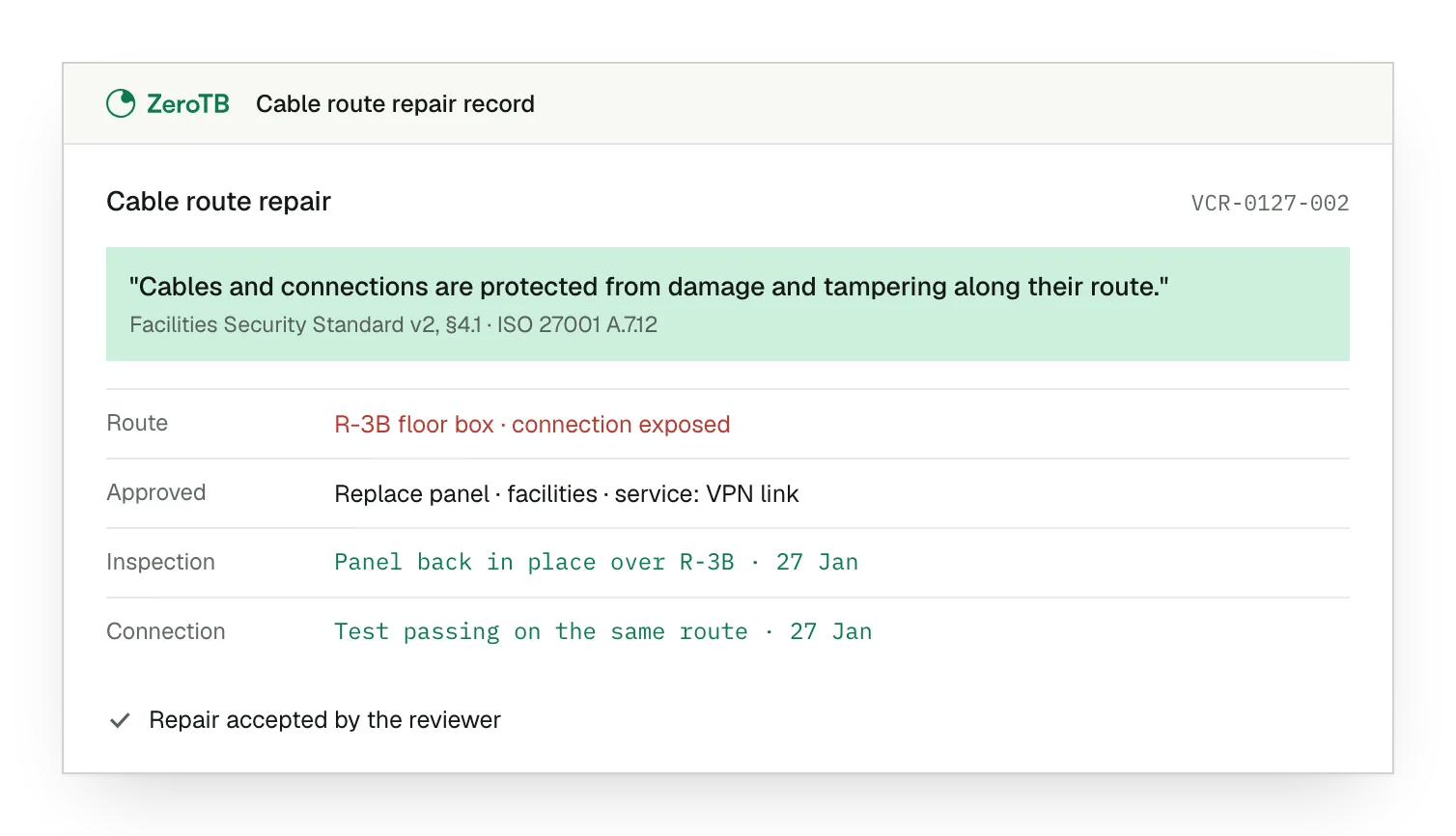
Exposed connection. The route reference identifies where the inspector found a connection left exposed by refurbishment.
Approved repair. The approval records the panel replacement, with IT confirming which service uses the affected connection.
Protection restored. The inspection result records that the panel is back in place over the exposed connection.
Service confirmed. The passing connection test sits beside the physical inspection, allowing the reviewer to accept the repair.
Cable protection checklist
Match the location and connection points to the systems covered by the approved cable protection commitment.
Confirm who controls the affected space and who can approve work on the route and connected service.
Specify the physical condition and service result required before the owner can accept the proposed repair.
Inspect the restored protection and test the connection, keeping any incomplete or unavailable result open for follow-up.
Link the finding, approval and verification, and update route references when the work changes the installation.
Sources
- ISO/IEC, ISO/IEC 27002:2022 overview, 2022.
- NIST, SP 800-53 Rev. 5, PE-4 and PE-9, 2020, with December 2020 updates.
- HHS, Summary of the HIPAA Security Rule, accessed November 4, 2026.
- ZeroTB, Continuous control monitoring, 2026.
Related pages
ISO 27001 controls
Place cable protection within the wider set of controls supporting the information security management system.
Compliance frameworks
Explore the requirements that share an interest in protected facilities, systems and information.
How it works
Follow a control commitment through an approved correction to a verified result and its evidence.
Start with the Pilot
Talk with our team about recurring control gaps and whether the eight-week Pilot fits. We map up to 25 commitments and take two real gaps through approved correction and verified restoration, with evidence of the completed work.