What does ISO 27001 A.7.14 require before equipment disposal or reuse?
ISO 27001 A.7.14 addresses sensitive information left on equipment that is being disposed of or reused. Before releasing a device, identify its storage, apply the approved sanitization or destruction method, and accept the result. The release record should identify the device and explain how its data was removed.
A laptop can return to IT with a reset ticket and no evidence that its previous data was removed. For physical controls, the practical question is whether the next handover can proceed. That decision needs a result tied to the device being released.
Equipment and storage scope
The scope includes storage removed from the equipment as well as storage still inside it. A laptop may reach disposal with a replacement drive installed. Its former drive still needs an accounted-for destination, even though it no longer travels with that laptop.
Match each medium to the information it held and where it will go next. These details let the operator select the applicable procedure. They also give the reviewer a list of items to reconcile against the results, including work performed by an external provider.
Sanitization methods
A method is suitable only if it addresses the data on the particular storage medium. Deleting visible files or removing an account may leave that data recoverable. The approved procedure must use a technique the medium supports and provide the required protection.
NIST's media sanitization guidance groups methods as clear, purge or destroy. Choosing among them requires the device documentation, approved technical guidance and the data's sensitivity. A command that worked on an older drive, or a familiar number of overwrite passes, may be unsuitable for its replacement.
Reuse and disposal decisions
Reuse depends on whether a suitable method can protect the previous data while preserving the equipment for its next purpose. Destruction gives up reuse of the affected media. The owner makes that choice with the destination, data sensitivity and available techniques in view.
The owner also decides which information must be retained elsewhere before work begins. Losing the only needed copy would create a separate problem during disposal. The approval therefore identifies the media, the intended disposition and any retention decision that must precede an irreversible operation.
Handover gaps
An asset can become available for reassignment before its data-removal work is accepted. The collection team closes the return ticket, and the inventory records a device ready for use. The missing connection is the sanitization result that should authorize that change of status.
Keep the equipment on hold until the reviewer accepts the result, with that condition visible in the release workflow. Internal reassignment needs the same decision as external disposal. A device that stays inside the company can still pass recoverable information to its next user.
Custody during disposal
Pending disposal creates a period when equipment still holds data but is no longer in normal use. Protect it during that period, with a recorded location, custodian and hold. The person arranging its next move needs to know that processing remains incomplete.
For an external handover, the transfer list and returned certificate should identify the same items. Compare those identifiers before accepting the evidence. If a device is absent from the certificate, its result remains unresolved even when every other item in the shipment is accounted for.
Verification and acceptance
A successful tool status is one part of the release decision. NIST distinguishes verification of the operation from validation of its effectiveness. Verification examines completion, errors and anomalies; validation considers whether the method and result provide acceptable protection for the data.
The reviewer therefore needs enough detail to judge the outcome for the affected media. An operation can finish successfully while using an unsuitable technique. Record why the result was accepted, including how any reported errors were resolved, before the equipment proceeds to its approved destination.
Failed sanitization
A failed or uncertain result keeps the affected media out of the release queue. The responsible owner selects a suitable next action, such as another sanitization technique or controlled destruction. A deadline for collecting or reissuing equipment does not resolve an incomplete result.
The corrective work needs its own outcome check. Retain the failed attempt beside the approved correction so the reviewer can follow what changed. If the new result remains uncertain, keep the hold in place and the gap open until an acceptable outcome is established.
Release records
A result is useful only when the reviewer can connect it to the media released. Record the device or media identifier alongside the method, tool and version, operator and date. Include the verification outcome, acceptance decision and final disposition of the item.
The logs and certificates support that record. They let someone follow the item from the approved scope through processing to reuse, recycling or destruction. That trace matters when collection, sanitization and release are handled by different people who each see only part of the work.
Checks between audits
A disposal procedure can stop working after a supplier, device or workflow changes. The next review should examine what changed and what recent records show. For example, a new drive type may require another technique, while a revised return process may omit the release hold.
Corrections often involve both the operator and the team responsible for the commitment. ZeroTB's control restoration process follows that work through approval and verification. In a physical disposal case, closure relies on evidence from the operator and the reviewer who accepts the result.
Audit evidence
For a selected device, the evidence should explain what was approved, what happened and why release could proceed.
| Requirement | What an auditor asks for | Where it comes from |
|---|---|---|
| Defined scope | Which devices and media were included, what data they held and where they were going | Asset inventory and approved disposal or reuse request |
| Suitable method | Why the procedure applied to that storage type and its data | Approved procedure, device documentation and the owner's decision |
| Traceable custody | Who held the item between collection, processing and final handover | Collection records, transfer lists and provider receipts |
| Accepted result | What the operation reported and how the reviewer judged its outcome | Tool logs, inspection records and sanitization certificates |
| Authorized release | Which accepted result supported the decision to release that item | Release approval linked to the device or media record |
Framework mapping
| Framework | Control | What it covers |
|---|---|---|
| ISO 27001 | A.7.14 | Sensitive information removed from equipment before disposal or reuse |
| SOC 2 | CC6.5 | Information protected through the disposal of physical assets |
| HIPAA | 164.310(d) | Electronic protected health information on devices and media being handled, disposed of or reused |
Example of preventing premature laptop release
A reset ticket without a sanitization result leaves the laptop on hold. Here, the owner approves a suitable procedure, the operator completes it and the reviewer accepts the outcome. The device record then contains the evidence that permits reassignment.
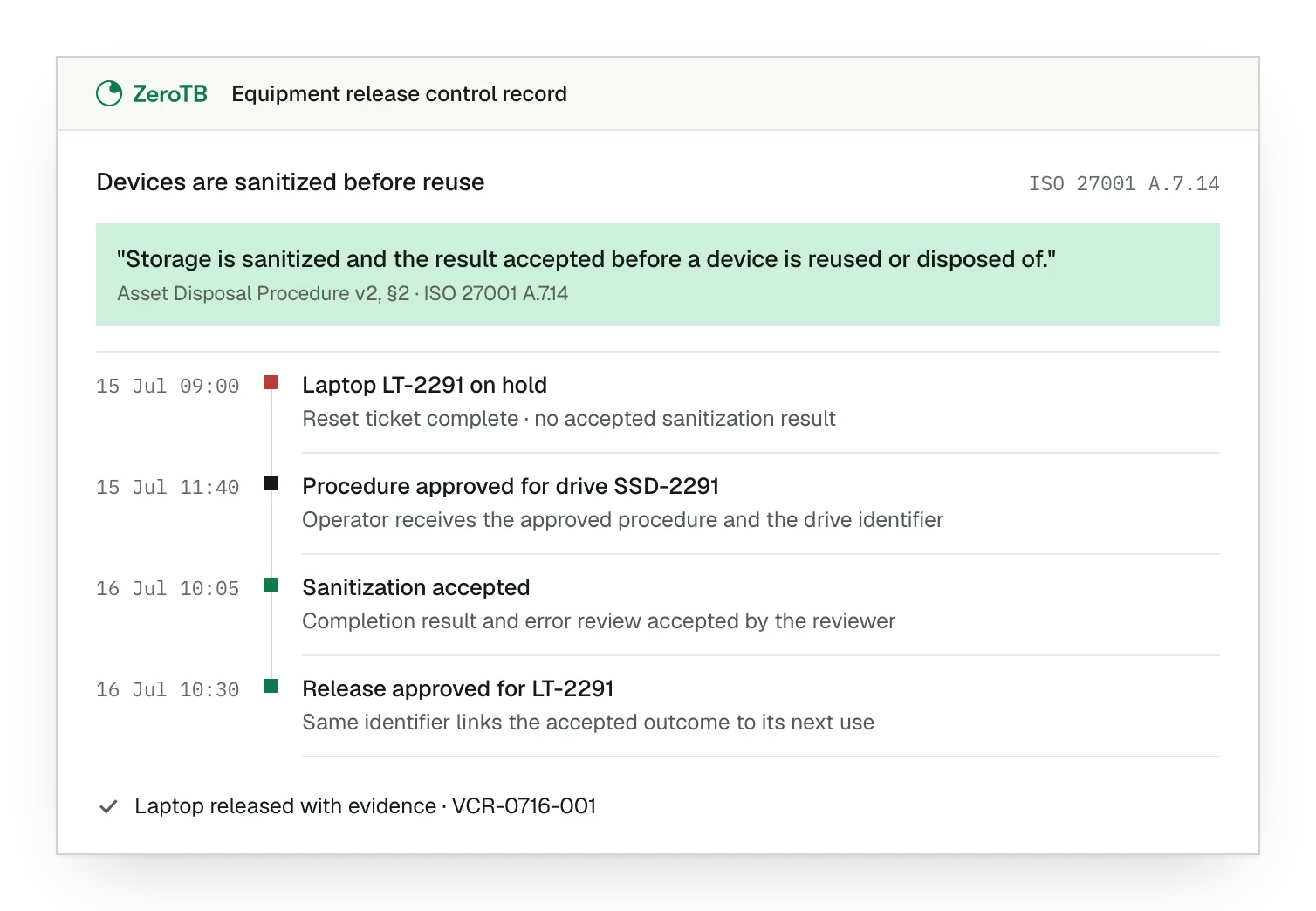
Missing result. The reset ticket is complete, but the laptop record has no accepted sanitization result.
Approved correction. The operator receives the approved procedure with the identifier of the drive to process.
Accepted outcome. The completion result and error review support the reviewer’s decision to accept the sanitization.
Recorded release. The same laptop identifier connects the accepted outcome with the approval for its next use.
Equipment release checklist
Match the equipment and its storage to the disposal request, including media removed during repairs.
Choose an approved technique suited to the medium, data sensitivity and intended destination of the equipment.
Confirm the scope and any required data retention before approving sanitization or destruction of the identified media.
Check completion and errors, then decide whether the outcome provides sufficient protection to permit the planned release.
Link the result and release approval to the device identifier, custody history and final destination.
Sources
- ISO/IEC, ISO/IEC 27002:2022 overview, 2022.
- NIST, SP 800-88 Rev. 2: Guidelines for media sanitization, September 2025, sections 4.3–4.6 and Appendix C.
- HHS, Reuse and disposal of equipment containing electronic protected health information, reviewed August 12, 2026.
Related pages
Physical controls
Explore the other ISO 27001 controls for equipment, premises and physical protection of information.
ISO 27001
See how individual controls fit within the wider information security management system and its commitments.
Compliance frameworks
Find guidance on related requirements across the frameworks that apply to the company's systems and information.
Start with the Pilot
The eight-week Pilot maps up to 25 commitments and takes two real control gaps through approved correction and verified restoration. Talk with our team about where controls fail between audits and how the Pilot could help.