What does ISO 27001 A.7.3 require for securing offices and rooms?
ISO 27001 A.7.3 calls for physical protection of offices and rooms that suits the information and equipment inside. A change in storage or room use can leave that protection inadequate. Review the changed space, agree a correction with its owner and check the completed arrangement at the location.
An office cupboard can become a place for backup media without anyone changing who holds its key. The contents have changed; the access arrangement still belongs to the cupboard's earlier use. This is a reason to reopen the room's security assessment.
Room security scope
A.7.3 covers physical protection in the places where the organization handles information. Its scope can include offices, storage rooms and equipment rooms. A room's name tells only part of the story: the assessment needs to describe what happens inside it.
For each space, connect its use and contents to the protection provided. Identify who can enter, what they can reach and who is responsible for the arrangement. A reviewer can then compare the room they inspect with the one the assessment describes.
Protection by room use
A room's use determines which protection makes sense there. A meeting room needs to admit visitors; a records room may hold material those visitors must never reach. The assessment should account for both uses before specifying locks, storage or access restrictions.
Sometimes the sensitive material occupies only a small part of a shared office. A restriction on its cupboard may be sufficient. If protected equipment fills the room, the restriction may need to cover the entrance. Explain that choice in the room assessment.
Exposure from adjoining areas
Information can be exposed to people who never enter the room. A visitor in a corridor may see papers or a display through an open doorway. An assessment that considers only the door lock can miss this kind of exposure.
Check the arrangement from the adjoining areas that people normally use. Moving a display, changing storage or adding a suitable barrier may address the problem. The resulting layout should let people do their work while protecting the information visible beyond the room.
Internal access
Permission to enter the building does not establish a need to enter every room. Building access may serve employees, visitors and maintenance staff whose work requires different areas. Internal restrictions should reflect those differences and the contents that each area protects.
Review access to the protected contents as well as access to the room. A locked office offers little protection for a cupboard whose key is routinely shared beyond the approved group. Check how keys or credentials are issued and used.
Shared premises
In a shared building, responsibility for security can stop at different doors. The landlord may manage the entrance and the company its own rooms. Identify who controls each safeguard, especially where the company relies on someone else to maintain it.
A faulty building door needs a repair route through the landlord and an owner who checks that the repair worked. A company-owned cupboard may be simpler to change. Record these responsibilities before a gap leaves both parties waiting for the other to act.
Changes in room use
A change in what a room holds can invalidate its earlier security assessment. Moving backup media into a general office cupboard creates a new protection need even if the building entrance remains secure. The old assessment describes a different use of the space.
Include changes in storage, occupants and room purpose in the review process. The person arranging a move may know about it before the security owner does. Including the security owner in move decisions allows protection to be reassessed before the new arrangement becomes routine.
Suitable corrections
Choose a correction for the exposure found in the room. The available responses can include moving sensitive material, restricting its storage or changing access to the room. Consider how each option would affect the people who still need to work there.
Restricting a whole office may be unnecessary when its only sensitive contents fit in a locked cupboard. Moving those contents may work better if shared access is essential. Keep the reason for the choice with the assessment, so it survives a change of owner.
Approval responsibilities
The person approving a correction needs authority over the space or safeguard being changed. The information owner identifies the protection needed; the facilities or space owner assesses how to provide it. Their decision should preserve the access required for legitimate work.
Agree the expected result before the change proceeds. Where a permanent correction must wait, record any temporary arrangement, its owner and the conditions for reviewing it. Keep the gap open while a repair is pending, and record what protection remains in place.
Physical verification
An inspection must establish that the corrected arrangement provides the intended protection. The responsible facilities, IT or service owner checks the affected location under normal working conditions. A completed work order alone cannot show how the room is now being used.
Record what was inspected, when it was checked and whether the agreed condition held. If the restriction fails or protected material remains exposed, keep the gap open. NIST's assessment guidance combines examination, interviews and testing when assessing physical protection.
Further checks
A successful inspection describes the room at the time it was checked. Later changes can make that observation outdated. Give further checks an owner and a review schedule that reflects the room's use, alongside reviews triggered by changes to its contents.
Keep the date and scope of each observation visible. A manual inspection may be necessary to establish how a room is arranged or used. An electronic access record can contribute evidence, but it cannot show everything a person can see or reach inside.
Evidence continuity
The record needs to explain why the room was changed. An inspection date and a closed ticket leave that reason unclear. Connect the room, its contents, the gap and the approval to the finding that allowed the owner to close it.
ZeroTB's control restoration process connects approved changes to checked results in this way. The same room inspection may also help with another framework's review. Before reusing it, establish which location, assets and requirement it supports; a similar control name is not enough.
Audit evidence
A reviewer should be able to follow the decision from the room assessment to the inspection that closed the gap.
| Requirement | What an auditor asks for | Where it comes from |
|---|---|---|
| Defined scope | Which rooms are covered, and what is kept or done there | Room inventory and changes recorded since the previous assessment |
| Appropriate protection | Why these safeguards were selected for this room | Assessment of the contents, layout, use and exposure |
| Assigned responsibility | Who maintains the protection, including safeguards operated by a landlord | Facilities responsibilities and agreements for the building or service |
| Approved correction | What was wrong, what change was agreed and who authorized it | The gap record and the space owner's change approval |
| Verified result | What was checked after the change, and whether anything remains unresolved | Dated inspection notes linked to the approved correction |
Related framework controls
| Framework | Control | What it covers |
|---|---|---|
| ISO 27001 | A.7.3 | Protection of the offices, rooms and facilities where information is handled |
| SOC 2 | CC6.4 | Physical access to facilities and information assets, restricted to authorized people |
| HIPAA | 164.310(a)(1) | Access to facilities holding electronic protected health information; the facility security plan addresses the premises and equipment |
Example of protecting backup storage
This example follows backup media moved into a shared office cupboard. The correction restricts the media to approved users while leaving the office available for ordinary work. A physical inspection establishes whether the new storage arrangement meets that decision before the gap is closed.
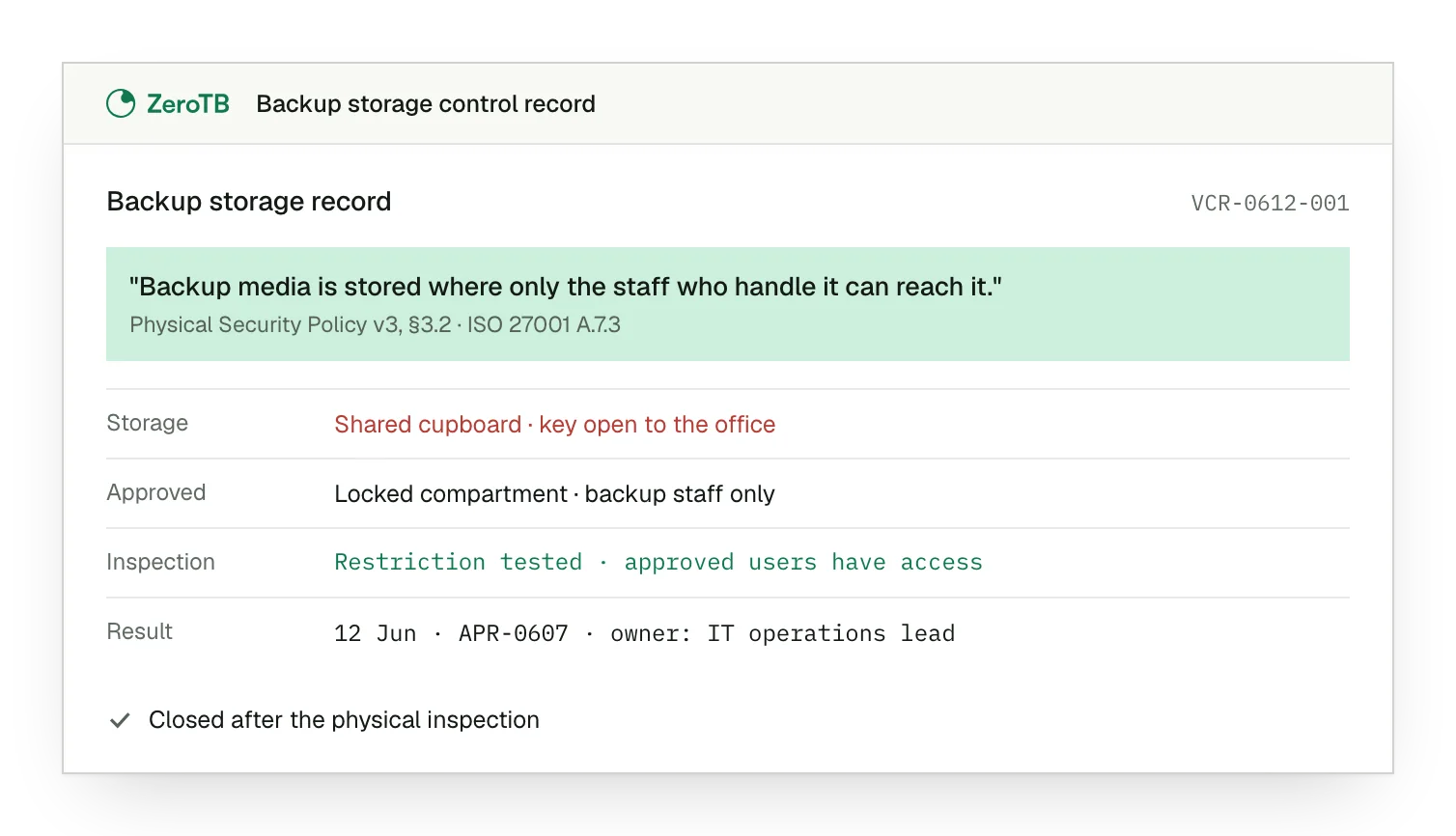
Changed storage use. The media has moved, and the cupboard key is still available to the wider office.
Approved storage restriction. A locked compartment is approved, with access reserved for the staff who handle the backups.
Physical access checked. At the cupboard, the inspector tests the restriction and checks that approved users retain access.
Recorded inspection result. The inspection date and finding sit beside the approval and the owner of future checks.
Room security review checklist
Compare the room's current contents and purpose with the arrangement described in its last security assessment.
Establish who can approve changes to the room, storage and any building safeguards the company relies on.
Choose a response to the identified exposure and define the access that must remain available afterward.
Check the affected location under normal use and keep the gap open until the agreed protection holds.
Retain the inspection result with the approval, room assessment and owner responsible for checking subsequent changes.
Sources
- ISO/IEC, ISO/IEC 27002:2022 standard overview, 2022.
- NIST, SP 800-53A Rev. 5: Assessing security and privacy controls, 2022, physical protection assessment methods.
- AICPA & CIMA, 2017 Trust Services Criteria with revised points of focus, 2022 revision.
- HHS, HIPAA audit protocol, 2018 update, facility access controls and facility security plan.
Related pages
Physical controls
Read the other control guides covering physical protection across the places where information is handled.
ISO 27001
See how physical controls fit within the wider information security management system and its commitments.
Compliance frameworks
Explore the framework library for related requirements and the evidence used to support them.
Start with the Pilot
Talk with our team about the controls that need attention. The eight-week Pilot maps up to 25 commitments and takes two real control gaps through approved correction and verified restoration, with a record of the action, approval and result.