What does ISO 27001 A.7.5 require for physical and environmental protection?
ISO 27001 A.7.5 concerns physical and environmental threats to information and the systems that support it. Fire, water and harmful conditions require protection suited to the location. Decide who maintains that protection, and verify it after building work, equipment moves or repairs change the conditions covered by the assessment.
The room may have changed since its last assessment. A new equipment position or maintenance arrangement can affect protection that previously worked. For physical controls, the practical question is whether the earlier assessment still describes the hazards and safeguards in place today.
Location-specific hazards
Physical protection starts with the hazards that could damage information or interrupt systems at a particular location. Fire, leaking pipes and unsuitable environmental conditions call for different safeguards. The assessment connects each relevant hazard to the information, equipment and services it could affect.
The choice of protection follows that exposure. A room containing essential network equipment needs a different assessment from an office used mainly for meetings. Facilities specialists can identify suitable measures and explain how the proposed protection addresses the conditions at that site.
Scope of protection
The assessment needs to cover the places where information and supporting equipment could be harmed. Identify the rooms, facilities and hosted services within the agreed scope. This makes it possible to distinguish safeguards operated directly from protection supplied by a landlord or provider.
For hosted infrastructure, the relevant evidence comes from the provider's arrangements for the facilities supporting the service. For occupied premises, it includes local conditions and responsibilities. Both need a clear connection to the systems or information the organization relies on at that location.
Shared responsibilities
Shared premises need an explicit division of responsibility for protection. The landlord may maintain a building system while the tenant manages the equipment it protects. Their agreement needs to identify who reports a defect, who arranges repairs and whose approval the work requires.
A report for the building may leave a particular room or safeguard unaccounted for. The control owner needs an agreed contact who can explain that coverage and supply the relevant record. That contact also gives the owner a route to resolve defects found between maintenance visits.
Changes to premises
A premises change can make an earlier assessment inaccurate without changing the assessment document. Moving equipment below a water pipe introduces an exposure that may be absent from the original record. The control owner needs to know whether the existing protection covers the new position.
Facilities and IT can answer that question while planning the move. Their review covers the affected safeguards and any maintenance or response instructions that need updating. The resulting decisions belong with the assessment, so a later reviewer can relate its conclusions to the changed room.
Safeguard maintenance
A safeguard remains useful only while it can perform the protective function selected for it. Maintenance records should identify the equipment, location, work completed and unresolved defects. Those details let the owner judge whether the selected protection is still available where it is needed.
NIST's physical protection guidance addresses fire-system maintenance, environmental monitoring and working, accessible water isolation valves. These are useful technical references when selecting checks. The appropriate measures and inspection arrangements depend on the site's hazards, equipment and specialist advice.
Alarm response
An alarm is useful when its warning reaches a person or service able to respond. Establish who receives it during working hours and when the premises are empty. The response arrangement needs to cover the affected location and the equipment at risk there.
A detector may still work after the person receiving its warnings has changed roles. A controlled check can expose that break in the response arrangement. The current owner can confirm receipt and check whether the instructions still describe the room and equipment they must protect.
Corrective work
Corrective work needs agreement on the hazard to resolve and the conditions to preserve during the repair. Facilities staff and relevant specialists determine the physical work. The responsible owner approves it after IT or service owners have assessed the effect on dependent services.
Some repairs require temporary protection while permanent work is arranged. The owner decides whether that protection is acceptable and sets a review point. The record must still identify the unresolved exposure, so a temporary arrangement cannot be mistaken for a completed repair at the next review.
Verification at the location
A completed repair needs a check against the protective condition that failed. Agree the expected result before the work begins, then use inspection or controlled testing to establish whether it holds. The method should suit the safeguard and avoid exposing people or essential services to harm.
The responsible reviewer records what was checked, where and when, with the result and any remaining limits. A failed or unavailable check leaves the gap open. The work order records the repair; the verification result establishes whether the required protection now holds at the location.
Records of protection
A useful record connects the hazard, the corrective work and the evidence that supports closure. Include the affected location and equipment, the owner's decision and the dated result. Another reviewer should be able to follow why the owner accepted the protection after the work.
Earlier observations help a later reviewer understand what changed and why the owner accepted the result. ZeroTB's operating approach connects approved actions to verified restoration in this way. For physical safeguards, the supporting evidence comes from the people who examine or test them.
Evidence of physical protection
The evidence should explain what protects the location and how the owner knows that protection works.
| Requirement | What an auditor asks for | Where it comes from |
|---|---|---|
| Assessed exposure | Which hazards affect the location and why the selected safeguards are suitable | The site assessment, equipment inventory and record of changes to the premises |
| Assigned responsibility | Which party maintains the safeguard and arranges work when it fails | The facilities responsibility record and relevant landlord or service agreements |
| Maintained safeguards | What maintenance covered and whether the equipment has outstanding defects | Reports identifying the equipment, location, date and findings of the maintenance visit |
| Working response | Whether warnings reach the team responsible for the affected area | Results of alarm checks, response instructions and the current service contact details |
| Verified correction | Why the owner accepted the protection after corrective work | The approved change and dated inspection or test result for the safeguard concerned |
Related controls
| Framework | Control | What it covers |
|---|---|---|
| ISO 27001 | A.7.5 | Safeguards for information and supporting systems exposed to physical or environmental hazards |
| SOC 2 | CC9.1 | Measures to manage the risks of an interruption to business operations |
| HIPAA | 164.308(a)(7) | Arrangements to respond to emergencies affecting systems that contain electronic protected health information |
Example of resolving water exposure
A relocation needs evidence that the equipment has reached a suitable position. In this example, network equipment has been placed below pipework during a room change. The correction moves it away from that exposure, with facilities and IT agreeing the position before work begins.
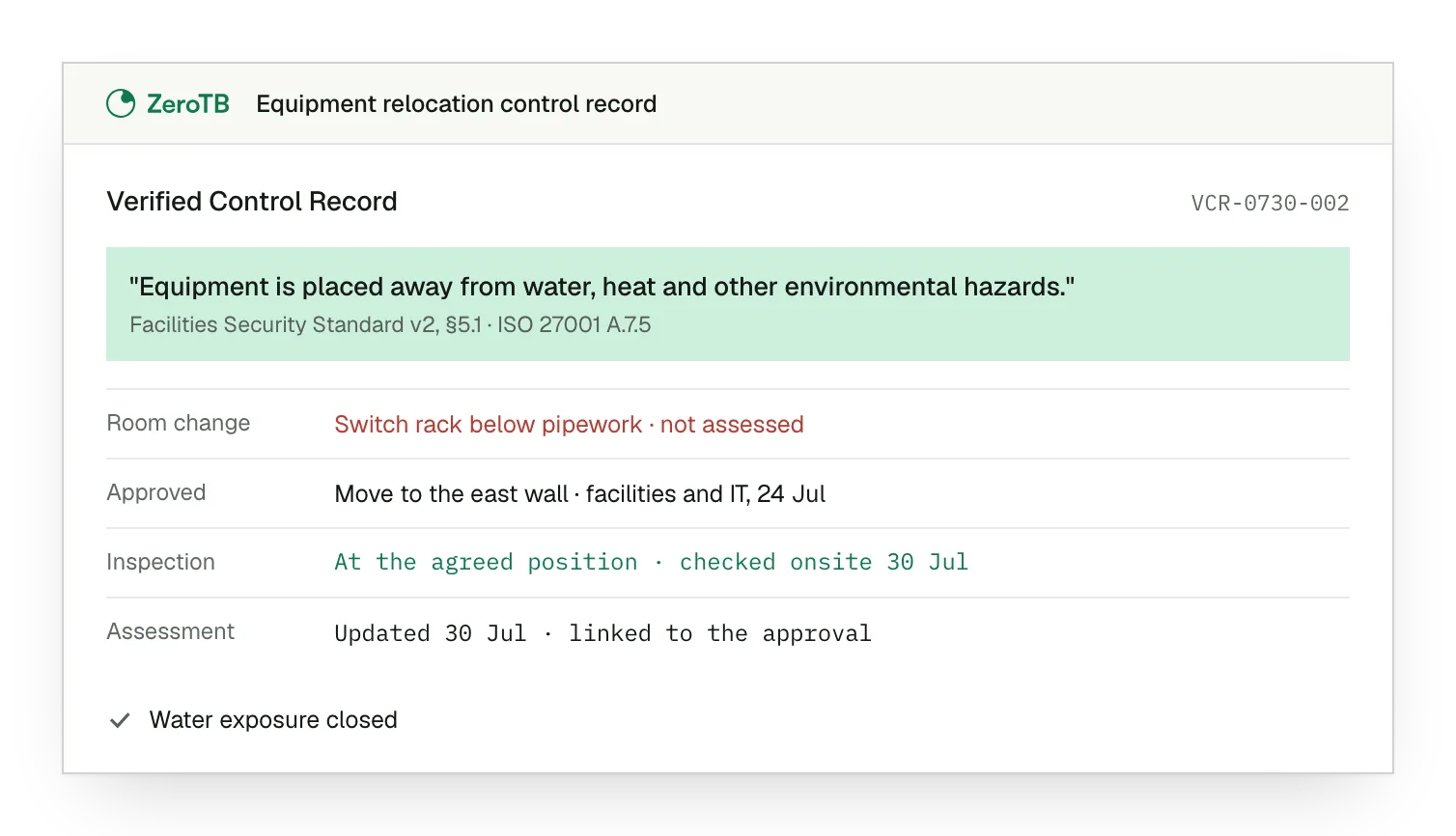
Changed room layout. The equipment now sits below pipework, in a position the earlier assessment did not cover.
Approved equipment move. Facilities and IT agree where the equipment can operate safely away from this water exposure.
Completed site inspection. The inspection establishes that the move reached the agreed position and records the date checked.
Recorded protection. The updated assessment sits with the approval and inspection result, explaining why the gap was closed.
Physical safeguards checklist
Select a location and identify the hazard, affected equipment and protection the current assessment expects.
Establish who maintains the safeguard and who can obtain evidence or authorize work when protection fails.
Agree the physical work with facilities and relevant specialists, including any temporary protection needed during the change.
Use a safe inspection or test to verify the agreed protection before accepting the gap as closed.
Retain the result with its assessment and identify the premises or service changes that require another review.
Sources
- ISO/IEC, ISO/IEC 27002:2022 overview, 2022.
- NIST, SP 800-53 Rev. 5, physical and environmental protection, 2020, PE-13, PE-14 and PE-15.
- AICPA & CIMA, Trust Services Criteria with revised points of focus, 2022 revision.
- HHS, Summary of the HIPAA Security Rule, accessed November 4, 2026.
Related pages
Physical controls
Continue through the physical control guides for related questions about premises, equipment and the protection they need.
ISO 27001
Return to the framework guide for the relationship between individual safeguards and the information security management system.
Compliance frameworks
Compare the framework guides when several sets of requirements apply to the information and systems being protected.
Start with the Pilot
Our team uses the eight-week Pilot to map up to 25 commitments and take two real control gaps through approved correction and verified restoration. You receive evidence of the results. Talk with us about the controls that need attention.