HIPAA administrative safeguards set out how an organization manages security for electronic protected health information (ePHI). They cover the people responsible, the procedures they follow and how the organization responds when something goes wrong. These guides explain each standard and the ongoing control work ZeroTB can help carry out.
Nine administrative safeguard standards
Assigned security responsibility
Identify the security official who is responsible for developing the required security policies and putting them into practice.
Business associate contracts
Record the security responsibilities in the agreement with each business associate that handles ePHI for the organization.
Contingency plan
Make plans to recover ePHI and protect it during emergencies, including backups and the restoration of lost data.
Evaluation
Examine how well security policies and procedures meet the rule, periodically and in response to relevant changes.
Information access management
Determine how access to ePHI is authorized and how permissions are granted, reviewed and changed.
Security awareness and training
Give workforce members security training, including reminders and guidance on passwords, log-ins and protection against malicious software.
Security incident procedures
Prepare to recognize security incidents, respond to them, limit their harm and record what happened.
Security management process
Identify risks to ePHI and manage them through security measures, sanctions and regular reviews of system activity.
Workforce security
Address authorization, supervision and access when someone starts work, takes a different role or leaves.
Gaps in recurring security work
Security procedures can fall behind when people, systems and suppliers change. A manager leaves before finishing an access review. Nobody takes over the review, so permissions that should have been reconsidered stay in place. At the next assessment, the security team has to piece together what was missed.
Review owner leaves
Access review goes unfinished
Old permissions remain active
Ongoing control work with ZeroTB
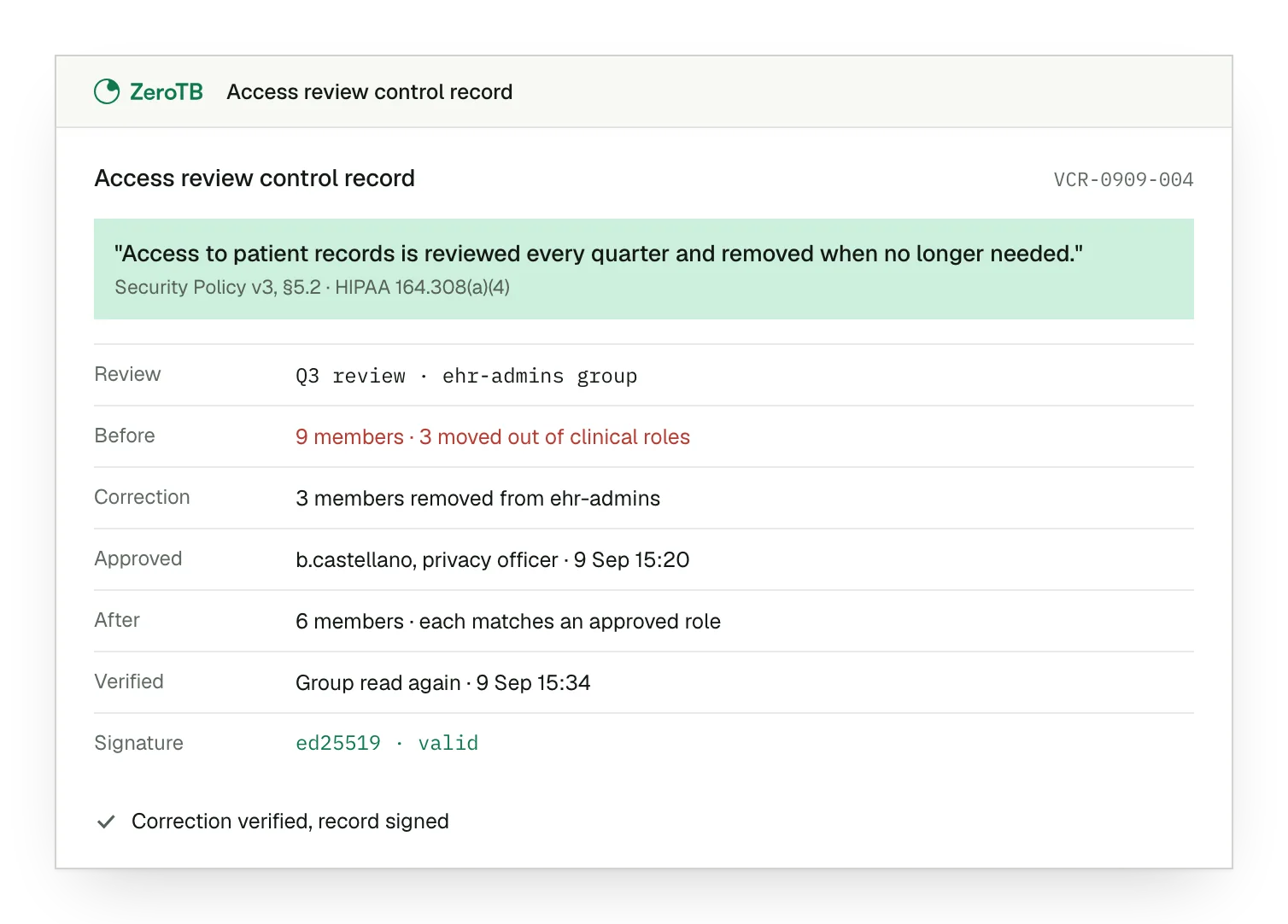
ZeroTB carries recurring control work from your policies through to a verified result. We read the commitment and check whether systems meet it. If a repair is needed, we draft it for approval. We then check the approved change and preserve a signed Verified Control Record.
Checks follow the commitments in company policies
People authorize material changes to systems
Completed repairs leave evidence for review
Talk to our team
Talk with us about overdue security reviews, changing access and the work needed to keep administrative safeguards operating.
FAQ
Do these safeguards apply to business associates as well as healthcare providers?
Covered entities and business associates both have duties under the Security Rule. HHS describes the organizations covered in its Security Rule summary. Their duties concern the ePHI they handle. The HIPAA overview explains how the administrative, physical and technical safeguards fit together.
How do we handle an addressable implementation specification?
An addressable specification calls for an assessment of whether it is reasonable and appropriate in the organization’s environment. If it is, implement it. Otherwise, document why and use an equivalent alternative when reasonable and appropriate. HHS describes that decision in its risk analysis guidance.
Does a risk analysis also satisfy the evaluation standard?
A risk analysis alone does not establish that the evaluation standard has been met. It identifies risks and vulnerabilities to ePHI. Evaluation has a different scope: how security policies and procedures meet the Security Rule. The same findings may help with both, but each question needs an answer.
Can ZeroTB help with recurring training and review tasks?
Yes. A policy may promise regular training, vendor reviews, incident exercises or policy reviews. ZeroTB turns those commitments into scheduled tasks with owners, escalates late work and verifies that it is complete. The security team can follow an overdue commitment through to completion.
What evidence remains after a control gap is resolved?
The Verified Control Record preserves the commitment, the state before and after the change, the action, approval and verification. A reviewer can trace the correction to its source requirement and examine the result. The record supports review of that control's operation within the wider HIPAA program.
Can we review evidence of HIPAA control work in ZeroTB?
Yes. ZeroTB keeps the commitments, checks, repairs and evidence for the controls it operates. ZeroTB handles the ongoing control work and keeps its Verified Control Records. Reviewers can read those records in ZeroTB to see the repairs and their verified results.
Start with the Pilot
The Pilot covers eight weeks of work: mapping up to 25 commitments and taking two real control gaps through verified restoration. You receive the restored controls and signed records of the actions, approvals and checks behind them.