Home / Administrative safeguards
What does 45 CFR 164.308(a)(6) require for security incident procedures?
Under 45 CFR 164.308(a)(6), HIPAA security incident procedures must address suspected and known incidents, mitigation of known harm where practicable, and documentation of outcomes. Covered entities and business associates need a working response process. Check whether reports reach the right people, then test any corrections before closing the gaps.
The procedure lists a mailbox, but who reads it now? After a team change, an incident report can arrive at the listed address without reaching anyone responsible for the system. Following that report through to a responder reveals whether the written instructions still work.
Incident response duties
The response and reporting specification applies to suspected incidents as well as incidents the team has confirmed. A procedure needs to explain how an uncertain report reaches someone who can investigate. Waiting for complete certainty can leave that initial report without a response.
The standard also requires mitigation of known harmful effects where practicable and documentation of outcomes. Define the response around those duties. A report needs an assessment, appropriate action and a record explaining how the team handled it.
Reporting and escalation
Someone must receive the report and decide what happens next. The procedure should tell staff whom to contact, what information to include and where to turn if nobody responds. These instructions need to be available at the point when a person notices a possible incident.
Reports from business associates need the same attention. Check who receives a supplier's incident report and how that person reaches the internal response team. A contact list helps only if the people on both sides understand which part of the response they own.
Responder access
A responder who receives an alert may still be unable to investigate it. Access to the affected application's logs might belong to another team. Check whether the person assigned to assess the report can obtain the records needed for that assessment.
Keep those permissions tied to the assigned task. Reading logs does not necessarily require permission to change the application. If the exercise reveals missing access, ask the system owner to decide the appropriate rights and test whether they let the responder perform the task.
Changes after approval
Procedures can become outdated when ownership changes, even if the application stays the same. A team move can leave the old contact in the document and the old destination in the alert settings. Neither will change simply because someone approves the procedure again.
Review the dependency affected by the change. For a new reporting address, compare the written instructions with the configured destination and test delivery. For a new responder, check access as well. The change tells the reviewer which part of the procedure needs another look.
Exercise scope
Choose an exercise that can answer the question about the procedure. A tabletop can reveal uncertainty about who makes a decision. To find out whether an alert reaches the current responder, send a controlled test report through the route that staff would actually use.
NIST's HIPAA guidance recommends considering tests of incident response plans. Agree the scope before a test and use test information. Record which steps participants performed and which they only discussed, so the result does not imply that an untested route worked.
Corrections after an exercise
Each exercise finding needs a correction that someone can approve and a result that someone can check. "Update incident procedure" leaves both unclear. A useful finding identifies the failed handoff, the responsible owner and what must happen when the test runs again.
Keep the proposed change beside the observation that prompted it. The owner can then decide whether the correction addresses the failure and preserves necessary access. If the exercise exposes several gaps, give each its own closure condition so one completed task cannot conceal unfinished work.
Verification before closure
Close a reporting gap only after a test shows that the intended responder receives and acknowledges the report. Changing the destination is an action; the acknowledgement is evidence of its effect. Record both so a reviewer can follow the correction through to the result.
Check any fallback included in the approved commitment, too. A successful primary route leaves an untested fallback unresolved. If delivery fails or the result cannot be observed, keep the relevant gap open and identify what remains to be tested before accepting the repair.
Incident records
The incident record should explain the response as a whole, including its outcome. Keep a chronology of the report, assessment, response actions and mitigation. Record consequential decisions with their timing so a later reviewer can understand what the team knew when it acted.
A corrected reporting route belongs in that history when it affected the response. Its Verified Control Record can preserve the change, approval and test result. The wider incident record still needs to explain the investigation and outcome, including any work that remains open.
Breach assessment
Incident response and breach assessment may proceed at the same time. The HIPAA Breach Notification Rule addresses notification after a breach of unsecured protected health information. The incident procedure needs to identify who assesses that question and how the response team reaches them.
A repair cannot answer whether a disclosure occurred earlier. For that reason, closing a technical gap should leave the breach assessment and any required notification work visible in the incident record. Keep the evidence and decisions for that work with the response history.
Documentation retention
Incident closure does not end the obligation to keep required documentation. Under section 164.316, retain it for six years from creation or its last effective date, whichever is later. This covers records of actions, activities and assessments that the Security Rule requires documenting.
Keep the procedure version that applied during the incident as well as the required incident documentation. Supporting technical records need their own retention decision in context. Section 164.316 does not, by itself, set a six-year retention period for every raw system log.
Continuing checks
A repaired route needs an owner after the test passes. Otherwise, the next team move can leave it pointing to another unused address. Keep the last result with the reporting commitment and agree when the owner will check that the arrangement still works.
Scheduling incident exercises and following control corrections through verification are part of ZeroTB's operating approach. The response team continues to make incident judgments. The record gives that team a dated result for the tested route, which later checks can confirm or challenge.
Incident response evidence
A reviewer should be able to follow an incident from the applicable procedure through the actions taken and their outcome.
| Requirement | What an auditor asks for | Where it comes from |
|---|---|---|
| Usable procedures | Instructions that applied at the time, including roles and response responsibilities | Approved procedure version and assigned responsibilities |
| Reporting and coordination | Evidence that reports reached the people responsible for handling them | Incident reports, escalation history and relevant business-associate communications |
| Response and mitigation | What responders did about the incident and its known harmful effects | Dated investigation notes, actions taken and the decisions behind them |
| Documented outcomes | The team's conclusion and any work still open when it recorded that conclusion | Incident history with the recorded outcome and unresolved items |
| Verified corrections | Evidence that an approved repair addressed the failure found in an exercise | Original finding, approval and results of the test after correction |
Related framework controls
| Framework | Control | What it covers |
|---|---|---|
| HIPAA | 45 CFR 164.308(a)(6) | Handling suspected and known incidents, mitigating known harm and documenting outcomes |
| SOC 2 | CC7.4 | Carrying out the organization's response to security incidents it has identified |
| ISO 27001 | A.5.26 | Handling information security incidents according to established response procedures |
Example of restoring incident reporting
A repeat test gives the owner evidence that a corrected reporting route works. This example follows an alert sent to a retired mailbox during an exercise. After the owner approves a new destination, the team tests it and records the responder's acknowledgement.
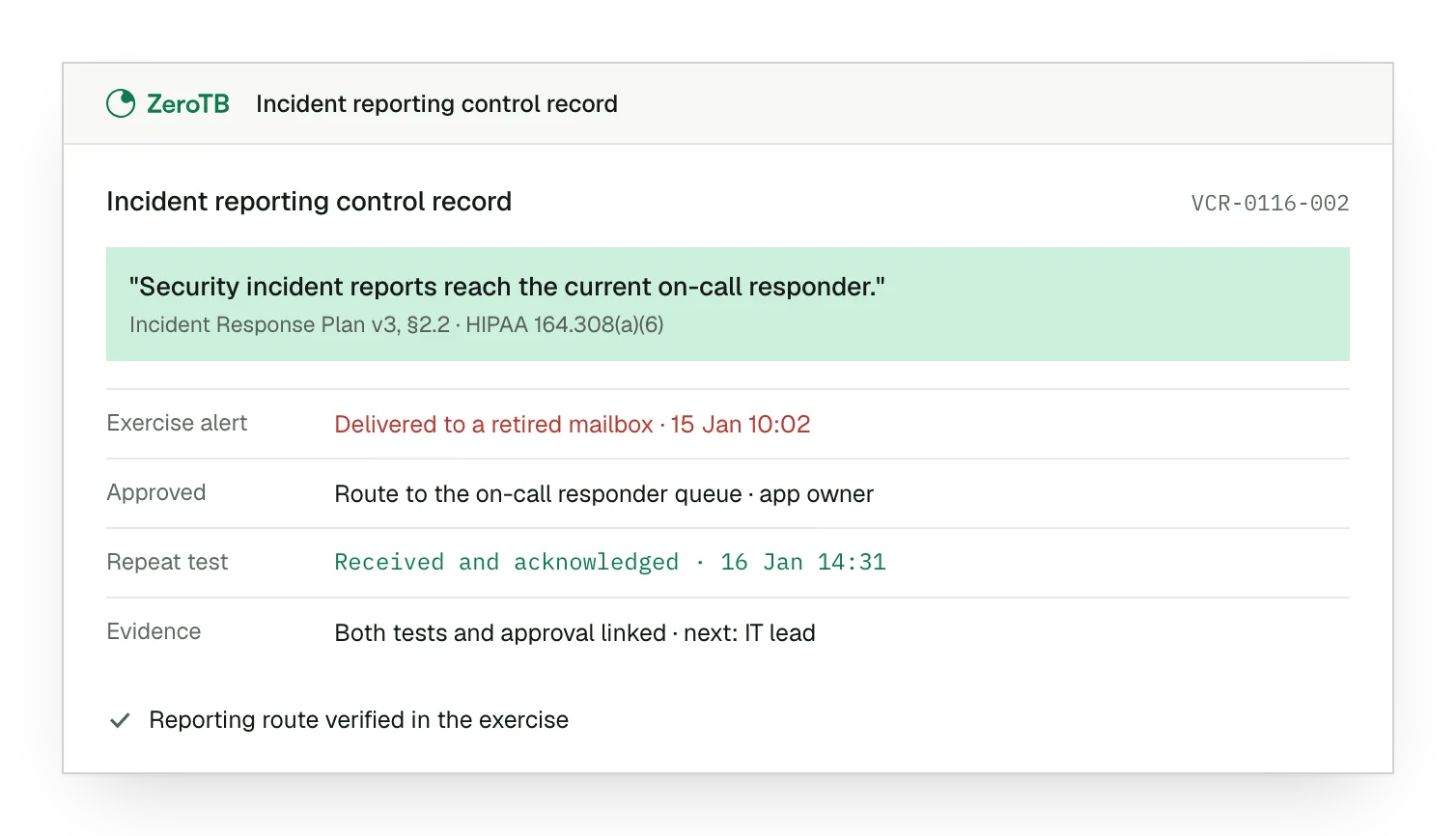
Missed test report. The delivery record shows the retired mailbox as the destination for the exercise alert.
Approved routing change. The application owner's approval identifies the monitored destination that will receive future reports.
Confirmed report receipt. The responder acknowledges the repeated test, confirming that the changed route reaches the right team.
Recorded test result. The reporting commitment links to both test results and the approval for the change.
Incident procedure review checklist
Identify the report, intended recipient and escalation route that the approved incident procedure requires for the selected system.
Compare the written instructions with the actual destination, current responder and access needed to assess the report.
Put the observed failure and proposed change before the responsible owner, with a clear result required for closure.
Use a controlled report to check receipt and acknowledgement, including any fallback covered by the approved commitment.
Keep the approval and test evidence together, link any relevant incident record, and assign ownership of further checks.
Sources
- eCFR, 45 CFR 164.308: Administrative safeguards, current text checked November 2026.
- HHS, HIPAA audit protocol, July 2018 update, security incident procedures and response/reporting entries.
- NIST, SP 800-66 Rev. 2: Implementing the HIPAA Security Rule, 2024, section 5.1.6.
- HHS, Breach Notification Rule, accessed November 2026.
- eCFR, 45 CFR 164.316: Policies, procedures and documentation requirements, current text checked November 2026.
Related pages
Administrative safeguards
Place incident procedures alongside the responsibilities and processes that support the HIPAA Security Rule.
HIPAA
Explore the safeguard groups and how their requirements apply across a HIPAA security program.
Frameworks
Find related guidance for the compliance requirements that your company manages across its systems.
Start with the Pilot
Talk with our team about incident procedure gaps. The eight-week Pilot maps up to 25 commitments and takes two real control gaps through approved correction and verified restoration, with a record of the work and results.