Home / Administrative safeguards
What does 164.308(a)(2) require for assigned security responsibility?
HIPAA assigned security responsibility requires an identified security official who develops and implements the organization's Security Rule policies and procedures. Document that person's duties and distinguish them from delegated security work. After a role change, check that pending reviews and security decisions reach someone with authority to act.
Security work can continue across IT, engineering and compliance while a decision waits in a former employee's queue. A policy may still identify that employee as the security official. The team needs to correct both the documented assignment and the route that carries work to its owner.
Assigned security responsibility connects the person accountable for the program with the people who operate its safeguards. A useful review follows that connection through an actual decision. It establishes who has responsibility, what they can decide and whether unfinished work reaches them.
The security official
A covered entity or business associate must identify a security official responsible for developing and implementing its Security Rule policies and procedures. Section 164.308(a)(2) establishes this requirement. It does not prescribe the title of chief information security officer or a particular reporting structure.
The assignment should identify the individual who holds the responsibility. A department name alone leaves staff uncertain about who can resolve a policy question. Record the official's duties where staff and reviewers can find them, including the date the assignment took effect.
Authority and resources
The assigned official needs a practical way to resolve security decisions and obtain help from the teams that implement them. A role description should explain which decisions the official can make and which need management approval, such as spending beyond an agreed budget.
NIST's implementation guidance asks about the official's access to senior management and who can accept system risks for the organization. These questions expose an assignment that exists on paper but leaves decisions unanswered. Define how the official raises a decision that exceeds their authority.
Delegated security work
Delegating security tasks gives each team a defined part of the work. IT can administer accounts, for example, while engineering maintains application safeguards. One official still has overall responsibility. Teams need to know which decisions they can make and when to involve that official.
For external support, use the agreement to establish the provider's duties and approval requirements. A provider may encounter a request beyond the agreed work. Give it a route to the person authorized to decide what happens next, so the request has an owner.
Privacy and security roles
The same person can serve as both privacy official and security official. HHS guidance allows this arrangement, which can suit an organization where one person has the relevant knowledge and enough capacity. The role description should identify the responsibilities associated with each assignment.
Separate role holders need a clear way to coordinate work that affects both privacy and security. For example, a change to how a system handles health information may require input from both. The choice should make those decisions easier to resolve as the organization grows.
Changes in responsibility
Responsibility can drift when a person changes jobs while policies and approval queues still refer to the previous assignment. A reorganization can produce the same problem without anyone leaving. The official remains listed, but the teams or decisions they oversee have changed.
Compare the documented assignment with current roles, review destinations and unresolved approvals after these changes. A recurring review can also expose old references that a handover missed. Set its timing around the organization's staffing and security processes; this standard specifies no universal review interval.
A complete handover
A handover should transfer the pending decisions as well as the security official designation. Management confirms who holds the role and when the assignment begins. The transfer should identify open reviews, unresolved exceptions and security work awaiting a decision from the outgoing official.
Update the destinations used by those processes, including policy approval requests and escalation contacts. Preserve the earlier assignment and its effective dates so past decisions remain understandable. The incoming official should be able to distinguish inherited work from decisions already completed under the previous assignment.
A working decision route
A test of a pending review shows whether the new official can receive the work and make the required decision. Choose a real review that needs attention. Confirm that it reaches the approved destination and that the official has the access needed to examine it.
Receipt alone leaves the decision untested. Follow the review through an approval, rejection or documented request for further information. If it requires another person's authority, check that escalation too. Keep the routing gap open until the responsible people can use the revised process.
Delayed security work
Overdue work needs a decision after the successor takes responsibility. Consider what changed while a review waited: the policy might still describe a system that the team has since replaced. The official needs to assess the consequences and decide whether immediate action is needed.
Record the routing issue separately from any gap in the affected safeguard. Once the review reaches its owner, that route may be working again. The safeguard still needs its own assessment. Retain the review decision and check the result of any correction before closing that gap.
Evidence over time
Dated records let a reviewer follow who held responsibility when a security decision was made. Retain the designation, defined duties and relevant policy versions alongside decisions made under them. An organization chart explains current reporting relationships but cannot establish who held responsibility in an earlier period.
Section 164.316 requires covered documentation to be retained for six years from creation or the date it last applied, whichever is later. It also requires availability and periodic updates. Preserve superseded assignments with their dates so a later review can reconstruct the responsibility at that time.
Continuing oversight
Recurring checks can identify overdue work, while management remains responsible for choosing the security official. ZeroTB schedules policy reviews and other recurring work from approved commitments, assigns it to an owner, escalates delays and verifies completion. That gives the official evidence of work that still needs a decision.
The useful distinction is between a workflow that completed and a security decision that remains unresolved. Where a review depends on human judgment, the record should retain that judgment and its supporting evidence. Automatic reminders can support the process; the designated official remains responsible for the decision.
Evidence for responsibility
Use the appointment and work history together to show who held responsibility and how they exercised it.
| Requirement | What an auditor asks for | Where it comes from |
|---|---|---|
| Identified security official | The person appointed for the period being examined | Appointment record and the policy effective on that date |
| Defined security duties | The official's duties and work delegated to other people | Job descriptions and approved reporting structure |
| Communicated responsibility | Where staff send security questions that need a decision | Staff communications and the contact listed in procedures |
| Updated assignment | The reviews transferred to the incoming official | Handover record showing previous and replacement assignments |
| Completed follow-up | The decision on delayed work and results of any correction | Completed review, decision and linked Verified Control Record |
Framework responsibility mapping
| Framework | Control | What it covers |
|---|---|---|
| HIPAA | 164.308(a)(2) | The official responsible for developing and implementing Security Rule policies and procedures |
| SOC 2 | CC1.3 | Reporting relationships and assigned authority within the structure used to pursue organizational objectives |
| ISO 27001 | A.5.2 | Information security duties and the people or roles assigned to perform them |
Example of restoring policy review ownership
Reassigning a review allows the new official to address unfinished work. This example follows an access-policy review left in the outgoing official's queue. The successor receives it, identifies a change to the account review procedure, and follows that correction through to completion.
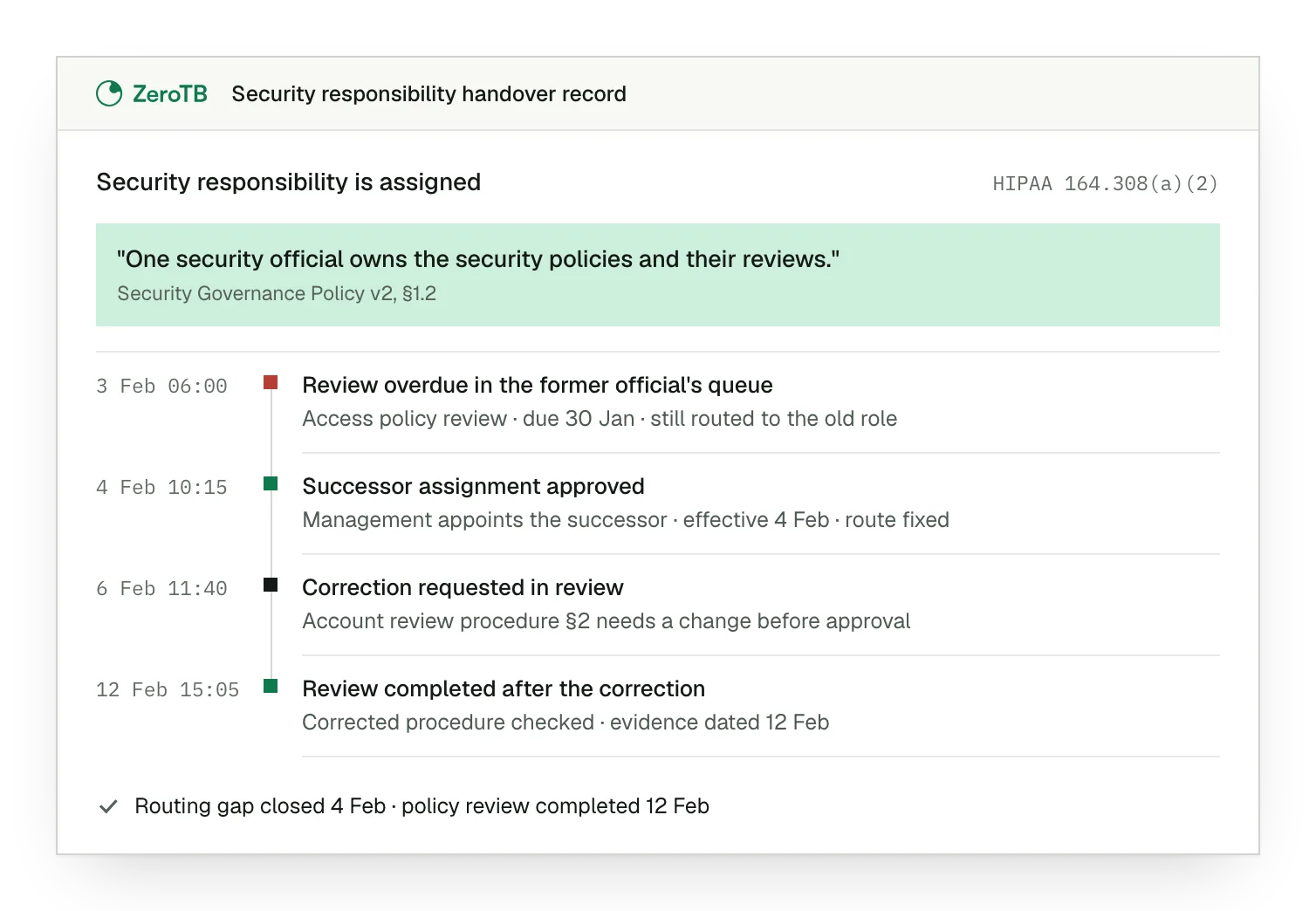
Missed handover. The former official's queue contains an access-policy review that has passed its due date.
Approved reassignment. Management has appointed the successor, who now receives the review through the corrected approval route.
Recorded decision. The review identifies an account review procedure that needs a correction before approval.
Verified follow-up. The successor completes the review after checking the correction, with the decision and evidence retained.
Security responsibility review checklist
Compare the approved designation with the current role holder and confirm the assignment's effective date.
Identify the official's decisions, delegated duties and route to management when an issue exceeds that authority.
Check whether pending reviews and unresolved exceptions transferred with the role, including work held in old queues.
Follow a pending review through receipt and a recorded decision, including any escalation the decision requires.
Assess overdue items separately, verify resulting corrections and retain their evidence with the relevant assignment history.
Sources
- eCFR, 45 CFR 164.308: Administrative safeguards, current text reviewed November 4, 2026.
- NIST, SP 800-66 Rev. 2, section 5.1.2, 2024.
- HHS, Security standards: Administrative safeguards, revised 2007.
- HHS, HIPAA audit protocol, updated 2018.
- eCFR, 45 CFR 164.316: Policies, procedures and documentation, current text reviewed November 4, 2026.
Related pages
Administrative safeguards
Find the HIPAA standards that address workforce security, risk management and other administrative safeguards.
Healthtech compliance
Explore how our team helps healthtech companies operate controls as their systems and staff change.
Verified Control Record
See what a completed record contains, from the original commitment to the result of verification.
Start with the Pilot
Talk with our team about keeping security responsibilities clear as roles change. The eight-week Pilot maps up to 25 commitments and takes two real control gaps through approved correction and verified restoration, with evidence of the completed work.