Home / Administrative safeguards
What does HIPAA 45 CFR 164.308(a)(3) require for workforce security?
HIPAA workforce security requires procedures that give workforce members appropriate access to electronic protected health information (ePHI) and prevent unauthorized access. Under 45 CFR 164.308(a)(3), authorization or supervision, clearance and termination procedures support that standard. Connect each workforce decision to the affected accounts, then verify that permissions reflect it.
A workforce record can show that someone has left while an application still allows them to read patient information. Keeping HIPAA administrative safeguards effective requires the employment decision and the system change to reach the same conclusion about that person's access.
Workforce scope
Workforce security follows the people whose work can expose them to electronic protected health information. The review needs to connect each person's current responsibilities with the systems and locations where that exposure occurs. A list of active employees alone can leave relevant arrangements outside the review.
Include workforce members whose access comes through a contract or another arrangement with the organization. For each arrangement, identify who knows when the work changes or ends. That person provides the context an application owner needs to judge whether existing access still serves an approved purpose.
Authorization and supervision
Authorization and supervision establish the conditions under which someone may work with ePHI. Those conditions also matter in locations where the information might be accessed. An account approval therefore needs to reflect the person's duties and any supervision on which the decision depends.
Where supervision forms part of the procedure, identify who provides it and what work it covers. A supervisor's departure or reassignment can change those conditions even when the worker's account stays unchanged. The access decision then needs review against the arrangement that actually remains.
Clearance decisions
Workforce clearance establishes whether a person's proposed access is appropriate for their responsibilities. The decision connects the work they will perform with the information they may reach. The person who configures the account needs that decision to assign the approved permissions.
The HHS audit protocol examines clearance before access is granted and its later revalidation. Existing approval can become outdated when responsibilities change. Retaining the decision and its basis helps a reviewer distinguish access that still fits the job from permissions inherited from earlier work.
Addressable specifications
All three workforce security specifications are addressable, so each needs an implementation decision suited to the organization. Under 45 CFR 164.306(d), assess whether the specified measure is reasonable and appropriate in the environment. Implement it when that assessment supports doing so.
If the specified measure is unsuitable, document why and implement an equivalent alternative when reasonable and appropriate. The workforce security standard still applies. The record should explain how the chosen approach protects ePHI, so a later reviewer can understand the decision and evaluate its continued suitability.
Role changes
A transfer can leave someone with permissions from two jobs. The new role needs access, so those rights are added; the earlier rights can stay unless the review covers what the person has stopped doing. Their current duties should determine the access they keep.
The owner must decide which permissions to remove and which are still needed. That distinction matters when the person continues to use the same application. The user access review provides a way to compare that decision with the groups, roles and individual rights in the system.
Termination coverage
Access must end when the employment or other workforce arrangement that justified it ends, or when a clearance decision requires removal. Termination procedures need to cover each trigger. An employee leaving payroll and a workforce member finishing a contract can reach different administrators.
The procedure should make clear who receives the notice and when each removal is due. Alongside application and central identity accounts, it needs to cover relevant physical access. NIST's guidance includes deactivating facility access and recovering access devices such as keys and badges.
Access drift
A workforce decision can be correct while the permissions in an application remain wrong. Disabling a central work identity, for instance, can leave a local account available. The owner of that application needs to receive the same decision and check the account they manage.
Continuing checks compare each system's permissions with the latest decision. Someone must own the differences they find, including systems for which no current observation is available. Results from the other applications cannot settle the question of whether access remains open in an unchecked system.
Approved restoration
Restoration carries an access decision through to a checked result in the system. ZeroTB reads the commitment and compares it with the observed state, then drafts a fix. People approve the change; after it runs, ZeroTB verifies the result and keeps the record.
The approval needs to specify whose access changes, in which systems, and which rights should remain. Those details let an application owner judge the effect on work that continues. Any conditions for retaining access belong with that decision so the proposed correction preserves them.
Verification results
Verification must establish that the unwanted access ended and any approved access still works. A role transfer may require both outcomes in the same application. The acceptance criteria should identify the permissions that must disappear and those needed for the person's current responsibilities.
Check the resulting state in each affected system and retain the time and outcome of those checks. If a result is missing or contradicts the approved decision, keep that part of the correction open. A successful change request alone cannot establish the access that remains.
Continuing evidence
The record needs to show why access changed and what happened in the system afterward. Keep the workforce event beside the decision, affected accounts and dated results. A reviewer can follow that history without reconstructing it from separate messages and closed tasks.
The Verified Control Record holds the commitment, before-and-after state, action, approval and verification. That approved state gives later checks a reference. When the person's duties change again, the reference needs to change with them; otherwise a check can keep accepting permissions for an outdated role.
Workforce security evidence
The evidence should let an auditor follow one workforce event through its approvals and the access changes that followed.
| Requirement | What an auditor asks for | Where it comes from |
|---|---|---|
| Authorization and supervision | Which duties and access were approved, and who provided any required supervision | Workforce procedures, access approvals and supervisor assignments |
| Workforce clearance | Why the access was appropriate and when that decision was reviewed | Clearance decisions kept with the job responsibilities and access request |
| Termination procedures | When the arrangement ended and which access was removed | Departure or change notices, removal records and subsequent account checks |
| Addressable decisions | Why the organization selected its safeguard or an equivalent alternative | Documented implementation decisions and evidence of the selected measure |
| Verified correction | The approved change, resulting permissions and dated verification | The approved correction and dated observations from the affected systems |
Related framework requirements
| Framework | Control | What it covers |
|---|---|---|
| HIPAA | 45 CFR 164.308(a)(3) | Appropriate workforce access to ePHI through authorization or supervision, clearance and termination procedures |
| SOC 2 | CC6.3 | Authorization, modification and removal of access according to roles and responsibilities |
| ISO 27001 | A.6.5 | Information security responsibilities that remain after employment ends or changes |
Example of removing a former contractor's access
An ended contract can leave an application account active after the central work identity has been disabled. In this example, the application owner approves removal of the remaining account. Verification establishes that the former contractor can no longer use that route to reach ePHI.
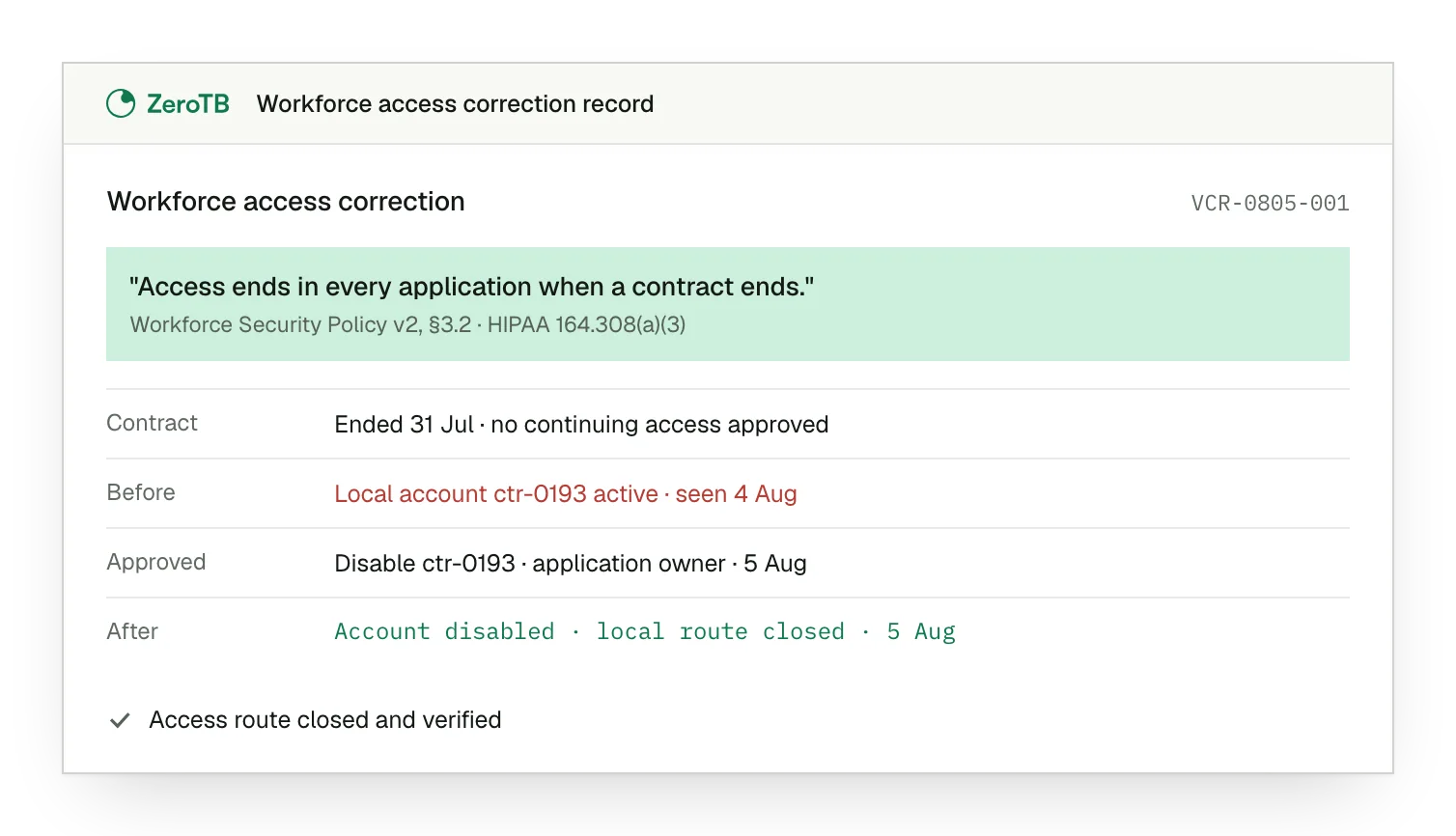
Ended arrangement. The contract end record establishes that the former contractor has no continuing approved access.
Remaining account. The application still lists an active local account associated with the ended workforce arrangement.
Approved removal. The application owner approves disabling that account after checking the person's access decision.
Verified result. The final observation confirms that the account is disabled and the local access route is closed.
Workforce security checklist
Follow a recent departure or transfer from the workforce record to the accounts it should affect.
Identify the permissions the person still needs and the owner authorized to approve the necessary changes.
Check the central identity and separate applications against that decision, and record any access still awaiting removal.
Test the affected access after the change, including any permissions the person needs to retain for current work.
Retain the decision beside the approval and dated results, and identify who owns the next check.
Sources
- eCFR, 45 CFR 164.308: Administrative safeguards, current text checked November 4, 2026.
- eCFR, 45 CFR 164.306: Security standards, general rules, current text checked November 4, 2026.
- HHS, HIPAA audit protocol, updated July 2018, workforce security provisions.
- NIST, SP 800-66 Rev. 2: Implementing the HIPAA Security Rule, 2024, section 5.1.3.
Related pages
Administrative safeguards
Explore the standards that connect workforce procedures, security responsibility and the wider HIPAA program.
HIPAA
See how administrative, physical and technical safeguards work together to protect electronic health information.
Compliance frameworks
Find related requirements across the frameworks supported by the controls your organization operates.
Start with the Pilot
Talk with our team about the controls you need to keep working. The eight-week Pilot maps up to 25 commitments and takes two real control gaps through approved correction and verified restoration, with evidence of each result.