Home / Administrative safeguards
What does HIPAA require for business associate contracts?
Under HIPAA, a covered entity must obtain written assurances that a business associate will safeguard electronic protected health information (ePHI) handled on its behalf. Those assurances belong in a business associate agreement (BAA) or another permitted arrangement. The agreement should cover the service in use, and its security duties need to be carried out as that service changes.
The contract folder shows a signed agreement for the support tool. Engineering has since added a feature that sends it patient records. The review now has to establish whether the agreement covers that use and what protects the information on its way there.
Written assurances
A covered entity must obtain satisfactory assurances that a business associate will safeguard ePHI before allowing it to handle that information on its behalf. 45 CFR 164.308(b) requires a written contract or permitted arrangement that meets the applicable requirements of 164.314(a).
The agreement gives both parties a record of their duties. HIPAA compliance for business associates also involves implementing the applicable Security Rule safeguards. A review therefore needs to establish what the parties agreed and whether the relevant protections are operating in the service they use.
Service scope
The agreement review needs a current description of the service and the ePHI it handles. Include the activity performed, the information involved and the systems that receive it. This gives the people reviewing the agreement a specific relationship to assess.
The supplier name alone does not describe how information is used. One supplier may provide several services with different access to information. Connecting the reviewed service to its actual configuration helps legal and security owners decide whether a proposed change fits the existing arrangement or needs further review.
Cloud storage
A cloud provider can be a business associate even when it cannot read the stored information. HHS cloud guidance includes providers that maintain encrypted ePHI without holding the decryption key. Encryption therefore does not remove the need to assess the business associate relationship.
The same guidance explains that customers and providers can have different responsibilities for safeguards. Their agreement and supporting documents should explain that division. A reviewer can then identify who manages access, who protects the underlying service and which evidence each party can supply.
Subcontractor agreements
A business associate obtains the required assurances from subcontractors that handle ePHI on its behalf. Section 164.308(b)(2) places that duty on the business associate. The covered entity does not obtain those assurances directly from the subcontractor under 164.308(b)(1).
For a review, the practical question is which organization engages each downstream service. Record that relationship beside the activity and information involved. If a supplier adds another provider, the responsible contracting party can assess its obligations without confusing the downstream agreement with the customer's original BAA.
Contract duties
The BAA sets out permitted information use and the safeguards the business associate must provide. 164.314(a) addresses Security Rule compliance, relevant subcontractor arrangements and reporting security incidents, including applicable breaches. Each of these terms needs consideration when the agreement is reviewed.
Other provisions described by HHS address return or destruction of information where feasible at termination, and termination rights for material violations. Legal owners judge whether the terms fit the relationship. The service owners translate the agreed safeguards and procedures into the work required to operate it.
Changes after approval
An unchanged supplier name can conceal a changed service. A release may add support attachments or send information to another destination while the vendor record still describes the old configuration. The next review needs to follow the data through the changed route.
The owners may decide to extend the arrangement, restrict the feature or remove the destination. That choice determines what the application team changes. Describing the service expected after the correction gives the reviewer a specific result to test and a basis for deciding whether the work is complete.
Incident reporting
A reporting obligation needs a working route from the supplier to the people who respond. Contact details, escalation paths and agreed reporting terms should describe the same process. A clause can remain unchanged while the people or channels responsible for receiving a report change.
A practical exercise can test whether a report reaches the intended recipient and receives an acknowledgement. Retain the result and resolve any failed handoff. This checks the communication route; the incident response process still determines what happened and which reporting duties apply to the event.
Approved corrections
A gap needs a decision about both the service arrangement and the affected safeguard. Legal owners decide whether the arrangement must change. The system owner approves the technical action, including any effect on legitimate access or service availability, before that action proceeds.
For the technical work, ZeroTB reads the commitment, checks the system and drafts a correction. After the owner approves it, the service checks the resulting state and retains the evidence. The record links the restored safeguard to the contractual decision that authorized its use.
Evidence for closure
The evidence used to close a gap must show what the correction achieved. If the approved action removes an export destination, a test should establish that the affected route no longer sends information there. The change ticket alone cannot show that result.
The Verified Control Record keeps the commitment, before-and-after state, action, approval and verification together. Linking it to the agreement and reviewed service description explains the significance of the test. A later reviewer can trace the result to the particular safeguard and relationship it supports.
Ongoing review
Further review should follow changes in the service and the commitments already agreed. Useful triggers include new destinations, added subcontractors, changed reporting contacts and service termination. These events help identify when an earlier decision needs attention, alongside the review schedule established for the relationship.
Assign responsibility for that continuing review and for unresolved gaps. A missed review, an unavailable observation and a confirmed failure need different follow-up. Preserving those distinctions helps the next owner understand what is known, what remains open and which decision or evidence is still needed.
Review evidence
A reviewer should be able to follow the agreement to the service it covers and the evidence supporting any correction.
| Requirement | What an auditor asks for | Where it comes from |
|---|---|---|
| Defined relationship | The contracting parties, service used and information handled | Service description checked against the current data flows |
| Written assurances | The written assurances obtained for this business associate | Executed agreement or permitted arrangement, with its reviewed scope |
| Subcontractor safeguards | Downstream activities, agreements and the party responsible for assurances | Business associate records for the subcontractors handling ePHI |
| Incident reporting | The agreed route for reports and evidence that it reaches the recipient | Agreement, response procedure and the result of a communication exercise |
| Corrected safeguard | Approval for the change and a test of the result | Dated system observations linked to the Verified Control Record |
Related framework requirements
| Framework | Control | What it covers |
|---|---|---|
| HIPAA | 45 CFR 164.308(b)(1) | Written assurances that business associates will safeguard the ePHI they handle |
| SOC 2 | CC9.2 | Risk arising from vendors and business partners within the organization's scope |
| ISO 27001 | A.5.20 | Information security requirements agreed with suppliers for the relevant relationship |
Example of restoring an approved support route
In this example, a support release adds an export destination outside the reviewed agreement. The owners decide to remove it and keep the existing support route. The record shows the decision alongside tests of both routes, so the reviewer can see what changed.
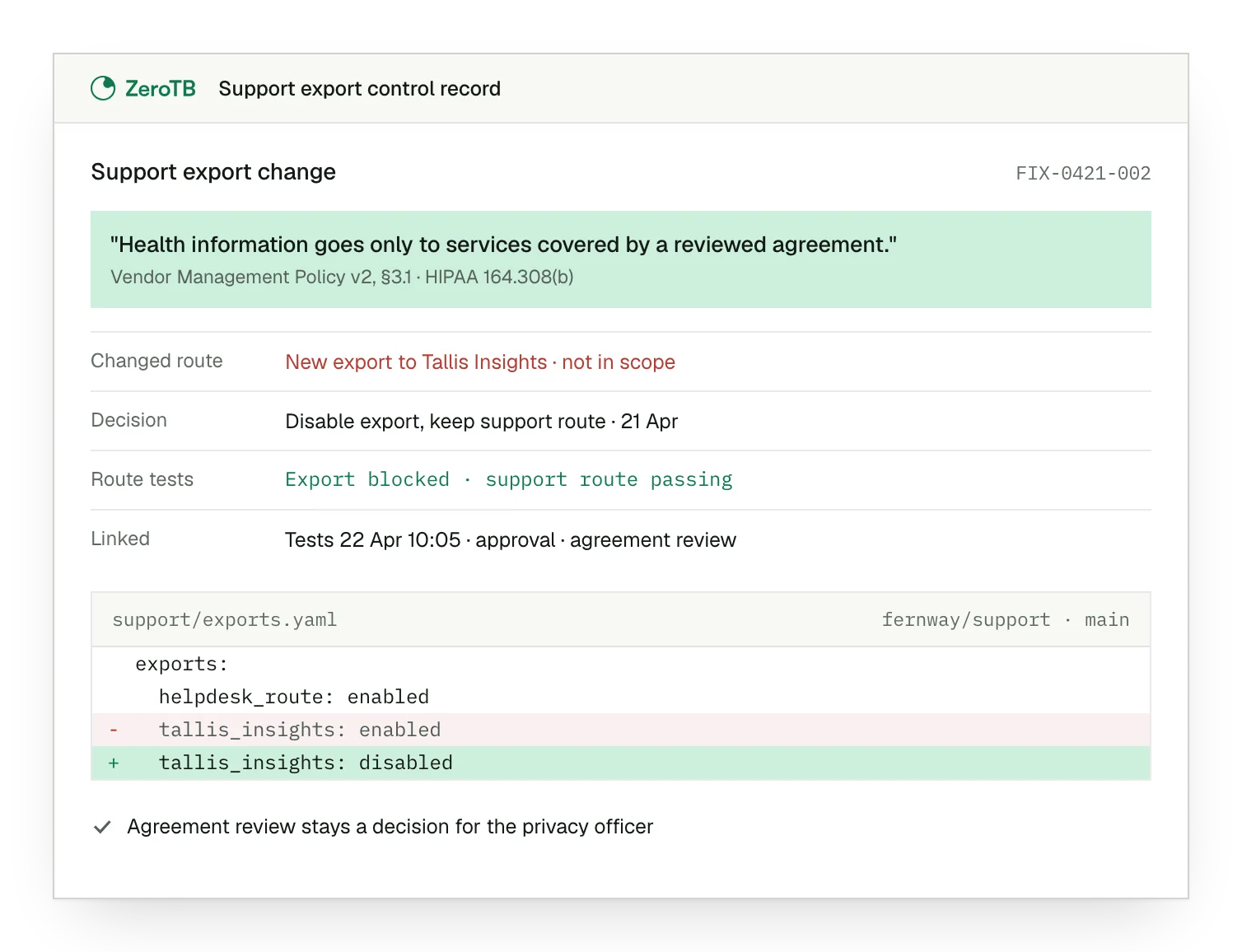
Export outside scope. The new destination receives health information beyond the service covered by the reviewed agreement.
Removal approved. The owners approve disabling the new export while retaining the support route already in use.
Route tests completed. The export test fails as intended, and the existing support route still passes its test.
Result retained. The record connects the dated test results to the approval and the agreement review.
Business associate review checklist
Identify who engages the supplier, what service it provides and which information passes through it.
Ask the legal owner whether the agreement covers the service as configured, including recently changed flows.
Specify the change proposed for the gap, its intended result and the owner who must approve it.
Test what should be blocked after the correction and what should remain available to approved users.
Retain the decision and dated result with the agreement, identifying who follows up on outstanding work.
Sources
- eCFR, 45 CFR 164.308: Administrative safeguards, current text accessed November 4, 2026.
- eCFR, 45 CFR 164.314: Organizational requirements, current text accessed November 4, 2026.
- HHS, Business Associate Contracts, 2013, accessed November 4, 2026.
- HHS, Guidance on HIPAA & Cloud Computing, accessed November 4, 2026.
Related pages
Administrative safeguards
Explore the standards governing security responsibilities, risk management and the processes that protect ePHI.
HIPAA controls
See how administrative, physical and technical safeguards fit together across a HIPAA security program.
Healthtech
See how ongoing control checks and approved repairs support teams handling sensitive health information.
Frameworks
Explore the framework library and the requirements supported by shared controls across the program.
Start with the Pilot
The eight-week Pilot maps up to 25 commitments and takes two real control gaps through verified restoration, with portable evidence records. Talk with our team about the safeguards behind your business associate arrangements and where recurring gaps need attention.