Home / Administrative safeguards
What does HIPAA 164.308(a)(4) require for information access management?
HIPAA information access management, 45 CFR 164.308(a)(4), governs how organizations authorize access to electronic protected health information (ePHI). It requires policies and procedures consistent with applicable Privacy Rule requirements. The practical task is to keep approved rights and system permissions in agreement as people change roles and assignments.
When someone changes jobs inside a company, their account often stays in place. The old permissions can survive the transfer. Access is still necessary, but some rights may belong to the previous job. Information access management gives the company a way to make and maintain those decisions.
Access authorization policies
Access authorization policies establish who can grant access to ePHI and on what basis. HIPAA places this work among the administrative safeguards. Its authorization specification includes workstations, transactions, programs, processes and other ways of reaching the information. Each needs a basis for deciding who receives access.
The technical access control standard addresses how electronic systems enforce those decisions. An administrator configuring permissions needs to know which actions the approval allows. Signing in successfully says little about whether the person should read a particular record, change its contents or export a copy.
Addressable specifications
Addressable specifications call for an assessment of what is reasonable and appropriate in the organization's environment. This standard has two: access authorization, and access establishment and modification. The second concerns procedures for establishing, documenting, reviewing and changing users' rights according to the organization's authorization policies.
Under 164.306(d)(3), the organization implements a specification when it is reasonable and appropriate. If it reaches a different conclusion, it documents why. It also implements an equivalent alternative measure when reasonable and appropriate. A reviewer reading the procedure should find the assessment that explains why the organization chose it.
Clearinghouse isolation
A health care clearinghouse within a larger organization must protect its ePHI from unauthorized access by that organization. Section 164.308(a)(4)(ii)(A) makes this a required specification where that organizational condition applies. Its policies and procedures need to address access across the boundary between the clearinghouse and the larger organization.
An account list may give little indication of the boundary when the two organizations share support or administrators. Examine what those arrangements allow people outside the clearinghouse to reach. Keep the authorized access and the protections together in the record, so a reviewer can understand how the separation operates.
Access decisions and permissions
An approval needs enough detail for the administrator to grant the intended rights. A request for application access can mean several things: reading records, updating them, exporting information or managing other users. Specify the work behind the request and the information needed to complete it.
For temporary assignments, the end condition matters as much as the initial purpose. It tells the reviewer when to reconsider the grant. Someone taking over the review should be able to understand that condition from the record, even if the original requester has left the team.
Effective access across systems
Effective access includes every grant that lets an account perform an action. An identity provider such as Okta can show group membership, while the application holds additional roles or direct permissions. Compare the combined rights with the approval to see where the system permits more than the decision allows.
Follow inherited permissions through to the application where they operate. Removing one group will leave access in place if another grant supplies the same right. When current application data is unavailable, record what remains unexamined. The missing observation leaves a question about access that the reviewer still needs to resolve.
Changes after approval
An active employee can hold rights that their current work no longer justifies. Transfers and completed projects create this problem when the earlier grants remain in place. The review must connect permissions to current duties, including rights acquired for work that has since ended.
A change to a shared role can affect several people without changing their individual assignments. During a user access review, examine the role's permissions as well as its membership. If the role has gained a permission since the previous review, its members have gained access that also needs an explanation.
Review timing and ownership
Access reviews need a schedule and a way to respond when work changes between scheduled reviews. Section 164.308(a)(4) specifies no universal quarterly interval. Set the cadence according to risk, with earlier attention when transfers, completed assignments or changes to privileged roles affect existing authorizations.
The reviewer needs enough knowledge of the work to decide which rights remain appropriate. The application administrator may know how to change a permission without knowing whether the person still needs it. Assign responsibility for unanswered questions, including who will obtain the decision and ensure the system team receives it.
Approved corrections
A correction should remove the unnecessary right while preserving the work still authorized. If an export grant has expired, disabling the employee's whole account could interrupt ordinary duties. Identify the grant that supplies export access and describe the effect of removing it before seeking approval.
ZeroTB checks systems against approved commitments, investigates a difference and prepares a correction for approval. For this standard, the policy owner's decision guides the system change. The approver can see which permission will change. The system owner can then test the access against that decision after the change.
Verification after changes
The test after a change must establish what the account can now do. Try the action that should be blocked, then check the work that should remain available. Together, the results establish whether the change removed the unwanted access without interrupting work the person is still authorized to do.
If the unwanted action still succeeds, inspect other groups or direct grants that could permit it. Keep the gap open while the correction remains incomplete. Record a failed test or missing observation with the change, so the next reviewer can investigate without assuming that completing the ticket resolved access.
Records for later review
The access record should let someone follow the decision from approval through to the resulting permissions. Dates, responsible roles and system observations make that history understandable. A Verified Control Record holds the commitment with the correction, its approval and the evidence that the intended access was restored.
Those records can also support SOC 2 or ISO 27001 controls. Before reusing evidence, compare the control's scope with the system and permissions the record describes. Keep the mapping specific: an approval may support an authorization requirement, while a permission test shows what happened in the application after a change.
Access management evidence
Use these records to explain how the access policy operates and how the team resolves differences.
| Requirement | What an auditor asks for | Where it comes from |
|---|---|---|
| Access authorization | Policies defining approval responsibilities and records explaining the rights granted | Approved access policies, requests and authorization decisions |
| Established and reviewed rights | Evidence that granted permissions follow approvals and receive review | Application permission exports, identity groups and dated access review decisions |
| Access modifications | The reason for a change, its approval and evidence of the resulting rights | Transfer or project records, change tickets and observations after the correction |
| Addressable decisions | The assessment and, where applicable, rationale and equivalent alternative measure | The documented assessment and the procedure implementing the chosen protection |
| Clearinghouse isolation, where applicable | Policies and evidence protecting clearinghouse ePHI from unauthorized access by the larger organization | Organizational scope records, access rules and checks of the relevant boundary |
Related framework controls
| Framework | Control | What it covers |
|---|---|---|
| HIPAA | 45 CFR 164.308(a)(4) | Authorization policies and procedures that govern a user's access to ePHI |
| SOC 2 | CC6.2 | Approval of new users before the organization issues credentials or provides access |
| ISO 27001 | A.5.18 | Access rights granted, reviewed, changed and removed in line with the organization's rules |
Example of ending temporary access
Consider a support employee whose reporting assignment has ended. The employee still needs ordinary record access, but the reporting group continues to allow exports. In this example, the owner approves removing the group. Tests then establish whether export access ended and ordinary support work remains possible.
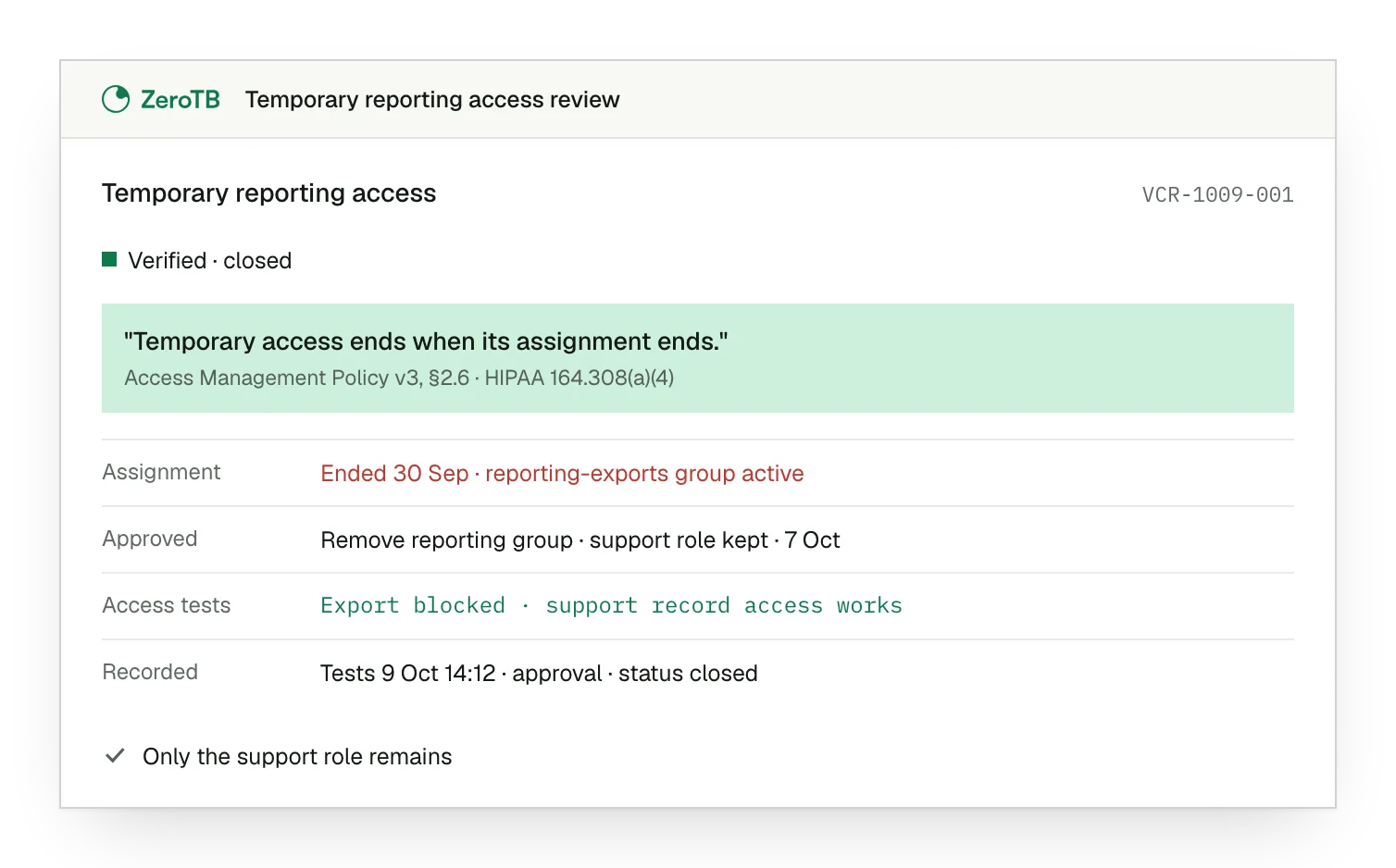
Expired reporting access. The reporting task is complete, and its temporary export permission remains active through group membership.
Targeted correction approved. The owner authorizes removal of the reporting group and retains the existing support role.
Access tests complete. The export test is blocked, while a separate test confirms that ordinary support access works.
Result recorded together. The closed record holds the approval and dated tests that establish the employee's resulting rights.
Access management checklist
Choose an authorization to examine and identify the systems and permitted actions it covers, including temporary rights.
Compare the application's current grants with the approval, including any rights inherited from groups or roles.
Ask the owner to decide which rights should remain and approve a change that preserves necessary work.
Attempt the restricted action after the change, and test whether the account can still perform its authorized work.
Save the decision with dated observations and the approval, so later reviews can follow the change and its result.
Sources
- eCFR, 45 CFR 164.308: Administrative safeguards, current text accessed November 4, 2026.
- eCFR, 45 CFR 164.306: Security standards, general rules, current text accessed November 4, 2026.
- HHS, HIPAA audit protocol, July 2018, information access management and access control entries.
Related pages
HIPAA safeguards
Read about the three groups of safeguards and the different parts of a HIPAA program they address.
Compliance frameworks
Browse the standards and control guidance for other frameworks, including related requirements for managing access rights.
Healthtech compliance
Learn how ZeroTB works with healthtech teams to maintain their controls through changes in systems and access.
Start with the Pilot
Talk with our team about keeping access aligned with the work people do. During the eight-week Pilot, we map up to 25 commitments and take two real control gaps through approved fixes and verified restoration. Each completed correction includes its approval and verification evidence.