Home / Administrative safeguards
What does HIPAA 164.308(a)(7) require in a contingency plan?
A HIPAA contingency plan under 164.308(a)(7) covers data backup, disaster recovery and emergency mode operations. It also addresses testing and revision, and the criticality of applications and data. The practical aim is to recover electronic protected health information and continue essential work safely when normal systems fail.
A database migration can leave the recovery plan pointing at the old system. Its backups still run, but they no longer contain the information the business needs. A review has to follow the current data and check whether the recovery instructions still work for it.
Required plan components
Backup, disaster recovery and emergency mode operations are the three required parts of the plan. Together they address an emergency affecting electronic protected health information, or ePHI: preserving retrievable copies, restoring lost data and continuing essential work with safeguards for that information.
164.308(a)(7) places these plans within the administrative safeguards. Procedures need people who can put them into effect. The plan should identify the person authorized to activate it, the people responsible for recovery and the authority for returning to normal operations.
Addressable decisions
Testing and revision procedures, and applications and data criticality analysis, are addressable specifications. Each needs an assessment of whether it is reasonable and appropriate in the organization's environment. When it is, the organization must implement it. The assessment needs to consider its contribution to protecting ePHI.
If implementation is not reasonable and appropriate, 164.306 requires a documented explanation and an equivalent alternative where reasonable and appropriate. The decision belongs with the plan so a reviewer can understand the chosen approach. A missing exercise record alone cannot explain that decision.
Recovery priorities
Recovery priorities start with the work that depends on each application and dataset. An outage may interrupt one essential service immediately while another process can wait. Establish the consequences of each interruption before deciding the recovery order and the resources each service needs.
The contingency-plan provision sets no universal recovery time. The organization's recovery objectives should give a test a clear result to measure: which information must be available, how recent it must be and when the service must resume. These are decisions about its operating needs and risks.
Backup coverage
A successful backup job establishes that its configured task completed. It can still cover an obsolete database after production has moved. Comparing the current application and data inventory with the backup configuration exposes a gap that a successful job status can conceal.
The comparison needs to identify the actual data source, backup destination and most recent usable copy. Check coverage again when a migration changes where ePHI lives. If the inventory or backup observation is unavailable, leave that coverage question open until the missing information can be checked.
Recovery dependencies
An available backup is little help if its decryption key cannot be retrieved during the outage. Recovery also depends on working accounts and accessible instructions. Trace those dependencies through the planned recovery route, especially where they rely on the service assumed to have failed.
The operator can try that route during a restore exercise. Record the account used and the services that remained available during the test. If the operator signed in through a working production service, that result leaves recovery during the service's failure untested.
Emergency operations
Some work has to continue before the recovery team can restore normal service. The emergency mode procedure makes those activities explicit, along with the health information staff need to perform them. Temporary arrangements need authorization and safeguards that protect the information throughout their use.
Activation also needs a way to inform the people affected. Knowing that a database is unavailable tells the recovery team where to investigate. Other staff need different instructions: how to continue their work, where to obtain permitted access and who can resolve an exception.
Test design
The choice of test determines what its result can establish. Discussing an outage in a tabletop exercise helps examine decisions and coordination. A technical restore tests recovery of selected data. Keep that distinction in the test report, including the parts of the plan the exercise leaves untested.
NIST's HIPAA guidance relates test design to business impact and acceptable loss of service. Using a separate environment can protect production during a restore. Document what differs from the planned outage, particularly services the operator could still use that would be unavailable in that outage.
Approved corrections
The owner of a failed test needs a correction that can be checked. Identify the failure, propose the change and state the recovery result it should produce. Before approval, the system owner also needs to understand whether the change could affect normal production work.
ZeroTB carries out checks, prepares fixes and verifies approved changes for cloud and infrastructure controls. Closing a backup coverage gap requires evidence from the corrected configuration and the restore. Together, those observations establish whether the intended data was captured and recovered under the agreed conditions.
Ongoing checks
A recovery result remains useful only while its scope and assumptions still match the system. Changes to applications, accounts, providers or responsible staff can invalidate part of the plan. Connect those changes to a review of the affected recovery procedure and its evidence.
Configuration checks can identify changed backup scope between exercises; exercises test whether the recovery procedure remains usable. Give failures and unavailable observations an owner and a route for investigation. That continuing responsibility prevents an earlier successful test from becoming the only evidence for a changed system.
Recovery records
A closed recovery gap should be understandable to someone who did not attend the test. Keep the system, plan version and backup scope with the approval and dated results. The Verified Control Record connects the correction to the observed state and verification that support closure.
Under 164.316, required documentation stays for six years from creation or the date it was last in effect, whichever is later. Backup retention is a separate decision. Documentation must also be available to the people implementing the procedures and updated when circumstances require it.
Contingency plan evidence
The records below help a reviewer establish which parts of the contingency plan have been implemented and tested.
| Requirement | What an auditor asks for | Where it comes from |
|---|---|---|
| Data backup | Coverage of current ePHI and evidence that backup copies are retrievable | The current inventory, backup configuration and job history |
| Disaster recovery | The recovery procedure, its dependencies and the results obtained during testing | Runbooks and restore logs retained with the test report |
| Emergency operations | Activation authority, essential activities and protections for information used during the emergency | Emergency procedures and records from exercises involving the responsible staff |
| Addressable specifications | Decisions about testing, revision and criticality analysis, with reasons and alternatives where applicable | The risk assessment and recorded decisions on the plan |
| Corrected recovery gap | The failure, approved change and repeat-test result that justified closing the gap | Approval records and dated observations of the state before and after correction |
Related framework requirements
| Framework | Control | What it covers |
|---|---|---|
| HIPAA | 164.308(a)(7) | Responding to emergencies affecting ePHI through backup, recovery and protected operations |
| SOC 2 | CC9.1 | Addressing the risk that an event will prevent the business from operating |
| ISO 27001 | A.5.30 | Preparing information and communication technology to meet defined business continuity needs |
Example of restoring backup coverage
The backup job in this example still runs against a database that production has stopped using. The current database has no coverage. Its owner approves adding it to the configuration, and a controlled restore supplies the evidence needed to close that gap.
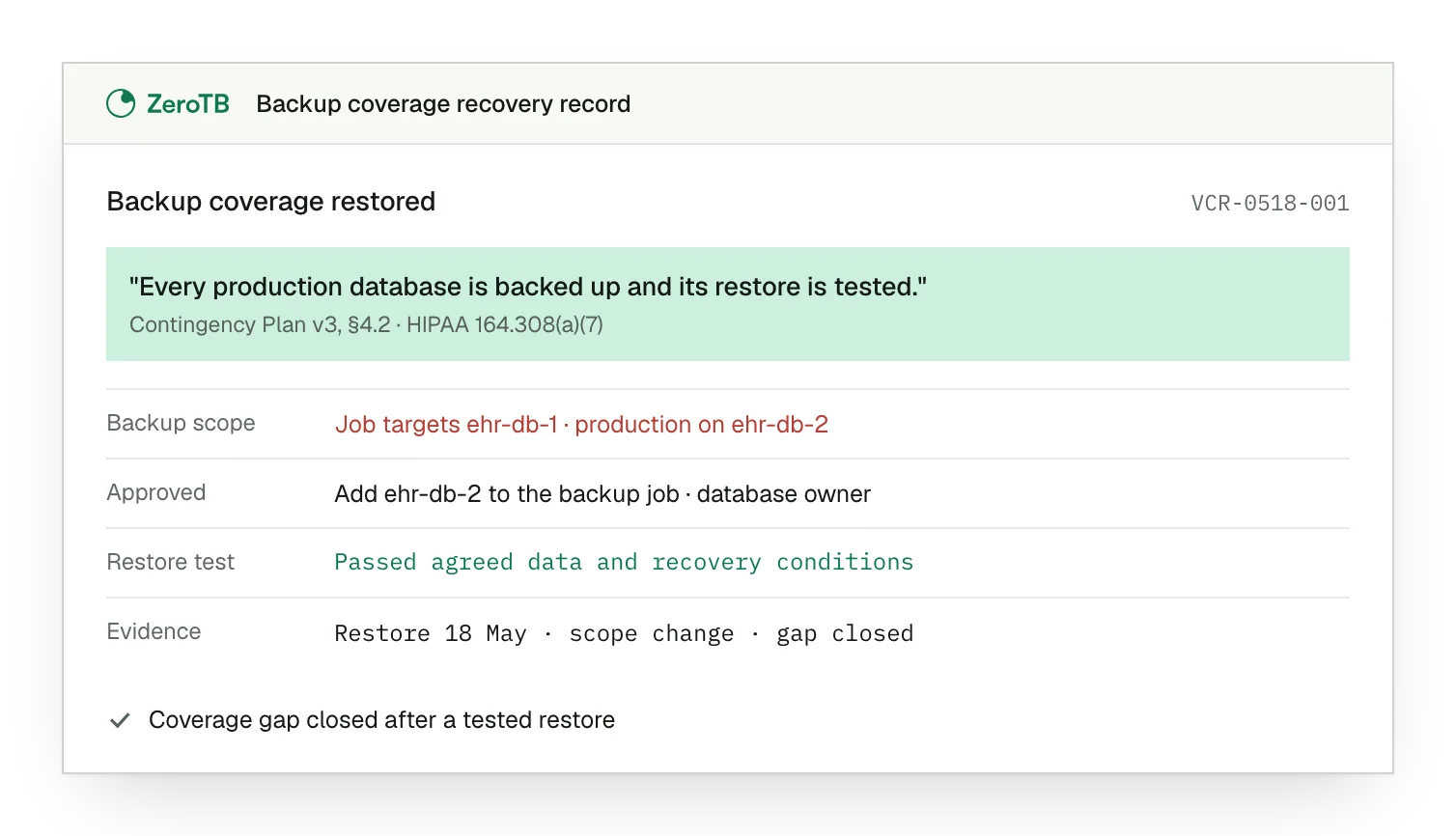
Missing production data. The backup targets the old database even though the inventory shows production has moved.
Approved scope change. The owner approves adding the database now used by production to the backup configuration.
Recovery test passed. The operator restores the captured data and checks it against the agreed recovery conditions.
Linked closure evidence. The record connects the corrected scope with its approval and the successful restore result.
Contingency plan review checklist
Compare the plan with the applications and ePHI currently in use, including changes since the last exercise.
Define the critical work, acceptable interruption and data needed to judge whether recovery succeeds.
Confirm that operators can reach the backups, keys, accounts and procedures under the planned outage conditions.
Repeat the relevant test after an approved change, retaining the failed and successful results together.
Agree who investigates changed scope and failed checks, and who updates the plan when systems change.
Sources
- eCFR, 45 CFR 164.308: Administrative safeguards, current text accessed November 2026.
- eCFR, 45 CFR 164.306: Security standards, general rules, current text accessed November 2026.
- eCFR, 45 CFR 164.316: Policies, procedures and documentation, current text accessed November 2026.
- HHS, Contingency planning newsletter, March 2018.
- NIST, SP 800-66r2: Implementing the HIPAA Security Rule, section 5.1.7, 2024.
- HHS, HIPAA audit protocol, updated July 2018.
Related pages
Administrative safeguards
Explore the standards that connect contingency planning with security responsibilities, risk management and evaluation.
HIPAA
See how administrative, physical and technical safeguards fit into the wider HIPAA Security Rule program.
Frameworks
Find related guidance for operating controls across HIPAA, SOC 2 and ISO 27001.
Start with the Pilot
Talk with our team about the recovery controls that need attention. The eight-week Pilot maps up to 25 commitments and takes two real control gaps through approved correction and verified restoration, with evidence of the work completed.