Home / Administrative safeguards
What does HIPAA 164.308(a)(5) require for security awareness and training?
Under HIPAA 164.308(a)(5), security awareness and training must include the whole workforce, including management. The program addresses security reminders, malicious software, log-in monitoring and password management through four addressable specifications. To review it, compare the assigned workforce and completed instruction with the procedures people use today.
A course can be complete while its password reset instructions lead to a service that has closed. The training record and the procedure have fallen out of step. Reviewing them together helps the program owner find what changed and who needs updated instruction.
Workforce coverage
The program must reach the entire workforce, including management. A completion percentage can hide people who never received an assignment. Compare the current workforce with the training population before using that percentage to judge coverage across the organization.
New starters, changed responsibilities and manager participation each need attention. A person may have a training account with the wrong material assigned. Record the relevant role and instruction together so the program owner can distinguish missing coverage from an overdue completion.
Addressable decisions
Each addressable specification needs a documented decision about how it applies in the organization's environment. Under 164.306(d), assess whether the safeguard is reasonable and appropriate, and implement it when it is. The decision should explain how the chosen approach protects electronic protected health information.
If implementing a specification is unreasonable or inappropriate, document the reason and use an equivalent alternative when reasonable and appropriate. Keep that assessment with the program's procedures. A reviewer can then understand the decision and what changed if the organization later adopts a different approach.
HIPAA password requirements
The password-management specification, 164.308(a)(5)(ii)(D), addresses creating, changing and protecting passwords. It does not prescribe a universal minimum length or fixed change interval. HIPAA password requirements leave those settings to procedures suited to the organization's environment and the risks to its information.
The settings and the training need to agree. If an application rejects passwords that a course describes as acceptable, someone must resolve the mismatch. The system owner can explain the enforced rule; the program owner can approve the revised instruction, including what to do about exposed credentials.
Password procedures in practice
Password instructions need to match the sign-in and recovery methods people actually use. A central work account and a separate application account may have different reset routes. Training should make those routes clear enough for workers to use the approved process.
Review the instructions alongside the current account procedures, including how a worker reports exposed credentials. A reset link can open successfully and still lead to a retired service. Check where the instruction takes the worker and who receives a request for help.
Security reminders
A security reminder should help a worker act on a current instruction. That might mean following a revised procedure or using a new reporting address. The message needs to reach the affected people and make the current instruction easy to find.
An annual course can support the program, with periodic updates between courses. Keep each update with its intended recipients and delivery date. If a group missed the message, the owner can arrange follow-up for that group and record the result alongside the original communication.
Malicious software procedures
Malicious software instruction should explain how workers recognize and report a possible problem. It also needs to reflect the organization's measures for preventing and detecting malicious software. People need to understand their role when a warning appears or a device behaves unexpectedly.
A general description of malware gives little help at that moment. The current procedure should identify the reporting route and the person responsible for the next action. Compare the training with that procedure so workers receive directions the security team can act on.
Log-in monitoring
Log-in monitoring requires a procedure for examining attempts and reporting discrepancies. Training needs to explain who does each part of that work. The person noticing an unfamiliar sign-in and the person investigating it need instructions that connect to the same reporting process.
A working address is only one part of that process. Someone must receive the report and have responsibility for acting on it. Send a test through the route described in the material, then check delivery with the assigned recipient. Record any broken handoff for correction.
Training after system changes
Completed training needs review when a system change affects its instructions. A new sign-in service can leave old reset guidance in place. A reassigned security role can make a listed contact obsolete. Workers may continue following the material until they receive an update.
Decide the extent of that update from the changed work. One revised procedure may need a focused message; several new responsibilities may need broader instruction. Identify the affected groups, record which version they receive and keep the earlier version for the completions already recorded.
Missed instruction and follow-up
An overdue training record should explain what still needs attention. A missing assignment, material that will not open and an unanswered reminder are different problems. Recording the reason helps the owner choose a correction and avoids sending the same reminder without resolving the obstacle.
ZeroTB's people-and-process work supports this follow-up by scheduling commitments, assigning responsible people, escalating overdue tasks and checking completion. Decisions about required instruction stay with the program owner. The resulting record gives that owner a way to review what happened to each identified gap.
Completion and verification
A completion record establishes that someone finished the assigned material. Its value depends on knowing which material that was and whether it matched the applicable procedure. A course result alone cannot establish that every reporting channel still works.
Use separate checks for separate questions. Compare recipients with the intended population to assess coverage, and test a reporting route to assess delivery. Keep any unresolved result visible. Closing a correction should depend on the checks agreed for that gap, with their dates and outcomes recorded.
Evidence retention
Required Security Rule documentation must be kept for six years under 164.316(b)(2). The period runs from creation or the date the documentation was last in effect, whichever is later. Replacing a procedure therefore requires attention to the old version and its dates.
An earlier completion needs the material that existed at the time. Keep historical procedures and course versions connected to the records that refer to them. If a file is overwritten with each revision, a reviewer may be unable to establish what a worker was taught.
Evidence for a training review
Keep the evidence connected so a reviewer can see who received the instruction and what happened when a gap was found.
| Requirement | What an auditor asks for | Where it comes from |
|---|---|---|
| Workforce coverage | Who needed training, including managers, and which instruction was assigned to each group | Current workforce lists checked against assignments, with the people missing from either list identified |
| Addressable decisions | Why each addressable safeguard was selected or an equivalent alternative was used in its place | The recorded assessment, the resulting procedure and the risks considered when making the decision |
| Current procedures | The instructions workers received for passwords, malicious software, log-in monitoring and periodic security updates | The approved procedures beside the course or message versions that explain them to workers |
| Completed instruction | Who completed each version of the instruction, when they completed it and who remains overdue | Completion records linked to the relevant material, with assigned follow-up for the remaining gaps |
| Corrected gaps | The gap identified, the decision to correct it and the checks that supported its closure | The action, approval and dated verification results kept together in a Verified Control Record |
Related framework requirements
| Framework | Control | What it covers |
|---|---|---|
| HIPAA | 164.308(a)(5) | A workforce-wide training program addressing reminders, malicious software, log-in monitoring and password management |
| SOC 2 | CC2.2 | Internal communication that gives people the information needed to perform their responsibilities for controls |
| ISO 27001 | A.6.3 | Security awareness, education and training appropriate to people's roles and the organization's policies |
Example of restoring current reporting instructions
A retired reporting mailbox leaves a gap even if the course completion records are current. This example follows its correction: the owner approves revised instructions, affected workers receive the update, and a test establishes whether reports reach the responsible security role.
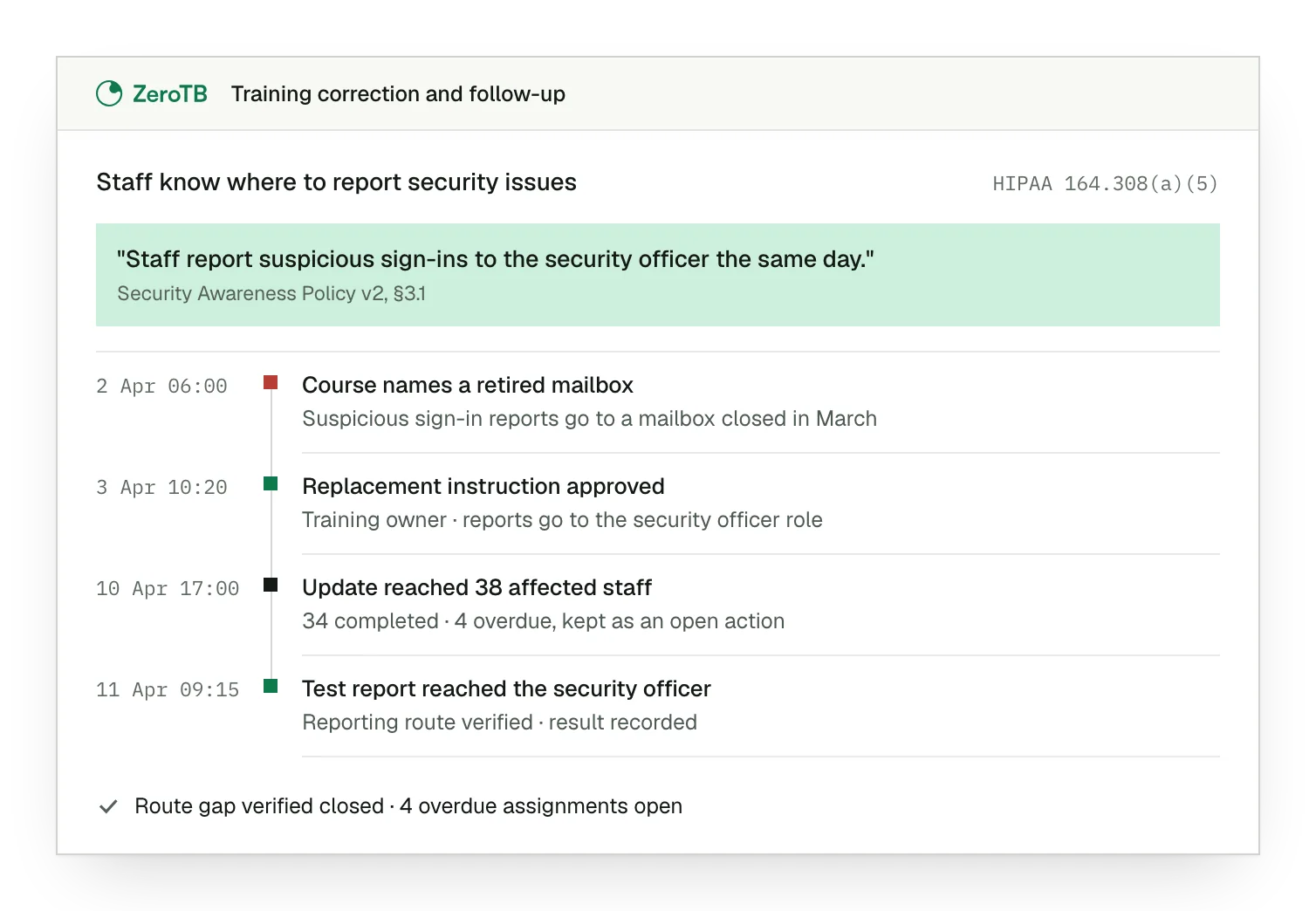
Obsolete reporting address. The old course gives a retired mailbox as the destination for suspicious sign-in reports.
Approved instruction update. The owner approves the new reporting address and the security role named in the revised instruction.
Affected workforce reached. The update reaches the affected group, with completed instruction recorded and overdue assignments left open.
Working reporting route. The reporting-route gap closes after a test report reaches its assigned recipient and the result is recorded.
Training review checklist
Look for workforce members missing from assignments, then check whether changed responsibilities require a different course or update.
Follow the password and reporting instructions as written, and compare monitoring responsibilities with the procedure in use.
Identify the affected material and recipients, then agree the revision and approval needed to resolve the recorded gap.
Decide what result will close each gap, and keep the dated check with the completed action and approval.
Sources
- eCFR, 45 CFR 164.308: Administrative safeguards, current text reviewed November 2026.
- eCFR, 45 CFR 164.306: Security standards, general rules, current text reviewed November 2026.
- HHS, HIPAA audit protocol, security awareness and training, July 2018 update.
- eCFR, 45 CFR 164.316: Policies, procedures and documentation, current text reviewed November 2026.
Related pages
Administrative safeguards
Place training alongside the other administrative standards that govern the security of electronic protected health information.
HIPAA
Explore the administrative, physical and technical safeguards that support the organization's wider HIPAA security program.
Frameworks
Find guidance on related controls and requirements across the frameworks that apply to the organization.
Start with the Pilot
Talk with our team about gaps in the controls your program depends on. The eight-week Pilot maps up to 25 commitments and takes two real control gaps through approved correction and verified restoration, with evidence of the results.