Home / Administrative safeguards
What does HIPAA 164.308(a)(1) require for security management?
HIPAA 164.308(a)(1) requires a security management process with four parts: risk analysis, risk management, sanctions and information system activity review. The analysis examines risks to electronic protected health information. The process must also put protective measures into operation, address workforce violations and use activity records to identify problems that need attention.
Completing an assessment leaves a practical question: which of its findings still need action? A healthtech team may have chosen an access restriction that has yet to reach the affected system. Following that decision through to a working safeguard is part of managing the risk.
Four required specifications
Security management under 45 CFR 164.308(a)(1) includes four required specifications. Risk analysis assesses potential harm to ePHI. Risk management puts measures in place to reduce that harm. A sanction policy governs workforce violations, and activity review examines what happens in the systems.
The requirement applies to covered entities and business associates. Completing the analysis leaves work under the other specifications: implementing measures, applying appropriate sanctions and regularly reviewing activity. This standard forms part of the administrative safeguards that govern the broader security program.
Scope of the analysis
The scope of a HIPAA security risk analysis is all electronic protected health information the organization creates, receives, maintains or transmits. This is commonly abbreviated to ePHI. Where a copy resides matters, whether it is in an application, export, backup, device or supplier system.
An inventory may list the application without describing every transfer it makes. System owners can help identify those transfers and the locations receiving the information. Including them gives the assessment a basis for examining risks that an application-only inventory could miss.
Threats and vulnerabilities
The analysis needs to explain how a threat could exploit a weakness and harm ePHI. Technical scans help identify some weaknesses. People, procedures and environmental conditions also affect the confidentiality, integrity and availability of the information, so the analysis needs evidence beyond scan results.
How likely is the harm, and what would its impact be? Existing safeguards affect both judgments. A backup, for instance, helps with data loss only if restoration works. HHS guidance allows different analysis methods while describing the elements each must address.
Risk decisions
Risk management turns assessed risks into measures that protect the affected information. The rule calls for reducing risks and vulnerabilities to a reasonable and appropriate level. The decision depends on the organization, the risk and the safeguards available in its environment.
A treatment decision should explain which measure will reduce the risk, how it protects the information and who can implement it. Where work takes time, the decision must address exposure during that period. A planned correction leaves an open risk until the measure operates and its effect is understood.
Changes after assessment
New uses of ePHI can outgrow an assessment's scope. An export service added later may send information to a destination whose permissions have never been examined. The original application's assessment does not explain the risks at that new destination.
The service change gives the risk owner a reason to revisit the analysis. Its existing findings can remain useful, while the new information flow needs assessment. Supplier changes and new applications can require similar attention when they alter where ePHI goes or how it is protected.
Workforce sanctions
The sanction policy governs the response when workforce members fail to follow security policies and procedures. HIPAA requires appropriate sanctions for those failures. The people applying the policy need enough information about the violation to decide the response under that policy.
A technical correction can resolve the unsafe condition while leaving a workforce matter to address. Removing an unauthorized permission, for example, does not decide the response to the conduct that created it. Authorized people make that decision and handle the records through the workforce process.
Activity reviews
Regular review of system activity is a separate duty under this standard. Audit logs, access reports and security incident tracking reports are examples of the records it covers. The person reviewing them needs to determine what warrants investigation and what action should follow.
A review is easier to examine later when its record states the period covered, findings and response. Missing logs limit what can be established for that period. The related audit controls standard concerns the mechanisms that supply those activity records.
Approved corrections
Approval needs a specific proposed change. The owner should be able to see which condition is unsafe, what the correction will do and which access or service must remain available. An access restriction, for instance, needs to preserve the approved use of the system.
ZeroTB connects that work with the existing GRC program: check the approved commitment, draft the correction, obtain human approval, verify the changed state and retain a Verified Control Record. The organization decides its risk and policy questions, including whether an exception is justified.
Verification and closure
The verification result determines whether a correction has achieved its purpose. For access changes, check the route that should be blocked and the one that must remain available. The change record alone cannot establish either result; both need observations from the affected system.
A failed test means more work is needed. An unavailable observation leaves the result unknown. When both tests succeed, retain their dates and results with the approved action. A reviewer can then follow the evidence that supported closing this particular gap.
Continuing review
Risk analysis needs review when the environment changes, as well as at planned intervals. HHS specifies no single interval for every organization. A review date helps schedule the work, but a new ePHI service or incident may require an earlier assessment.
The extent of that assessment depends on what changed. A changed setting can be compared with the existing decision. A new information flow may require extending the scope and choosing additional safeguards. In either case, the review should test whether the earlier conclusions still apply.
Evidence retention
Required documentation has a six-year retention rule under 45 CFR 164.316. Count from the date of creation or the last date the document was in effect, whichever is later. Policies, procedures and required records need to remain available under that rule.
Raw system logs have no universal retention period set by this documentation provision. Their purpose and applicable obligations inform the retention decision. Keep the assessment and correction records connected to the relevant evidence so a later reviewer can understand both the decision and its outcome.
Security management evidence
The evidence should show what was assessed, what was decided and what happened after each decision.
| Requirement | What an auditor asks for | Where it comes from |
|---|---|---|
| Risk analysis | Scope of the ePHI assessed, the risk findings and the basis for their ratings | Data-flow records, system inventories and the documented analysis |
| Risk management | Selected safeguards, the reasons for choosing them and evidence that they operate | Treatment decisions, assigned actions and records from the affected systems |
| Sanction policy | The workforce sanction policy and evidence of its application to violations | Approved workforce policies and authorized records of responses to violations |
| Activity review | The period and activity reviewed, findings recorded and follow-up actions | Audit logs, access reports, incident reports and dated review records |
| Verified correction | The approved correction and dated test results that support closing the gap | Change approvals and observations linked in the control record |
Framework control mapping
| Framework | Control | What it covers |
|---|---|---|
| HIPAA | 45 CFR 164.308(a)(1) | Four connected duties addressing ePHI risks, safeguards, workforce violations and review of system activity |
| SOC 2 | CC3.2 | Identification and assessment of risks that affect the organization's ability to meet its objectives |
| ISO 27001 | A.5.7 | Gathering and analyzing information about threats so that security decisions can take account of them |
Example of restoring export access
In this hypothetical example, an export service writes ePHI to a new destination. A review finds that an extra account group can read those files. The owner approves removing that permission, with verification covering both the blocked group and the service that still needs access.
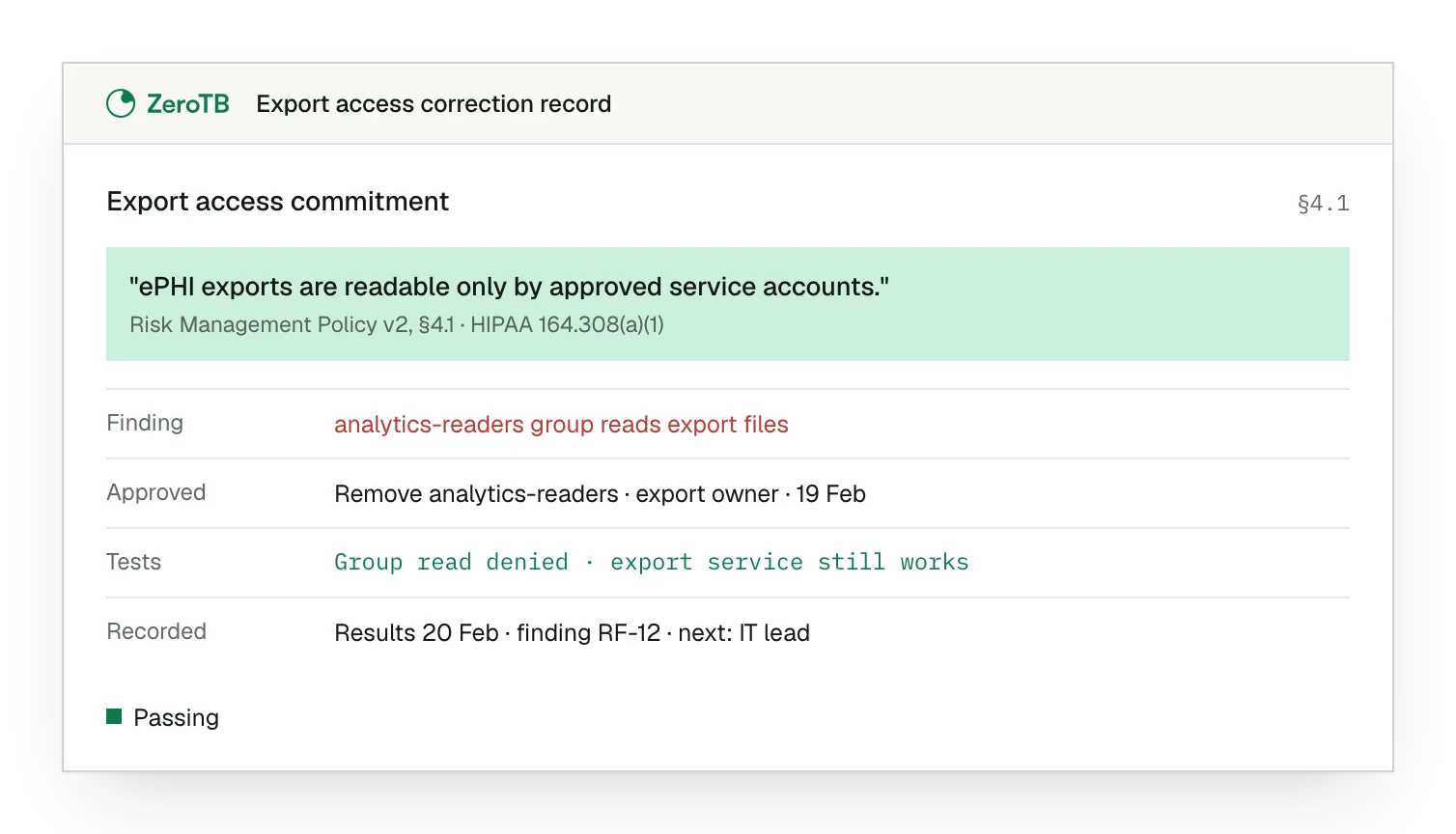
Identified exposure. The finding identifies the extra group and the export files it can currently read.
Approved restriction. The proposed permission change has approval from the owner responsible for the export destination.
Tested access. The group loses read access, while a separate test confirms the approved service works.
Recorded result. Dated test results accompany the approved action, with the next check assigned to an owner.
Security management checklist
Compare the analysis with current ePHI locations and transfers, including exports and supplier systems added since the assessment.
Check that each selected safeguard has a clear purpose, an owner and a way to establish whether it works.
Review how the sanction policy operates and how activity findings reach the people responsible for deciding the response.
Use fresh observations to judge the correction, including whether necessary access or service remains available after the change.
Connect the risk, decision, action and result, then identify the conditions that should trigger another review.
Sources
- eCFR, 45 CFR 164.308: Administrative safeguards, current text accessed November 4, 2026.
- HHS, Guidance on risk analysis requirements under the HIPAA Security Rule, accessed November 4, 2026.
- eCFR, 45 CFR 164.306: Security standards, general rules, current text accessed November 4, 2026.
- eCFR, 45 CFR 164.316: Policies, procedures and documentation, current text accessed November 4, 2026.
- HHS, HIPAA audit protocol, accessed November 4, 2026.
Related pages
HIPAA Security Rule
Explore the safeguard groups that connect this standard to the rest of the security program.
Compliance frameworks
Find guidance on the other frameworks supported by the controls in a shared security program.
Healthtech compliance
See how ongoing control work supports healthtech teams as their systems and data flows change.
Start with the Pilot
Our eight-week Pilot maps up to 25 commitments and takes two real control gaps through approved correction and verified restoration. Talk with our team about how that work could support the safeguards in your HIPAA program.