Home / Administrative safeguards
What does HIPAA evaluation under 45 CFR 164.308(a)(8) require?
Under HIPAA, organizations periodically evaluate how their technical and nontechnical safeguards meet the Security Rule. They also evaluate changes that affect the security of electronic protected health information (ePHI). Start with the current environment, examine how its safeguards operate, and retain the findings with decisions and evidence of corrective work.
An evaluation from before a migration may say little about the systems now handling health information. The next review needs to account for that change. Earlier findings remain useful when the evaluator can follow them through to the safeguards operating today.
Evaluation scope
A HIPAA evaluation asks how well the organization's security policies and procedures meet the Security Rule. That includes administrative, physical and technical safeguards. Reviewing cloud settings addresses part of the question; the evaluator also examines the work people do to protect ePHI.
Risk analysis supplies evidence about threats and vulnerabilities. The evaluation uses that evidence to assess the safeguards the organization has put in place. Each assessment needs its own conclusion, even where their records overlap. The HIPAA framework guide explains how both fit into the program.
Changes since the last review
The scope of an earlier evaluation can become outdated while its findings still appear current. After a migration, ePHI may sit in a different environment with new administrators. Decisions about recovery or access may also have moved to another team.
A change in working practice can have the same effect. For example, a new support procedure may let another team handle health information through an existing application. The evaluator needs to compare those arrangements with the ones examined in the previous review.
Evaluation timing
Periodic evaluation needs a schedule and a way to respond to changes affecting ePHI security. Section 164.308(a)(8) does not set a universal annual interval. A calendar review alone can leave a consequential change unexamined until the next scheduled assessment.
The evaluation process should explain which changes trigger review and when that review occurs. Planned changes allow an assessment of the intended safeguards before implementation, followed by checks of actual operation. An unexpected change may require the evaluator to revisit an earlier conclusion immediately.
Evaluator selection
HHS allows an organization to evaluate its own safeguards or use an external evaluator. The team conducting the review needs enough technical and operational knowledge to judge the evidence. It also needs to report findings objectively, including problems with established practices.
Internal reviewers can explain why a procedure exists and how it has changed. An external evaluator may supply missing expertise or a more independent view. System owners remain useful sources in either case, particularly when written procedures leave the actual working arrangements unclear.
Technical evidence
Technical evidence should show whether a safeguard works in the environment under review. A configuration export describes settings at a particular time. A test result can show what happened when the system performed the operation that the safeguard is intended to protect.
The reviewer needs the system, date and scope behind each result. A successful check against an old environment says little about its replacement. Where the evaluation uses samples, the record should identify what was tested so another reviewer can understand the conclusion's reach.
Nontechnical evidence
Nontechnical review connects the written policy to the work people actually perform. The evaluator examines procedures and work records, then asks the responsible staff how those procedures operate. This can expose differences between the documented process and current practice.
For example, a recovery test might succeed while the escalation procedure still directs staff to a former service owner. The test establishes that recovery worked on that occasion. The procedure review reveals a responsibility that needs to be corrected before the next incident.
Assessment criteria
A useful evaluation states what evidence would support each conclusion before the reviewer judges the result. The criteria connect a safeguard's intended purpose to an observable condition or practice. This gives the reviewer a consistent basis for explaining the finding.
When evidence is missing, the assessment needs to show what remains unknown. A check that never ran cannot establish that a safeguard worked. Recording that distinction helps management decide whether the next action is to gather evidence, correct a control or examine the scope again.
Finding ownership
Each finding needs a decision about the affected safeguard and the work required to correct it. The evaluation should identify the gap, its effect on ePHI security and the person responsible for the response. Management review connects those findings to decisions about corrective work.
A proposed correction needs enough detail for the system or procedure owner to judge its effect. Some findings require a configuration change; others require revised responsibilities or instructions. Keeping the response linked to the finding lets the evaluator follow progress without reconstructing separate conversations.
Verified corrections
A completed change needs a fresh check before the finding can be closed. The check should test the condition that failed in the affected environment. The record shows when the change was made and when the result was verified.
For a procedure gap, verification may involve showing that the responsible team can carry out the revised steps. For a technical gap, it may require a system test. The Verified Control Record retains the commitment, observed state, approved action and verification result for a restored control.
Evidence between evaluations
The next evaluator can use monitoring history to see how a safeguard behaved after its last review. Dates matter: they show whether a failed check preceded a correction, and whether later checks found the same problem again. A current passing result alone leaves that history unexplained.
ZeroTB's continuous control monitoring checks commitments, prepares fixes for approval and verifies the resulting state. The evaluator can use the records of that work when assessing the relevant safeguards. Interviews, procedure reviews and other assessment work supply the evidence needed for the rest of the evaluation.
Evaluation conclusions
A reader of the evaluation report should be able to follow the evidence behind its conclusions. The report identifies the environment examined, the methods used and who participated. It also explains any exclusions that limit what the assessment can establish.
Some corrective work may remain open when the evaluation ends. The report should make those findings visible alongside the corrections already verified. Later results can be linked to the original finding, so management can see progress without losing the record of what the evaluator found.
Evaluation evidence
Keep the evaluation decision and the evidence behind it together so a reviewer can follow each finding.
| Requirement | What an auditor asks for | Where it comes from |
|---|---|---|
| Current evaluation scope | Systems, procedures and changes affecting the ePHI safeguards examined | Evaluation plan, system inventory and relevant change records |
| Defined evaluation method | How the review runs, who participates and how management reviews findings | Evaluation procedures, assigned responsibilities and review approvals |
| Technical assessment | Dated observations and tests supporting conclusions about implemented safeguards | System settings, logs and test results linked to the evaluated environment |
| Nontechnical assessment | Evidence that policies, responsibilities and working procedures were examined | Policy reviews, interviews and records of the procedures performed |
| Findings and response | Identified gaps, risk decisions, corrective work and evidence supporting closure | Evaluation report, response plan, approvals and verification records |
Related framework requirements
| Framework | Control | What it covers |
|---|---|---|
| HIPAA | 45 CFR 164.308(a)(8) | Technical and nontechnical evaluation of security policies and procedures against the Security Rule |
| SOC 2 | CC4.1 | Ongoing or separate evaluations of whether internal controls are present and functioning |
| ISO 27001 | A.5.35 | Independent review of the approach to information security and its implementation |
Example of updating an evaluation after migration
After a hosting migration, the evaluation needs evidence from the new environment. In this example, backups are running, but nobody has tested recovery there. The evaluator records the missing test as a finding and can later follow it through to a successful restore.
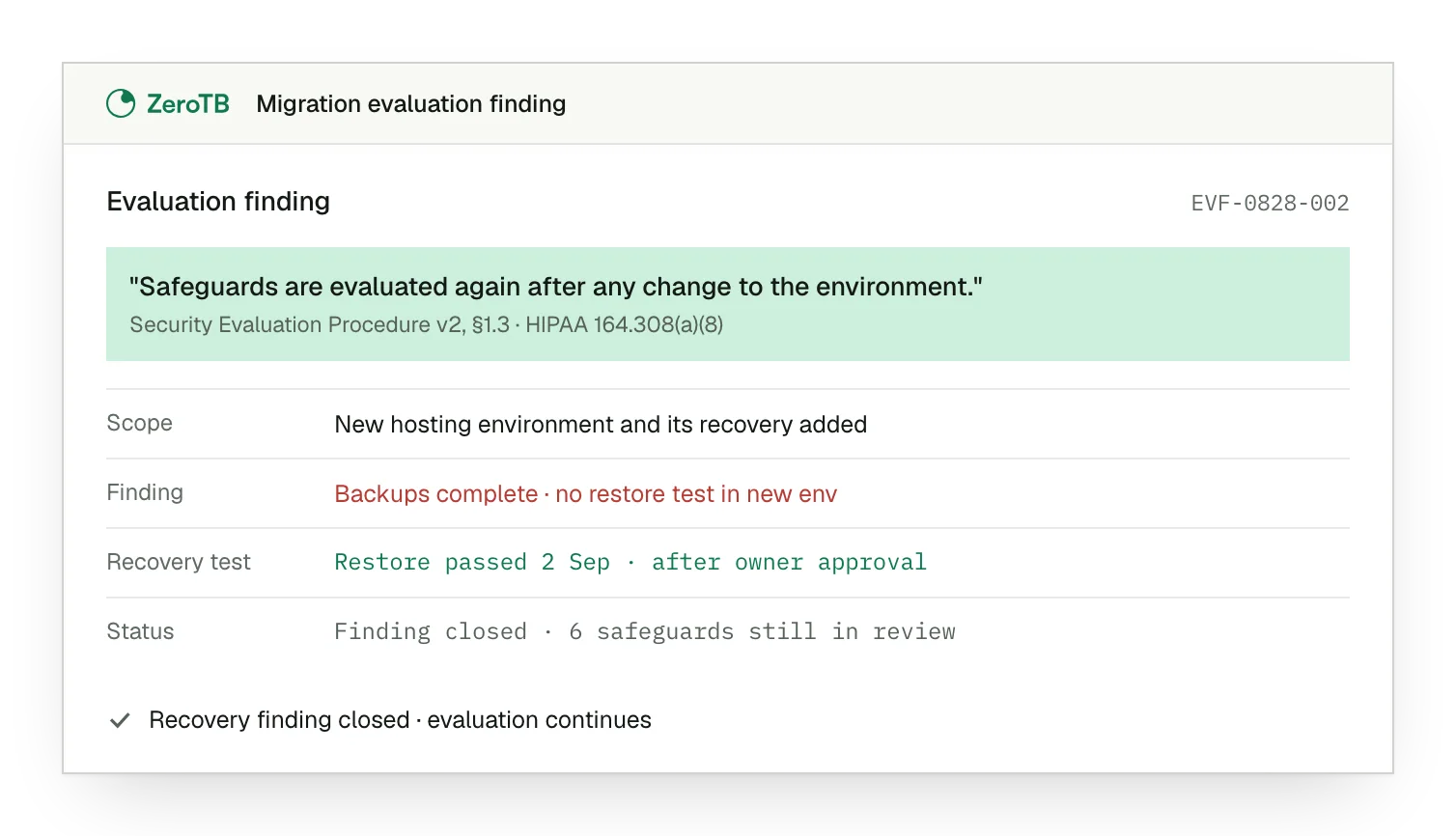
Changed review scope. The reviewer adds the new environment and its recovery arrangements to the evaluation scope.
Missing recovery evidence. The backup records show completed jobs, with no restore test for the new environment.
Verified recovery test. After owner approval, the selected backup is restored successfully and the test result is dated.
Separate review status. The evaluator closes the recovery finding and continues examining the other safeguards still under review.
Evaluation review checklist
Identify which systems and procedures have changed since the evaluation, and whether those changes affect ePHI security.
Look for a regular evaluation schedule and a process for deciding when changes need an earlier review.
Read the technical results alongside the policy and procedure evidence used to reach each evaluation conclusion.
Separate findings awaiting a decision from those awaiting corrective work or a check of the result.
Check that the next evaluator can trace each finding to current observations and any verified corrective work.
Sources
- eCFR, 45 CFR 164.308: Administrative safeguards, current text checked November 4, 2026.
- HHS, HIPAA audit protocol, evaluation section, 2018 update.
- NIST, SP 800-66 Rev. 2: Implementing the HIPAA Security Rule, section 5.1.8, 2024.
- HHS, Security Rule evaluation and certification FAQ, 2013 review.
Related pages
Administrative safeguards
Explore the standards governing security management, workforce responsibilities and other administrative protections for ePHI.
HIPAA
See how the administrative, physical and technical safeguards fit within the wider Security Rule.
Compliance frameworks
Find related guidance for the frameworks supported by the controls your organization operates.
Start with the Pilot
Talk with our team about the controls behind your evaluation findings. The eight-week Pilot maps up to 25 commitments and takes two real control gaps through approved correction and verified restoration, with evidence of the results.