Under SOC 2 CC7.3, a company assesses security events to decide whether an incident has affected its objectives. The person assessing an event needs to explain its effect and decide the next action. Retain that decision with its evidence, including the reason for escalating the event or closing it.
An acknowledgment in the security queue can leave an important question unanswered: what happened after someone received the alert? CC7.3 addresses that assessment within SOC 2 CC7. The decision and its supporting evidence tell the next person why the event needs attention or can be closed.
Event assessment within CC7
CC7.3 addresses the decision about whether a security event has become an incident affecting the company's objectives. CC7.2 monitoring supplies events for assessment. The assessor determines their significance and whether they require action through the incident process.
An alert acknowledgment shows that someone received the event. The assessment needs to explain what that person concluded and why. This distinction matters when a queue shows completed tasks but the team cannot identify which events required a response or who received them.
Incident criteria and affected objectives
The assessor must connect the activity to an effect on the service or its information. That connection explains why an event meets the company's incident criteria. It also gives the response team a reason for the severity assigned to it and the priority it receives.
NIST's incident response guidance describes estimating impact and scope, then using defined criteria to decide whether an incident occurred. Apply this to the company's own objectives when recording a CC7.3 assessment. If new information changes the decision, preserve the earlier conclusion and explain the revision.
Context for the decision
An assessor needs enough context to explain what the event means in the affected system. Useful context includes the account, its permissions, the time of the activity and the information involved. Related observations help the assessor test the initial explanation.
For example, an unexpected privileged sign-in may need comparison with the account owner's activity and the actions taken after entry. Keep the observations separate from assumptions about who used the account. This lets the next reviewer see which parts of the explanation still need investigation.
Assessment ownership and escalation
An event needs an assessor who can make the decision or reach someone with that authority. A routing rule may deliver an alert to a shared queue while leaving that responsibility unclear. The process needs to identify who accepts the assessment and who covers their absence.
Define when an unanswered or unresolved event moves to another decision maker. Use the response expectations in the approved process, including the treatment of urgent events. A change of owner should preserve the investigation and the next action so that reassignment does not restart the assessment.
Decisions with incomplete evidence
Missing evidence leaves an assessment unresolved and may justify escalation. A disconnected source or unavailable log can prevent the assessor from understanding the event's effect. Record what is missing, how it limits the conclusion and who will obtain or investigate the remaining information.
Possible serious effects can warrant a response while the investigation continues. The decision maker needs to see both the concern and the uncertainty. Control checks should preserve that unresolved state and its next action until the assessor has enough information to support a decision.
Reasons for closing an event
Closing an event requires a reason that another reviewer can follow. If the assessor concludes that the activity was expected or benign, the record should connect that conclusion to the observations reviewed. A status change alone leaves the basis for closure unexplained.
An approved activity record might explain an unusual sign-in, but the explanation must match the account, time and activity under review. Retain the supporting reference and the assessor's decision. If later observations contradict that explanation, the team can reopen the assessment with its earlier reasoning intact.
Handoff to incident response
An incident decision should give the response owner enough information to continue the work. Link the event assessment to the response record, including the affected systems, known impact, unresolved questions and assigned severity. The receiving team can then investigate from the same starting point.
CC7.4 incident response covers the work that follows the incident decision. Completing the assessment does not establish that the incident is resolved. Keep the response owner and response status visible so that closing an assessment task cannot hide an incident still being handled.
Assessment drift after the audit
A working alert source can feed an assessment process that has lost its owner. Teams change, queues move and escalation contacts leave. The original policy may still describe a complete process even when current events stop before anyone records an impact decision.
Review actual event histories to find where this happens. Repeated transfers, overdue assessments and closures without reasons point to different failures. Identify the failed step before changing the process; a new routing rule will have little effect if the assigned assessor lacks authority to decide.
Repair of the assessment process
Identify where the assessment stopped before proposing a repair. The approved commitment establishes what should have happened at that step. A queue assignment, escalation route or decision field may need correction; the responsible owner approves the proposed change with that specific failure in view.
The repair then needs a test: did an event reach the assessor and receive a recorded decision? Keep the result beside the original gap and approval. This is the work ZeroTB carries through to a Verified Control Record, giving the owner evidence of the correction's result.
Evidence across the review period
A reviewer needs to see how the assessment process operated over time. Event histories explain individual decisions; a repair record explains how a process failure was corrected. Keep both connected so the reviewer can distinguish an incident investigation from work to restore the assessment control.
Preserve the decision rules that applied when an event was assessed, including subsequent approved changes. Continue checks after a repair, with an owner for further failures. A successful test establishes that the repaired route worked at that point; later event records show whether it continued to work.
Evidence for CC7.3
The evidence should connect the assessment rule to actual decisions and the action each decision triggered.
| Requirement | What an auditor asks for | Where it comes from |
|---|---|---|
| Defined assessment process | Incident criteria, decision authority and escalation expectations for the systems within scope | Approved procedures and the ownership records used by the assessment team |
| Event context | The observed activity, affected systems and information used to judge its possible impact | Relevant logs, account records and investigation notes linked to the event |
| Supported decision | The incident or closure decision, its reason, severity where applicable and the decision maker | Dated assessment records with the observations that support each conclusion |
| Response handoff | The next action and responsible team for events that require an incident response | Linked response records showing the assessment received and the assigned response owner |
| Verified process repair | The assessment gap, approved correction and evidence that the repaired step worked | Change approval and test results retained with the Verified Control Record |
Related framework requirements
| Framework | Control | What it covers |
|---|---|---|
| SOC 2 | CC7.3 | Assessment of security events against company objectives and the decision about whether an incident occurred |
| ISO 27001 | A.5.25 | Assessment of information security events and decisions about which qualify as information security incidents |
| HIPAA | 164.308(a)(6) | Procedures for suspected or known security incidents, including response, mitigation and documentation within HIPAA's scope |
Example of restoring event assessment
The repair in this example restores the route from an alert to an assessor. After a queue change, a privileged sign-in event has no assigned owner. Correcting the assignment gets the assessment moving; the incident it identifies still needs a response.
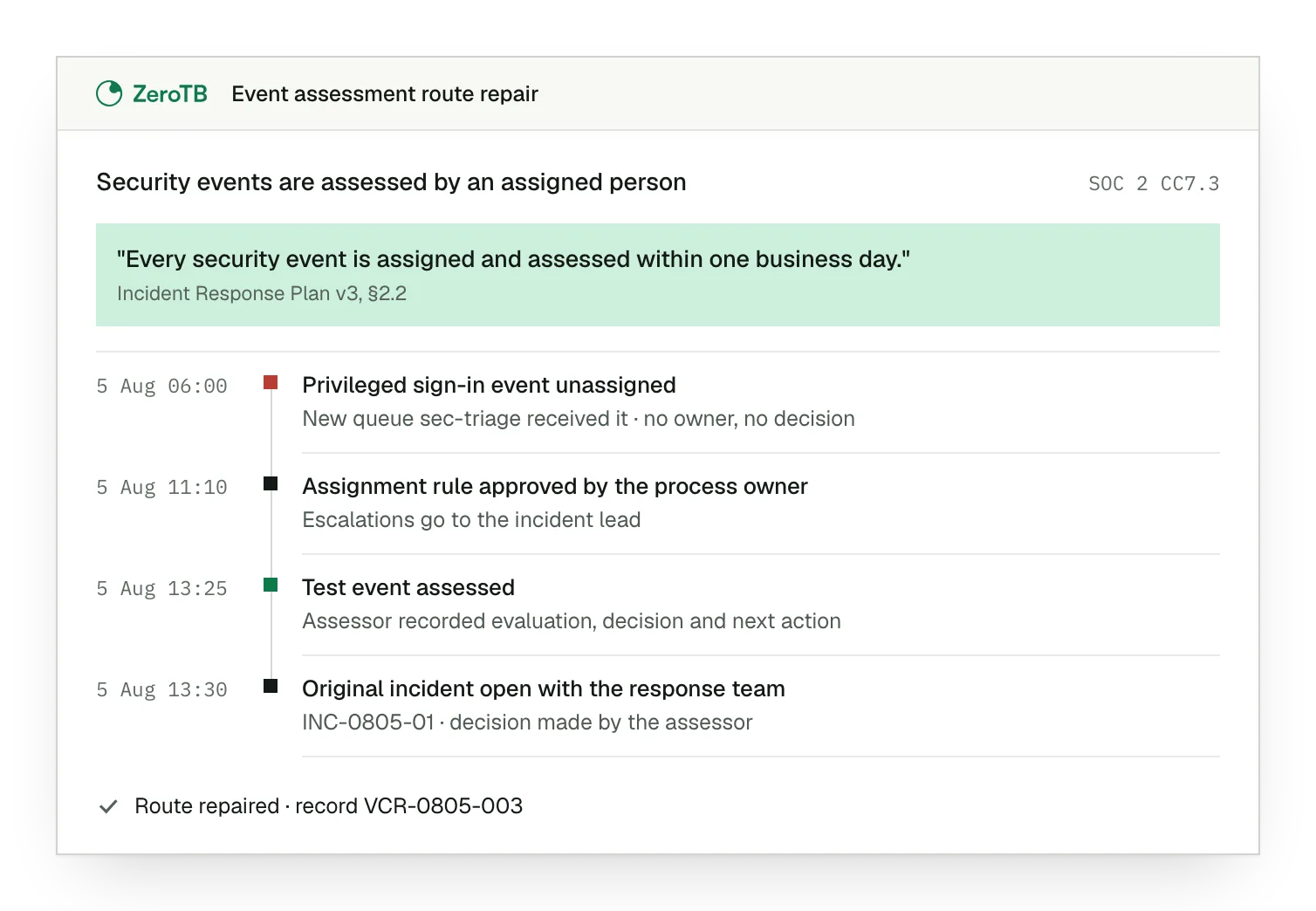
Missed assessment. The replacement queue receives the event, which remains unassigned and has no recorded assessment decision.
Approved routing change. The process owner approves the new assignment rule and confirms who receives escalations.
Tested decision path. An assessor receives the test event and records the evaluation, decision and next action.
Separate incident status. The repair passes its test, and the original incident stays open with the response team.
Event assessment review checklist
Read the approved rule for assessing events, including the incident criteria and the conditions for escalation.
Follow a recorded event from arrival to decision. Check whether each transfer left someone responsible for the assessment.
Look for the evidence the assessor used and their reason for closing the event or declaring an incident.
Send a test event through the corrected route and check that the assessor records a decision and next action.
Keep the event history linked to the repair evidence. Check that an open incident still shows its response owner.
Sources
- AICPA & CIMA, 2017 Trust Services Criteria with revised points of focus, 2022 revision.
- NIST, SP 800-61r3: Incident response recommendations and considerations for cybersecurity risk management, 2025, adverse event analysis.
- HHS, Security incident obligations for cloud service providers, 2016.
- ZeroTB, SOC 2 compliance automation with human approval, 2026.
Related pages
SOC 2 criteria
Explore the criteria surrounding event assessment and their role in the wider SOC 2 program.
Compliance frameworks
Find guidance on related requirements across the frameworks that apply to your systems and information.
Control operations
See how approved commitments become checks, corrections and evidence of controls operating between audits.
Start with the Pilot
Talk with our team about gaps in event assessment. The eight-week Pilot maps up to 25 commitments and takes two real control gaps through approved correction and verified restoration, with a record of the work and its results.