Control checks show whether an IT system or process meets a requirement at the time it is checked. Keeping IT controls working also requires a response to failed checks: someone approves the repair, and a fresh test establishes whether it worked. Keep those decisions and results with the evidence.
The audit is complete, but engineering has since added a repository and moved its reviewers to another team. The old evidence describes an earlier arrangement. A useful check follows those changes so the team can find a gap while someone still has time to correct it.
The requirement behind the check
A check needs a rule precise enough to test. A commitment to review production changes, for instance, needs a defined set of repositories and an approval requirement. Otherwise, two reviewers can examine the same change and reach different conclusions about whether it passed.
The observation supplies the other half of that comparison. It identifies the change, its repository, the approval and when each occurred. Keeping these details with the rule lets a reviewer follow the conclusion without reconstructing which requirement applied when the check ran.
Control types and their purpose
Technical controls use systems to apply or check a security rule. A required review setting is one example: it prevents a change from proceeding without approval. IT security controls also include the human procedures and physical protections that keep systems and information secure.
Detective controls find events or conditions that need a response. Checking for changes that bypassed approval is detective work, even when software performs it. The categories overlap because one describes the means of protection and the other describes what the control does.
IT general controls
IT general controls, usually shortened to ITGCs, govern access, changes and the operation of systems. Access administration, change management and backup operations fall within this work. Each needs a procedure that people can perform and evidence that shows whether the intended activity occurred.
An ITGC change management test follows the change through review, testing and deployment. The configured review rule explains the expected protection. The approval and deployment records help establish whether that protection held for the changes examined, including any exceptions permitted by the approved process.
Checks after system changes
Checks can miss a failure when their list of systems falls behind the work. Consider a new production repository: the existing repositories still pass, but nobody has added the new one to the check. The results describe only the older set.
Changes therefore need a review of check coverage as well as settings. The observation date matters for the same reason: a result from before the change describes an earlier state. If the source becomes inaccessible, an unknown or disconnected result makes that loss of visibility apparent.
Detective controls between audits
Detective controls need a schedule that leaves time to act on a failure before the next audit. When gaps appear weeks after a change, examine the interval between observations and the time between detection and investigation. Either delay can leave a failure unresolved.
Frequent automated checks suit changing settings with reliable data sources. Scheduled human activities need checks of their completion and outcome. NIST's continuous monitoring guidance connects ongoing visibility into control effectiveness with timely risk response. The appropriate schedule depends on the control and its risk.
Ownership after a reorganization
An engineering reorganization changes who can make a control work. A repository may still name reviewers from a former team. Failed checks may reach a mailbox that remains active even though its recipients have handed responsibility for the system to someone else.
The transition needs an owner decision about review, exceptions and repairs. Testing can then establish whether the new arrangements reach the right people and permit the required approvals. Keeping that decision with the control gives the next reviewer a reason for the changed assignments.
Control testing in audits
An audit test asks whether the evidence supports a particular control objective. The method depends on what the assessor needs to establish. NIST's assessment guidance describes examination, interviews and testing, covering records, the people doing the work and the behavior of the control.
A screenshot can show a setting at one moment. A ticket can explain who approved work and why. Automated checks add repeated observations. These sources answer different questions, so the assessor considers their scope and timing together when deciding what the evidence establishes.
Evidence across the operating period
Evidence for a year of operation needs a history of checks, changes and responses across that period. Retaining only the latest passing result loses the earlier failures and repairs. Dated records let the reviewer follow when a control changed and how the team responded.
That history also needs to show missing observations and changes in coverage. Repeated passes describe the conditions checked at those times; the interval between checks limits what they establish. The assessor decides whether the methods and retained evidence support the conclusion required for the audit.
Compliance across frameworks
One control can support several frameworks when the evidence covers each requirement's scope. IT compliance work can then reuse relevant observations while preserving the reason each requirement applies. The framework library connects framework-specific guidance to the systems and activities beneath it.
For a fintech with SOC 2 and PCI obligations, a shared access control may contribute to both programs. Each program still needs its own scope and assessment requirements. Matching control descriptions alone do not establish that different applications meet the requirement.
Verified closure of a gap
A compliance gap closes when a fresh check establishes that the approved correction restored the required condition. The response needs an owner and an approved action. After that action, verification tests the resulting state against the commitment and preserves the evidence used to close it.
This is the work ZeroTB carries through in its control operations process. The Verified Control Record keeps the commitment, before-and-after state, action, approval and verification together. A later reviewer can understand why the team closed the gap and what the final check established.
Example of restoring required reviews
A new production repository can miss the review rule that applies to the rest of the engineering team. In this example, a control check finds the missing requirement. The repair record follows the approved correction through a fresh test of the repository's protection.
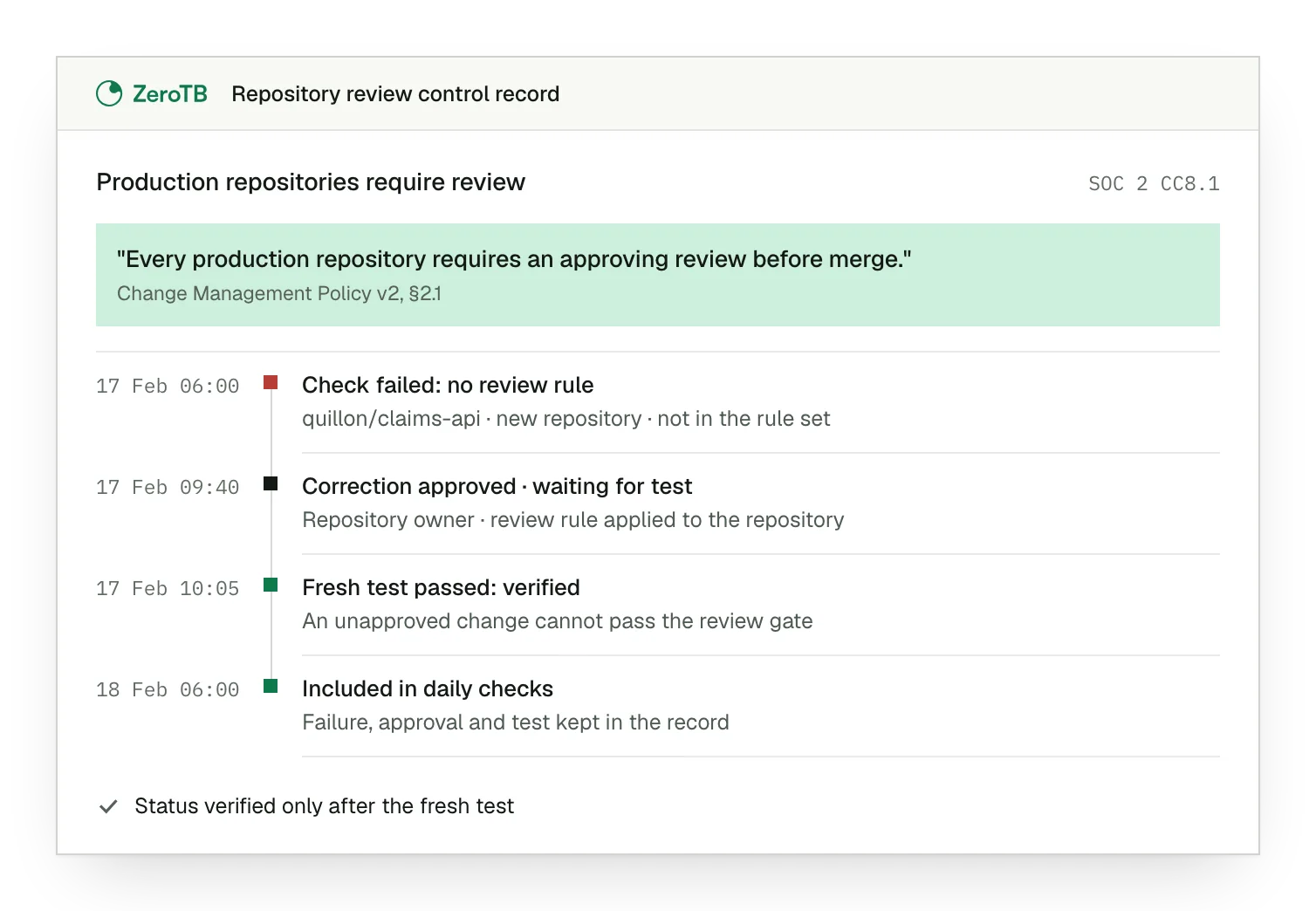
Missing review requirement. The new repository allows changes without the approval required by the company's change policy.
Approved rule change. The repository owner approves a correction that applies the required review rule to this repository.
Verified review protection. A fresh test confirms that an unapproved change cannot pass the required review gate.
Retained check history. The record keeps the original failure, approval and verification, with the repository included in subsequent checks.
Control check review checklist
Agree the intended condition, covered systems and permitted exceptions so the check can produce an interpretable result.
Decide whether the source, timing and coverage can establish the condition, including what an unavailable observation means.
Confirm who can authorize a repair or exception, particularly where a reorganization has changed system responsibilities.
Define the result that permits closure and the evidence that must accompany the approved correction and fresh check.
Sources
- NIST, SP 800-53A Rev. 5: Assessing Security and Privacy Controls in Information Systems and Organizations, 2022; release update 2025.
- NIST, SP 800-137: Information Security Continuous Monitoring, 2011.
- ZeroTB, Continuous control monitoring, 2026.
Related pages
Coding-agent compliance
Follow how control checks and approved repairs apply when coding agents change code and infrastructure.
Fintech controls
See how ongoing control operations support fintech teams managing requirements across changing systems and responsibilities.
Verified Control Record
Examine the evidence retained when an approved repair restores a control to its required state.
Start with the Pilot
Talk with our team about the controls that keep failing or are difficult to check. The eight-week Pilot maps up to 25 commitments and takes two real control gaps through approved repair and verified restoration.