SOC 2 CC7.2 calls for monitoring unusual activity and analyzing it for signs of a security event. That includes activity associated with malicious acts, errors and environmental events affecting system objectives. To check whether monitoring works, follow a relevant event from its source to the person who assesses it.
Recent logs keep appearing on the dashboard, but the alert destination has lost access. Nothing reaches the security team. This is a monitoring failure that a check of log collection can miss. CC7.2 calls for attention to the analysis that follows detection, too.
Monitoring scope
CC7.2 concerns unusual activity that could affect the objectives of the systems being monitored. The company's own monitoring commitment explains how this applies to its environment. Start there when reviewing coverage within SOC 2 system operations, with the affected systems and responsible team in view.
Suspicious access is one kind of signal; operating errors and environmental events can matter as well. The review needs to establish which of these signals each system supplies. Without that connection, a long list of monitored systems says little about the activity the team can detect.
Current event data
A reviewer needs current event data from the systems the control covers. The latest timestamp on a dashboard can be misleading if it comes from the only source still connected. A source that has stopped sending events may look quiet from that view.
Check the expected sources against the records available for analysis, including the fields a detection rule needs. Records can arrive with those fields missing. Until the data supports a meaningful check, leave the coverage gap open and identify which source needs attention.
Detection rules
The useful test of a detection rule is whether it catches the intended activity. A rule can still run after a source changes, yet miss an event expressed in the new format. Its enabled status alone cannot answer the question the control owner needs resolved.
Filters determine which events receive attention. Reducing repeated alerts can make review more manageable; excluding too much can conceal relevant activity. An approval to change a filter should address that trade-off and identify the conditions that must still produce an alert after the change.
Alert delivery
Detection is useful only if the resulting signal reaches someone able to assess it. An alert can exist in the monitoring system even though its destination rejected the message. The delivery check needs to continue beyond that system's record of having generated it.
Follow the alert to the responsible team or work queue. At that destination, the affected system, activity and time should be clear enough for a reviewer to investigate. Keep evidence of receipt alongside the assessment so the record shows what happened after delivery.
Event analysis
Analysis determines whether an anomaly represents a security event. The reviewer examines the activity in context and records the reason for the conclusion. A decision that no further action is needed should remain understandable to someone reviewing the event later.
CC7.1 addresses configuration changes and vulnerabilities; CC7.2 follows unusual operational activity into analysis. CC7.3 addresses the subsequent evaluation of security events and whether they are incidents. Keeping these decisions connected helps the team explain why an event was escalated or closed.
Changes to monitoring
A working monitoring route can fail after a change to the systems or people it depends on. A source changes its event format, a rule changes its filter, or an alert destination loses access. Each change affects a different part of the route.
Checks after relevant changes should follow the affected event far enough to establish continued coverage. A new destination needs a delivery check; a changed rule needs a detection check. Compliance monitoring connects these observations to the commitment that the system is expected to meet.
Approval of corrections
The owner approves a correction based on what it will do to monitoring coverage. Repairing destination access restores delivery. Removing a detection rule changes the activity that can generate alerts. The proposed action needs to make that effect clear before the owner decides.
Describe the failed stage and the result expected from the repair. If the action changes detection scope, approval must address whether the revised rule still meets the commitment. Retain the decision and any accepted exception so a later reviewer can understand why the change proceeded.
Verification after repair
A repair is ready for closure when a test establishes that the affected route works. Retain the changed setting, then follow a representative event through the stages that failed. Detection, delivery and the receiving team's assessment show whether the intended monitoring has resumed.
Set the expected result before the test begins and use an event that remains identifiable along the route. Missing delivery or insufficient context leaves the gap open. When the result meets the agreed condition, keep the test evidence with the approval for the repair.
Review of the gap period
Events from the interruption may still need review after delivery resumes. The new test establishes that the repaired route works now. It cannot explain what happened to earlier activity while the team was unable to receive alerts, even if the dashboard continued collecting logs.
Use the retained records to establish the affected period and identify activity requiring investigation. If some records are unavailable, keep that limitation with the owner's follow-up decision. The technical repair and the historical review need separate statuses, so one can finish while the other remains open.
Continuing ownership
The control needs continuing ownership after a repair closes. A later system change or scheduled check may expose another failure in the same route. An assigned owner can arrange the next correction and make sure it reaches a tested result, using the earlier repair history.
ZeroTB retains that history in a Verified Control Record: the commitment, observations before and after the change, action, approval and verification. Those details let a reviewer examine the basis for closure. They also give the next owner a record of the failure and its correction.
Monitoring evidence
A reviewer should be able to trace the requirement to the event, its assessment and any correction using these records.
| Requirement | What an auditor asks for | Where it comes from |
|---|---|---|
| Defined monitoring coverage | The systems covered, the relevant activity and who reviews it | Approved monitoring procedures, system inventory and assigned control ownership |
| Usable event data | Dated events from the sources used to evaluate the monitored activity | Source logs, collection status and records of missing or interrupted data |
| Working detection and delivery | A detected event, its alert and a record of receipt | Detection settings, representative event results and delivery records |
| Documented analysis | The review decision and its reasons, linked to any escalation | Review records linked to the underlying event and incident assessment where needed |
| Verified restoration | The failure, approval, corrected state and result of the verification test | Change approval, dated verification results and records of the historical review |
Related framework requirements
| Framework | Control | What it covers |
|---|---|---|
| SOC 2 | CC7.2 | Detection and analysis of unusual system activity that could indicate a security event |
| ISO 27001 | A.8.16 | Observation of unusual behavior across systems, networks and applications, followed by evaluation |
| HIPAA | 164.312(b) | Records and examination of activity in systems that contain or use electronic protected health information |
Example of restoring alert delivery
A delivery test can expose a monitoring failure while the event dashboard still looks current. In this example, the alert destination rejects messages after losing access. The repair record separates successful delivery after correction from the remaining review of events during the interruption.
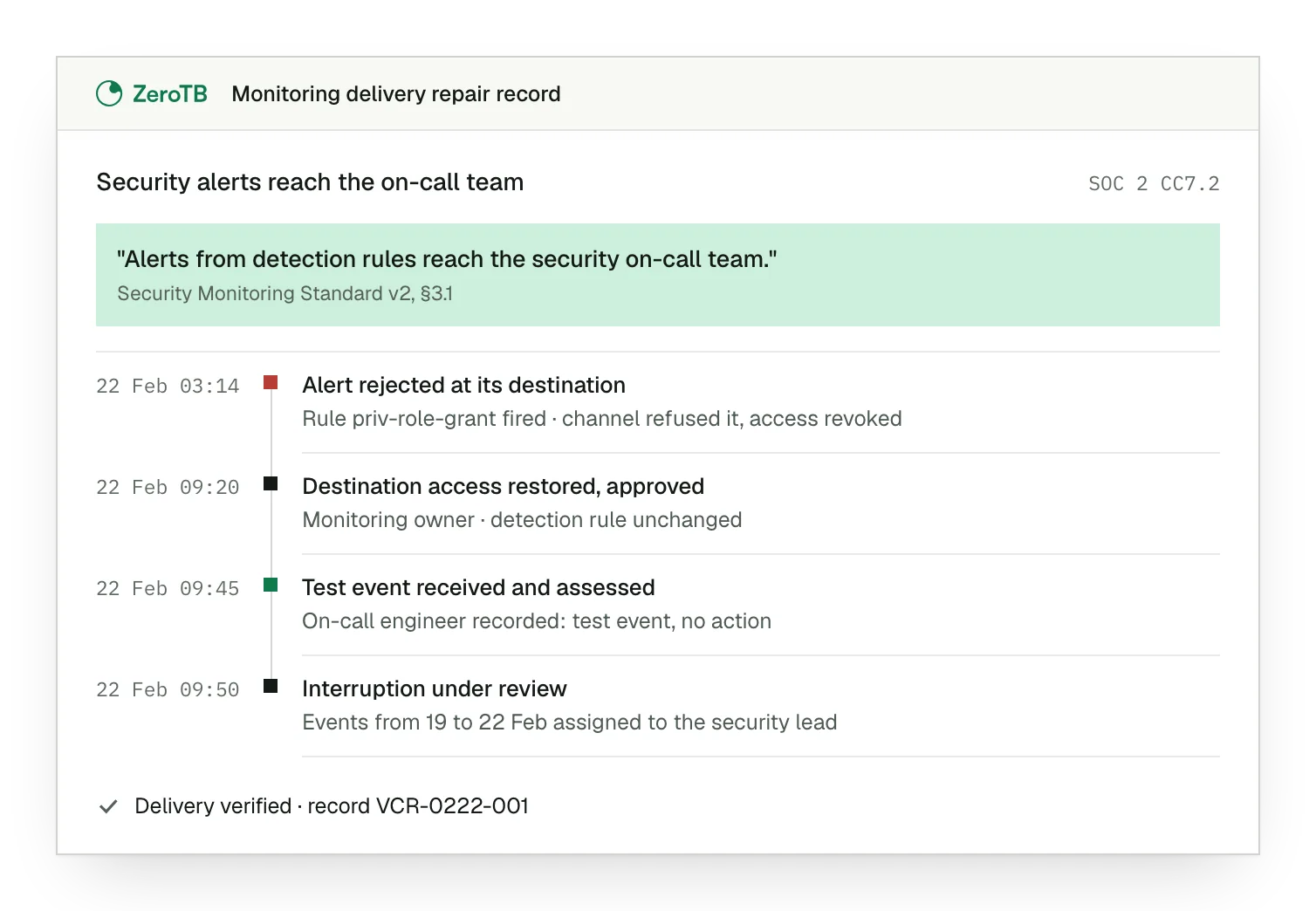
Failed delivery. The detection rule generates an alert, but the destination rejects the message before anyone receives it.
Approved repair. The owner approves restoring the destination's access while keeping the existing detection rule unchanged.
Received test event. A new event triggers the rule, reaches the responsible team and receives a recorded assessment.
Earlier events. The record assigns the interrupted period for review and keeps that follow-up visible after delivery resumes.
Monitoring review checklist
Identify the approved monitoring commitment, the systems it covers and the activity that needs detection and analysis.
Trace an event from its source through the detection rule, alert destination and recorded assessment by the responsible team.
Review the failed stage and the proposed correction, including any effect on what the monitoring rule detects.
Compare the new result with the agreed pass condition and keep the gap open if the affected route still fails.
Retain the repair evidence and assign review of the affected period, including any records unavailable for analysis.
Sources
- AICPA & CIMA, 2017 Trust Services Criteria with revised points of focus, 2022 revision.
- ISO, ISO/IEC 27002:2022, information security controls, 2022.
- HHS, HIPAA audit protocol, audit controls, 2018 update.
- ZeroTB, SOC 2 compliance automation with human approval, 2026.
Related pages
SOC 2 criteria
Place system monitoring within the wider set of criteria for a SOC 2 program.
Compliance frameworks
Find guidance on related controls across the frameworks that apply to the company's systems.
Continuous control monitoring
Connect checks of current system behavior to ownership, approved corrections and evidence of restored operation.
Start with the Pilot
The eight-week Pilot maps up to 25 commitments and takes two real control gaps through approved correction and verified restoration. Talk with our team about where monitoring needs attention and the evidence each completed repair would leave.