SOC 2 CC7.4 calls for a defined program to respond when the company identifies a security incident. The SOC 2 incident response plan explains who investigates, contains and corrects the incident, and who communicates about it. Check that the people assigned these duties can perform them with the systems and access available today.
An approved plan may still direct responders to a former employee. The work under SOC 2 system operations includes checking those dependencies: who holds each response duty, whether they can be reached and whether they can use the systems the procedure requires.
Response scope
CC7.4 covers the response to an identified security incident. The team investigates the incident, acts to contain its effects and corrects the problem. Communication belongs in this work too: affected parties need information from the people authorized to speak for the company.
The preceding assessment under CC7.3 explains why an event was treated as an incident. Keep that assessment available to responders. As work moves toward recovery under CC7.5, pass on the containment measures still in place and the decisions awaiting action. These records help the next team continue the work.
Roles and authority
The incident lead needs authority to coordinate the people who can contain the incident. The plan should identify who leads the response, who can approve material actions and who takes over when those people are unavailable. Each role needs a usable contact route.
Responsibility also depends on access. A replacement lead may know the procedure but lack permission to inspect the affected service or request a change. Review the duties and required access together, including any outside support on which the response depends, before assigning the role.
Response procedures
Response procedures should describe actions the team can carry out in the affected service. A general instruction to contain an incident leaves important choices unresolved. The responder needs to know the available action, its likely effect on service and the authority required to proceed.
Investigation and containment can affect each other. Disabling access may limit further harm while changing what investigators can observe. The procedure should make these dependencies visible, explain when to escalate a decision and connect temporary measures to the work needed for a lasting correction.
Incident communications
The response plan should identify who approves and sends incident communications. Technical responders, service owners and customer-facing teams need a common account of the incident. Assign responsibility for checking the facts, choosing recipients and recording the messages sent as the investigation develops.
A useful update distinguishes confirmed information from questions still under investigation. Keep the communication record connected to the incident timeline so later reviewers can understand what was known when a message was approved. Use the affected service's reporting obligations to decide who must receive an update.
Incident evidence
An incident record should explain what happened and why the response team acted. Preserve the timeline, observations, actions and material decisions as the response proceeds. This gives the reviewer a basis for understanding the outcome without reconstructing the incident from scattered conversations afterward.
Restrict access to sensitive incident material while keeping it available to the people responsible for review. Record where supporting logs and communications are held and how they relate to the incident. Retain unresolved questions alongside the conclusions so the record accurately reflects the investigation.
Changes after the audit
Changes to the team or service can leave a response procedure unusable. An old contact may no longer answer, and the replacement may lack the former lead's permissions. The plan can still look complete even though the current team cannot carry out a step.
A new review date does little to expose this problem. Check the contacts and access against the duty described in the plan. Describe any failure precisely: which person could not perform which action, on which service? That gives the owner a specific problem to resolve.
Response exercises
An exercise tests whether the current team can carry out the response described in the plan. Choose a scenario that reaches the duties under review, then record where participants need clarification, additional authority or access. The findings should identify the failed step and its consequence.
Discussion can reveal unclear responsibilities, while a controlled test can establish whether required access works. Select the method for the question being tested and protect the service during technical checks. Keep exercise observations separate from real incident records, with enough detail to repeat a failed step.
Repair of response gaps
Repair starts with the response step that failed and the person who can change it. A contact correction and a permission change require different work. Describe what must work afterward, then put the proposed change before the owner of the affected service for approval.
ZeroTB connects this work to the approved commitment. It checks the current state, drafts the fix and obtains approval before the correction proceeds. A further check establishes the result; the Verified Control Record retains that evidence with the action and approval. See the control restoration process.
Verification before closure
A correction is ready to close when a repeat check confirms that the failed response step works. For a permission gap, the check should establish that the assigned responder can perform the intended duty. A completed access request alone leaves that result untested.
Keep the original observation beside the repeat result, with the date and conditions of the check. If access remains unavailable or the result cannot be observed, retain the gap as unresolved. Separate completion of this correction from any wider incident work that remains open.
Continuing ownership
Responsibility for the plan continues after an exercise ends. Someone needs to review the response duties when a lead leaves, a service changes or permissions are revised. Otherwise, a successful exercise can remain on file long after the conditions it tested have changed.
Use the approved commitment to decide when checks are due, and consider which changes could invalidate earlier results. Keep unfinished corrections with the teams responsible for them and an expected completion time. The next reviewer can then distinguish work still awaiting action from repairs already tested.
Audit evidence
A reviewer should be able to trace the response from the plan in use to the actions taken and their results.
| Requirement | What an auditor asks for | Where it comes from |
|---|---|---|
| Defined response | The procedures the team used to investigate, contain, correct and communicate the incident | The approved response plan and the relevant service procedures |
| Assigned responsibilities | The people assigned to the response and their authority to act | Assignments and contact details, supported by relevant permission records |
| Recorded actions | The observations that prompted action and the reasons for the decisions made | The timeline and decision record kept during the incident |
| Coordinated communications | The approved updates, their recipients and when the team sent them | Copies of messages and the corresponding approvals |
| Corrected response gaps | The exercise failure, the correction and the result when the team tried again | The exercise report and control records containing the repeat checks |
Related framework requirements
| Framework | Control | What it covers |
|---|---|---|
| SOC 2 | CC7.4 | How the company acts on security incidents identified within its SOC 2 scope |
| ISO 27001 | A.5.26 | How established procedures direct the response to information security incidents |
| HIPAA | 164.308(a)(6) | Procedures to respond to security incidents, reduce harmful effects and document outcomes where HIPAA applies |
Example of restored response access
The access assigned to a replacement lead can decide whether a response proceeds. Here, an exercise stops because the new lead cannot inspect the service. The repair includes the service owner's approval and a test using the lead's account, so the team can check the result.
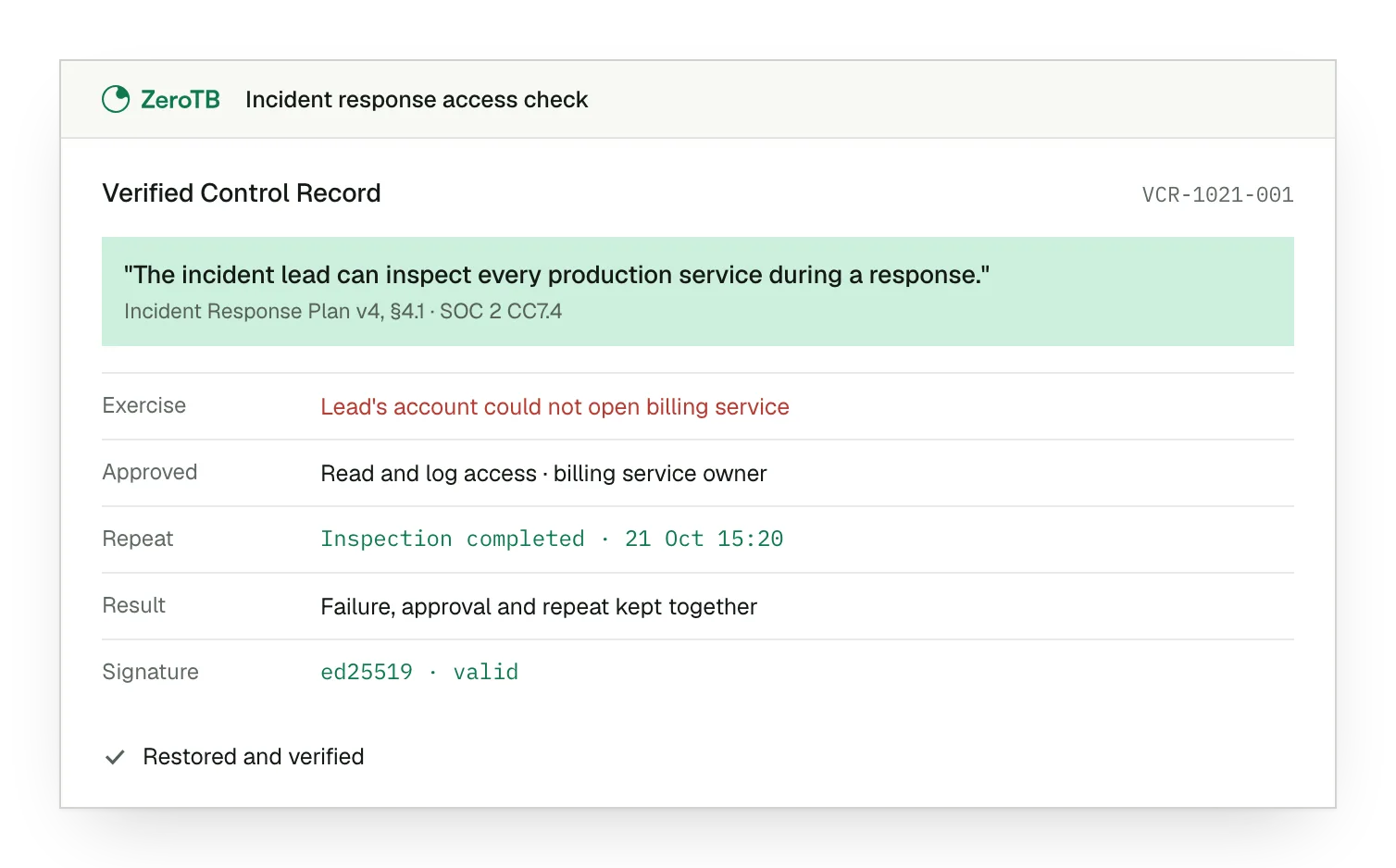
Exercise failure. The lead reaches the inspection step but cannot open the service with the assigned account.
Owner decision. The service owner approves the access required to perform this particular response duty.
Inspection repeated. With the approved permissions, the lead completes the inspection that failed during the exercise.
Result retained. The record keeps the failed attempt, approval and repeat result together for later review.
Incident response review checklist
Select a duty in the approved plan and identify the service and team on which it depends.
Compare the listed contacts and required permissions with the people who currently hold the response roles.
Read the failed steps from the last exercise and check whether each has an owner and proposed correction.
For a closed gap, find the later test result and compare it with the original failure.
Find any repairs still awaiting action, then check who owns them and when they are due.
Sources
- AICPA & CIMA, 2017 Trust Services Criteria with revised points of focus, 2022 revision.
- NIST, Incident response recommendations and considerations for cybersecurity risk management, SP 800-61r3, 2025.
- HHS, HIPAA audit protocol, security incident procedures, 2018 update.
- ZeroTB, SOC 2 compliance automation with human approval, 2026.
Related pages
Start with the Pilot
Our team can discuss where the response plan needs attention. In the eight-week Pilot, we map up to 25 commitments and take two real control gaps through verified restoration. Each correction leaves a record of the approval and verification.