What does HIPAA 164.312(b) require for audit controls?
Under HIPAA 164.312(b), audit controls must record activity in systems that contain or use electronic protected health information (ePHI) and enable its examination. Check that an event leaves a usable record where the reviewer expects to find it. Decide retention by record category: the six-year documentation rule does not establish one period for all raw HIPAA audit logs.
A reviewer opens the dashboard and finds no access events. Has nobody used the application, or have its records stopped arriving? Answering that question takes work across the application and logging systems. The control needs a check that follows activity all the way to review.
Audit coverage
Audit coverage follows ePHI across the systems that contain or use it. Under the HIPAA Security Rule, that includes the application as well as its infrastructure. A cloud account's history may explain an administrative change without showing who opened a patient record inside the application.
These sources need separate attention when deciding what to log. The HHS audit protocol examines the risk-based controls over those systems and evidence of recording and examination. Connecting each system to its relevant events and review destination makes an omitted source easier to identify.
Useful event records
The reviewer needs enough detail to understand an event and decide what to investigate. Depending on the activity, useful fields include an actor, action, resource, time and result. An access attempt becomes easier to interpret when the record also shows whether it succeeded.
A successful login still says little about what the account did afterward. An export event answers a different question, and its resource identifier helps establish what was involved. Record the context needed for that examination without routinely copying clinical content. Any health information included in logs also needs protection.
Log protection
Audit records need protection from the people and processes that can change the system. A person who can delete records may remove information needed for an investigation. Storage permissions and deletion settings therefore belong in the logging control's scope.
Separate permission to examine records from permission to alter their storage settings where the system allows it. Check how changes to logging, retention and access are recorded. These checks help a reviewer explain whether the available history is complete and whether an unexpected gap needs investigation.
Review responsibilities
Logs need a reviewer who can act on what they show. Regular examination of system activity falls under 164.308(a)(1)(ii)(D). A review procedure needs to identify the records, frequency and responsible people, including who investigates a finding that the initial reviewer cannot resolve.
The HHS audit protocol looks for evidence of completed reviews. That evidence can show the period examined, findings and subsequent decisions. An alert may help the reviewer find unusual activity; it still takes a decision about the event's meaning before the right team can respond.
HIPAA audit log retention requirements
Section 164.312(b) sets no universal retention period for raw audit logs. The six-year requirement in 164.316(b) applies to required Security Rule documentation. That period runs from creation or the date the documentation was last in effect, whichever is later.
Classify records before setting deletion rules. Required policies and documented actions have a different purpose from routine event data, although a log may also serve as required documentation. Retention decisions need to account for those duties, investigation needs and other applicable obligations. The approved schedule should identify each record category.
Archive retrieval
Keeping old records is useful only if a reviewer can retrieve and read them when needed. A file may still exist while permissions, unavailable keys or its format prevent access. Testing an archive means recovering records from the location that actually holds the older data.
There is a practical trade-off between storage cost and retrieval time. Recent activity may need immediate search; older records may take longer to obtain. Agree how that delay fits investigation needs. Keep the test result with the period retrieved and confirmation that the reviewer could interpret the records.
Coverage after system changes
A deployment can interrupt application logging while the central dashboard continues to receive other events. The dashboard may still look active because its infrastructure sources remain connected. Checks need to establish whether the expected application events arrive after the change.
Trace an appropriate test event from the affected system to the review destination. Compare the resulting record with the expected fields and delivery behavior. A changed event format can also break a search or alert even when delivery succeeds, so the check should include the view the reviewer uses.
Approved logging repairs
Agree what a successful repair will show before changing the logging configuration. The owner needs to understand the failed source or setting and the proposed correction. That gives them a basis for judging effects on the application, the volume of records and access to sensitive information.
Once the owner approves the repair, a new test should establish that the expected event arrives with usable detail. The reviewer must also be able to retrieve it. These observations answer the questions left open by a configuration change and provide grounds for closing the logging gap.
Unrecorded activity
A successful repair proves that logging works again, but it cannot explain activity for which no records exist. Keep the current test result separate from the earlier period without complete evidence. Otherwise, closing the repair can hide a question that still needs investigation.
The known start and end of the gap help define that question. Other records may explain some activity during the period, provided their coverage is understood. Preserve those records and use the incident procedure for suspected incidents. The repair and an investigation into past activity can have different closure decisions.
Continuing control ownership
The next release can undo a logging repair, so the check needs continuing ownership. An agreed control identifies changes that call for another test and who responds when an observation is missing or stale. Application, infrastructure and security teams can then see where their responsibilities meet.
ZeroTB checks agreed control conditions and keeps approved corrections in a Verified Control Record, connecting the gap to its approval and result. That evidence supports review across relevant compliance frameworks. The AWS integration supports checks on connected infrastructure, alongside the logging responsibilities that remain within the application.
Audit evidence
The following records let a reviewer compare the approved logging arrangements with the work performed.
| Requirement | What an auditor asks for | Where it comes from |
|---|---|---|
| Defined coverage | The selected systems and event types, together with the reasoning behind the coverage decision | System inventory, risk analysis and approved logging policy |
| Working records | Activity records that contain the information needed to examine events within the agreed scope | Application events, logging configurations and tests of the route to the review destination |
| Completed reviews | A record of the review period, the person who examined it and decisions on the findings | Review records and investigation records linked to the activity examined |
| Retention policy | The schedule for keeping each record category and tests showing that older records can be retrieved | Approved retention schedule, storage settings and dated retrieval tests |
| Verified repairs | Evidence of the failure and approval, followed by the test result used to close the repair | Change approval and verification results retained with the control record |
Related framework controls
| Framework | Control | What it covers |
|---|---|---|
| HIPAA | 45 CFR 164.312(b) | Mechanisms to record and examine activity in systems that contain or use ePHI |
| SOC 2 | CC7.2 | Monitoring system components and their operation for anomalies that may indicate security events |
| ISO 27001 | A.8.15 | Producing, storing, protecting and analyzing logs of relevant activities and events |
Example of restoring access records
In this example, a patient portal release stops sending record-access events to the review destination. Infrastructure events continue to arrive. The application owner approves a routing correction, and a new test confirms that the reviewer can retrieve the missing event type.
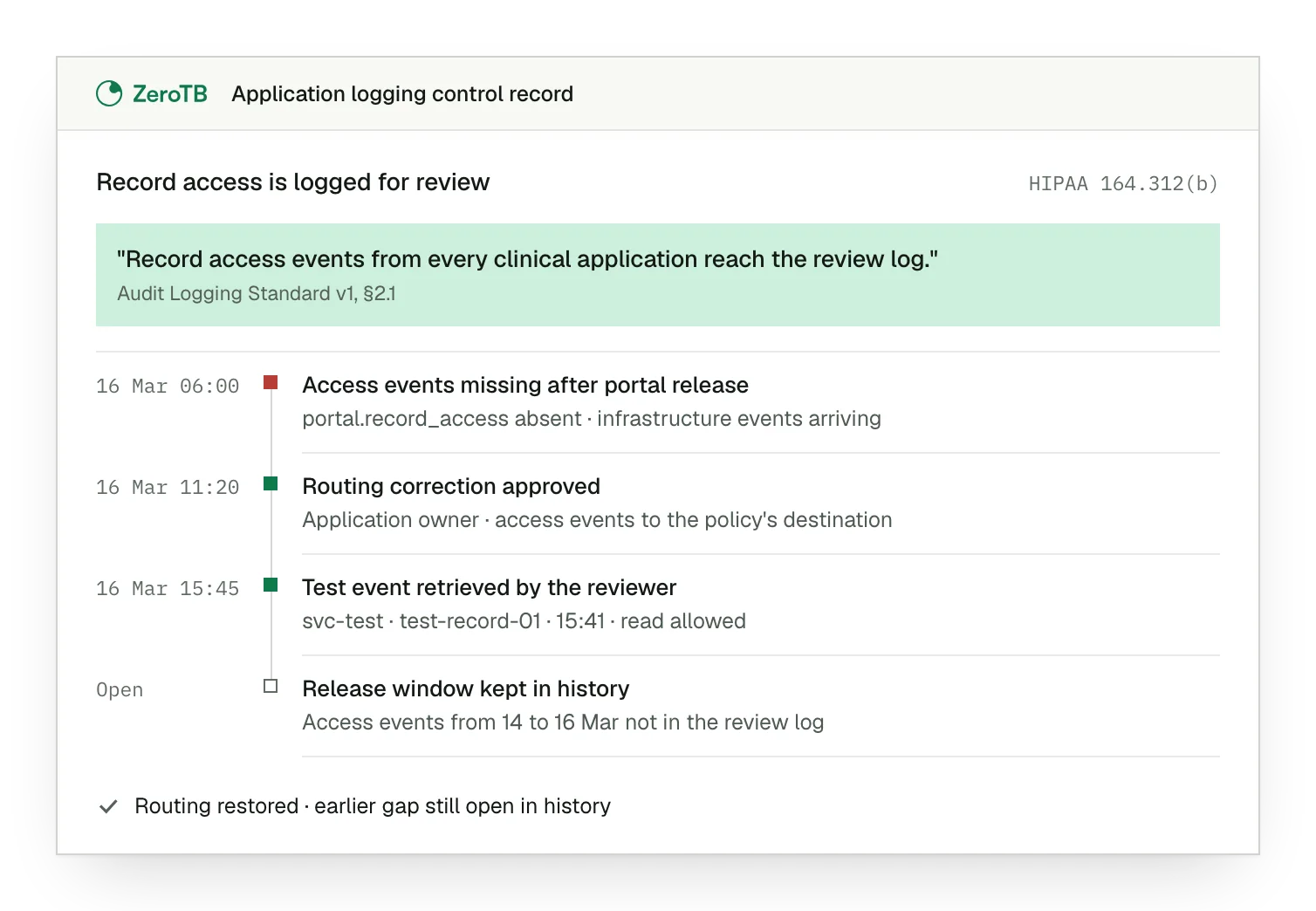
Missing access events. The portal's access event is absent from the review destination after the release.
Approved routing correction. The application owner approves sending access events to the destination specified in the policy.
Verified event retrieval. The reviewer retrieves a new test event with its actor, resource, time and outcome.
Audit control checklist
Confirm which application activities fall within scope and where the reviewer should be able to examine them.
Identify which records serve as required documentation and check that the schedule accounts for their applicable retention duties.
Confirm the owners of missing-event investigations, repair approvals and reviews of activity during a gap in logging.
Check the retrieval test and whether the record distinguishes a successful repair from questions about earlier activity.
Sources
- eCFR, 45 CFR 164.312: Technical safeguards, current text checked November 4, 2026.
- eCFR, 45 CFR 164.316: Policies, procedures and documentation requirements, current text checked November 4, 2026.
- HHS, HIPAA audit protocol, July 2018 update, audit controls and information system activity review.
- ZeroTB, SOC 2 compliance automation with human approval, 2026.
Related pages
Technical safeguards
Read the standards for protecting health information as people and applications use it.
Healthtech compliance
See how ongoing control work fits the responsibilities of security and engineering in healthtech.
Cloud infrastructure controls
Examine how changes to cloud settings affect commitments and the work needed to restore them.
Start with the Pilot
Talk with our team about the Pilot. Over eight weeks, we map up to 25 commitments and take two real control gaps through approved fixes and verified restoration. You receive records of the changes, approvals and verification results.