What does ISO 27001 A.8.16 require for watching systems for unusual behavior?
ISO 27001 A.8.16 concerns watching systems for unusual behavior and assessing the security implications. Monitoring needs a defined scope and someone responsible for investigating the signals. Test that connection after changes: an event should reach the detection rule, produce the expected alert and arrive with the team responsible for assessment.
Logs can keep arriving after a detection rule has stopped working. An application update may have changed a field the rule depends on. To understand what the dashboard is telling you, follow an event through the rule and see what reaches the receiving team.
Monitoring scope
The monitoring commitment should say which activity matters and where to look for it. "Privileged activity" needs enough detail to guide a check: the accounts involved, the operations they can perform and the systems in which the rule should detect them.
That scope gives the reviewer a starting point when an application or account is added. It also needs to identify who receives an alert and what response is expected. Otherwise, the rule may have a technical owner while the decision about suspicious activity belongs to nobody.
Log collection and detection
Receiving a log entry proves that collection worked for that event. It leaves a separate question about whether the detection rule recognized anything worth investigating. Logging under A.8.15 provides records for that analysis, including the event fields the rule uses.
Before investigating the rule, check the data it received. A connection may have expired, events may be delayed, or a required field may be missing. Retain the source and observation time so the reviewer can distinguish a failed detection from an incomplete view of the activity.
Normal activity and thresholds
Detection thresholds need to reflect the activity expected in the system as well as the security concern. Frequent alerts about ordinary work consume investigation time. Raising a threshold can reduce those alerts, but it can also exclude behavior the organization intended to detect.
The NIST guidance on tuning monitoring describes using normal activity patterns to improve detection. Use that reference when considering a rule change. The review should explain which ordinary activity caused the noise and how the revised rule will retain its intended coverage.
Changes that interrupt detection
Detection rules depend on details that can change during routine releases. An application upgrade may rename an event field. A new production account may fall outside a rule's scope. Logs can continue arriving in both cases, even though the expected activity no longer produces an alert.
A change review can identify these dependencies before a failure becomes difficult to trace. Record the event source, the rule that reads it and the alert destination affected by the change. The last successful test then provides a useful comparison when the team checks the revised system.
Tests of the detection path
Test the route far enough to establish whether the intended reviewer receives the alert. Agree a controlled activity and its expected result with the system owner before the test. Then follow the resulting event through the matching rule to the destination selected for assessment.
A stored-event replay can test a rule while leaving the live connection untested. Record that boundary so another reviewer knows what the result establishes. NIST SI-4(9) addresses testing monitoring mechanisms; the test chosen here should cover the dependencies relevant to the organization's own monitoring commitment.
Alert assessment and ownership
An alert needs an owner who can decide whether the activity requires further investigation. Delivery to a shared queue leaves an unanswered question if nobody assesses it. Keep the receiving team's decision with the event so a reviewer can understand the response.
The assessment may conclude that the activity was expected or that incident handling is needed. Retain the reason and any escalation. Where HIPAA applies, security incident procedures address responding to suspected or known incidents and documenting outcomes. A delivery receipt covers only part of that work.
Approval of monitoring repairs
Approval depends on knowing what the repair changes. A field-mapping correction lets the rule read an event again; a broader rule brings more activity within its scope. An alert-routing change sends the result to a different team. Each proposal needs to identify its intended effect.
The owner can then judge the consequences before authorizing the work. More coverage may also mean more alerts about ordinary activity. A new recipient must be able to assess the signal. Retain any decision to leave coverage incomplete, including when that decision will be reviewed.
Verification after the repair
The same detection path that failed should work before the repair is closed. Repeat the agreed test after the approved change and compare the result with the expected behavior. Confirm which event was recognized, where the alert arrived and how the receiving team assessed it.
The change ticket shows what the team changed. The test shows whether that change worked. If detection succeeds but delivery fails, the repair remains incomplete. Retain that finding with the next responsible owner. Closure needs evidence that the relevant route now supports the original monitoring commitment.
Checks between system changes
Monitoring needs further checks because its sources, rules and recipients keep changing. Give each check an owner and a schedule that reflects the commitment and its risks. Changes to those dependencies should prompt a decision about whether the existing test remains sufficient.
Continuous control monitoring helps organize this recurring work around coverage, fresh observations and ownership. ZeroTB connects approved corrections to their verification in a Verified Control Record. That history lets a later reviewer see whether the same dependency failed again and which earlier repair was tested.
Monitoring evidence
The records should let an auditor follow what monitoring covered, where it failed and how the team checked the repair.
| Requirement | What an auditor asks for | Where it comes from |
|---|---|---|
| Defined coverage | The monitored activity and systems, the receiving team and the expected response | Approved monitoring procedures checked against the system inventory |
| Usable source data | Dated evidence that the source supplied the events and fields needed by the rule | Source records and checks of collection and connection status |
| Working detection | A test event connected to the rule that matched it and the resulting alert | Test results retained with the rule configuration and alert |
| Assessed alerts | The receiving team's conclusion, including the reason for escalation when one occurred | Alert assessment history linked to any resulting incident record |
| Verified repair | The authorized change and the result of testing the affected route again | Change approval and before-and-after results in the verification record |
Related framework requirements
| Framework | Control | What it covers |
|---|---|---|
| ISO 27001 | A.8.16 | Unusual activity in systems, with an assessment of its implications for security |
| SOC 2 | CC7.2 | Anomalous activity detected through monitoring and analyzed for security events |
| HIPAA | 45 CFR 164.308(a)(6) | Suspected or known security incidents, the response and mitigation of harmful effects, and documented outcomes where HIPAA applies |
Example of restoring a missed alert
This example follows a privileged-action rule after an application update. The source event arrives, but a renamed field prevents detection. An approved mapping change allows the rule to recognize the event again. The test follows the alert through delivery and assessment before closure.
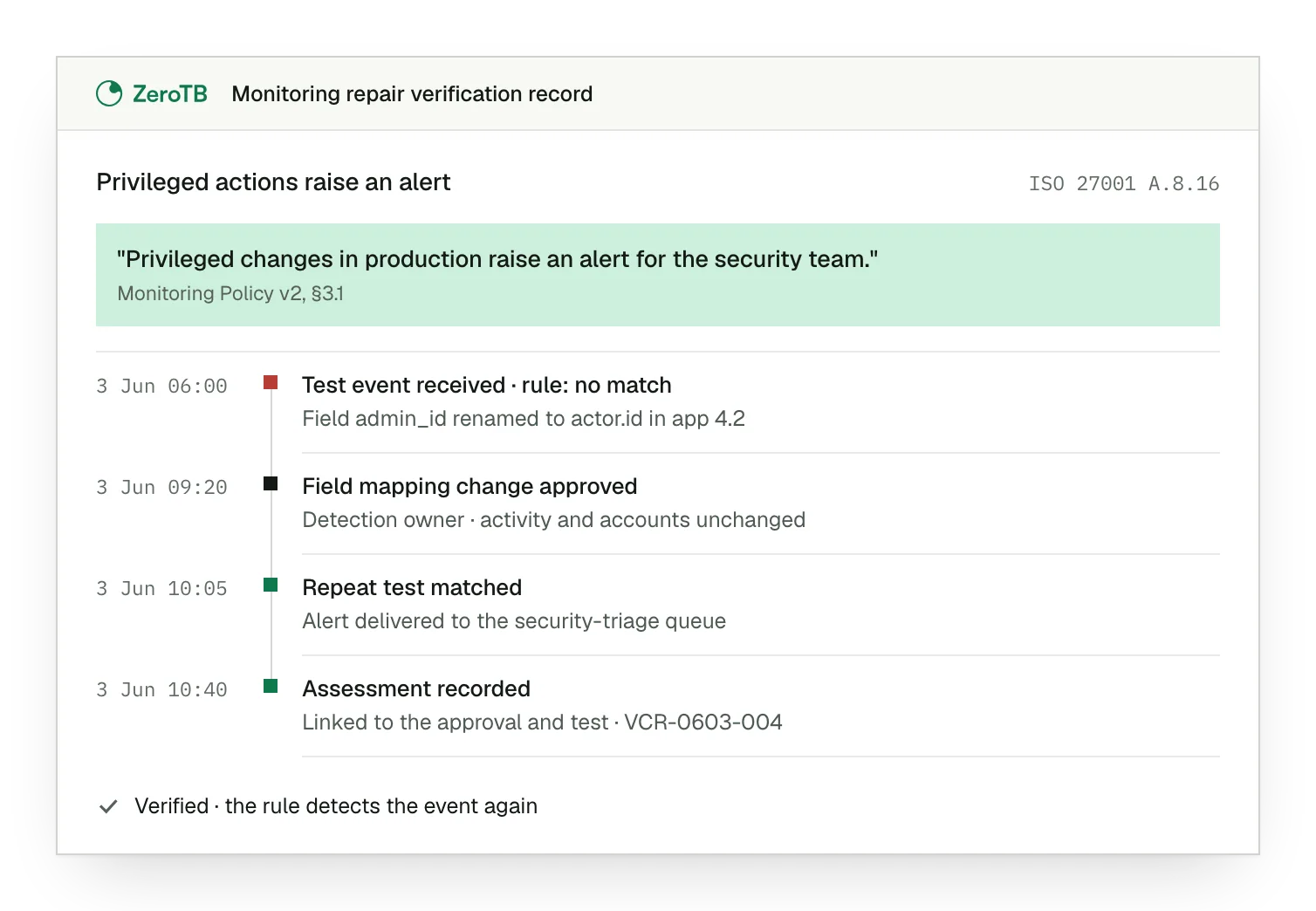
Missed test event. The application supplied the event with a changed field that the rule could not interpret.
Approved mapping repair. The owner authorized the mapping change without expanding the activity or accounts covered by the rule.
Repeated detection test. The next test produced an alert and delivered it to the security team's expected queue.
Recorded assessment result. The reviewer can follow the assessment back to the test, approved correction and verified result.
Monitoring review checklist
Start with the approved commitment, then identify the event, systems and accounts that the monitoring rule should cover.
Follow an event from its source to the rule and alert destination to locate where detection or delivery failed.
Examine the proposed repair with the owner, including the activity it would cover and the alerts it would produce.
Repeat the agreed test after the change and retain the receiving team's assessment with the generated alert.
Connect the failure, approval and verification result so a later reviewer can see what the repair established.
Sources
- ISO/IEC, ISO/IEC 27002:2022 overview, 2022.
- NIST, SP 800-53 Rev. 5, SI-4: System monitoring, 2020, including testing and tuning guidance.
- AICPA & CIMA, Trust Services Criteria with revised points of focus, 2022 revision.
- HHS, HIPAA audit protocol, 2018 update, security incident procedures.
Related pages
ISO 27001
Explore how the monitoring control fits within the wider information security management system.
Compliance frameworks
Find control guidance for the other frameworks included in the organization's compliance program.
Compliance monitoring
See how ZeroTB checks commitments against operating systems and follows gaps through to verified restoration.
Start with the Pilot
Talk with our team about the monitoring gaps that recur as systems change. The eight-week Pilot maps up to 25 commitments and takes two real control gaps through approved repairs to verified restoration, with evidence of the completed work.