SOC 2 CC7.1 addresses detection of configuration changes that introduce weaknesses and newly identified vulnerabilities in system components. Check that detection reaches the systems in scope, including new accounts and resources. Restoring a missed scan establishes coverage; any vulnerabilities it finds still need their own assessment and response.
A production account missing from a scanner's inventory will be absent from its results. Successful runs in other accounts can conceal that gap. This part of CC7 system operations examines how detection covers the changing environment and how an owner establishes that missing coverage has been restored.
Detection scope
CC7.1 covers two problems that need different checks. The first is a configuration change that introduces a weakness; the second is a newly identified vulnerability in a system component. Together, these checks help the owner understand whether the systems still meet their approved requirements.
For configuration, the comparison is between the approved baseline and the settings observed in production. For vulnerabilities, the question is whether a known weakness affects the components in use. A system can pass the configuration check and still contain vulnerable software, so both results belong in the review.
Approved configurations
A baseline records the configuration a system is supposed to have. It gives the reviewer a reference when current settings differ from the policy or report commitment. The baseline also needs to identify the environments where those settings apply; otherwise, the comparison lacks a clear scope.
After detecting a difference, the owner can check its authorization and assess whether it introduces a weakness. The baseline should remain available during that investigation. If someone changes it to match production before resolving the finding, the difference disappears from subsequent checks without an explanation of what happened.
Asset coverage
An account that enters production also needs to enter the checks covering production. Compare cloud and infrastructure account records with the accounts reached by scans and configuration checks. This comparison can reveal a missing account even while checks elsewhere continue to report successful results.
The scanner's list is only one side of that comparison. Use account and resource records to establish the other side, including resources created since the last review. Keep exclusions and their reasons visible. The reviewer needs to know whether an absent resource was deliberately excluded or missed.
Scan reliability
A clean scan supports a conclusion only about the assets and checks it actually reached. A listed resource may still be inaccessible to the scanner. Failed access, exclusions or an incomplete run can leave the relevant condition unobserved even when other checks succeed.
Review the completion status and observation date alongside the findings. A stale result cannot establish the state after a later change. Keep missing observations visible until the cause is understood, so the owner can distinguish a healthy system from one that has not been checked.
Newly identified vulnerabilities
An earlier scan can become insufficient when new vulnerability information appears. The installed software and its configuration may be unchanged, but a weakness in that version is now known. Check whether the affected component is present and whether the detection method can identify the weakness.
NIST's vulnerability scanning guidance covers checking for newly identified vulnerabilities and updating the weaknesses included in scans. Those requirements apply to controlled unclassified information. They offer a technical reference for this work; a SOC 2 review still uses the company's own commitments to establish what its checks must cover.
Check frequency
The interval between checks matters when production changes during that interval. Start with the cadence in the approved commitment, then consider what would make an earlier result insufficient. A new account, changed setting or newly identified vulnerability can each create a reason for another check.
A check triggered by a change depends on the change being reported. Periodic comparisons can catch additions that missed that route. The owner needs visibility of failed runs and missing observations under either approach, with a way to investigate them before relying on the reported results.
Response decisions
A response decision establishes what will happen to the finding. The owner considers the proposed correction, its effect on the system and the permissions it requires. If an exception is retained, the decision needs a reason and conditions under which the owner will review it again.
For a correction, connect the approval to the resources affected and the result expected. Permission to add an account to scanning does not by itself authorize changes to that account's production settings. Describing the action gives the approver a concrete change to assess and the verifier an expected result.
Verification after correction
The check that failed must run successfully before its coverage gap can close. An inventory entry shows that an account has been added to a list. A completed observation shows whether the scanner reached that account with the access needed to inspect the relevant condition.
A newly covered account may have vulnerabilities of its own. Assign those findings for response and retain their status when closing the coverage gap. Where the correction changes a production setting, inspect that setting afterward. The closure record needs the result of the test that establishes restoration.
Continuing ownership
A repair leaves an ongoing responsibility for the detection coverage it restored. Someone needs to investigate missing observations and make sure new resources enter the relevant checks. That responsibility applies when engineers change production and when coding agents make changes on their behalf.
ZeroTB handles the work from reading commitments and checking systems through drafted corrections, human approval and verification. The resulting Verified Control Record holds the commitment, before-and-after state, action, approval and test result. When a gap returns, the owner can see which repair was made and what the earlier check established.
Evidence for a CC7.1 review
Keep enough evidence to show what was covered, what failed and why the resulting state was accepted.
| Requirement | What an auditor asks for | Where it comes from |
|---|---|---|
| Detection scope | Systems included in checks, excluded resources and the reasons for each exclusion | Account and resource inventories compared with the populations covered by configuration checks and scans |
| Approved configuration | The expected settings and the authority for accepting changes to those settings | Approved baselines linked to policies, report commitments and the relevant change decisions |
| Completed detection | Dated results showing which checks completed, which failed and which resources remained unobserved | Configuration observations, scan logs, access failures and records of the vulnerability information used |
| Response decisions | The owner, proposed response and approval or exception associated with each finding | Change requests and exception records describing the decision and any conditions for review |
| Verified restoration | Evidence that coverage was restored, with separate status for weaknesses discovered during verification | Completed checks linked to the original gap, corrective action, approval and remaining findings |
Framework requirements
| Framework | Control | What it covers |
|---|---|---|
| SOC 2 | CC7.1 | Detecting configuration changes that introduce weaknesses, alongside newly identified vulnerabilities affecting components of the system |
| ISO 27001 | A.8.8 | Identifying technical vulnerabilities, assessing the organization's exposure and deciding how to address that exposure |
| HIPAA | 164.308(a)(1) | Assessing risks and vulnerabilities to electronic protected health information and taking measures to manage them |
Example of restoring scan coverage
Restored scan coverage can reveal a second problem. In this example, the owner adds a missing production account to scanning, and the first completed run finds a vulnerability. The coverage record can close with that result while the vulnerability remains assigned for response.
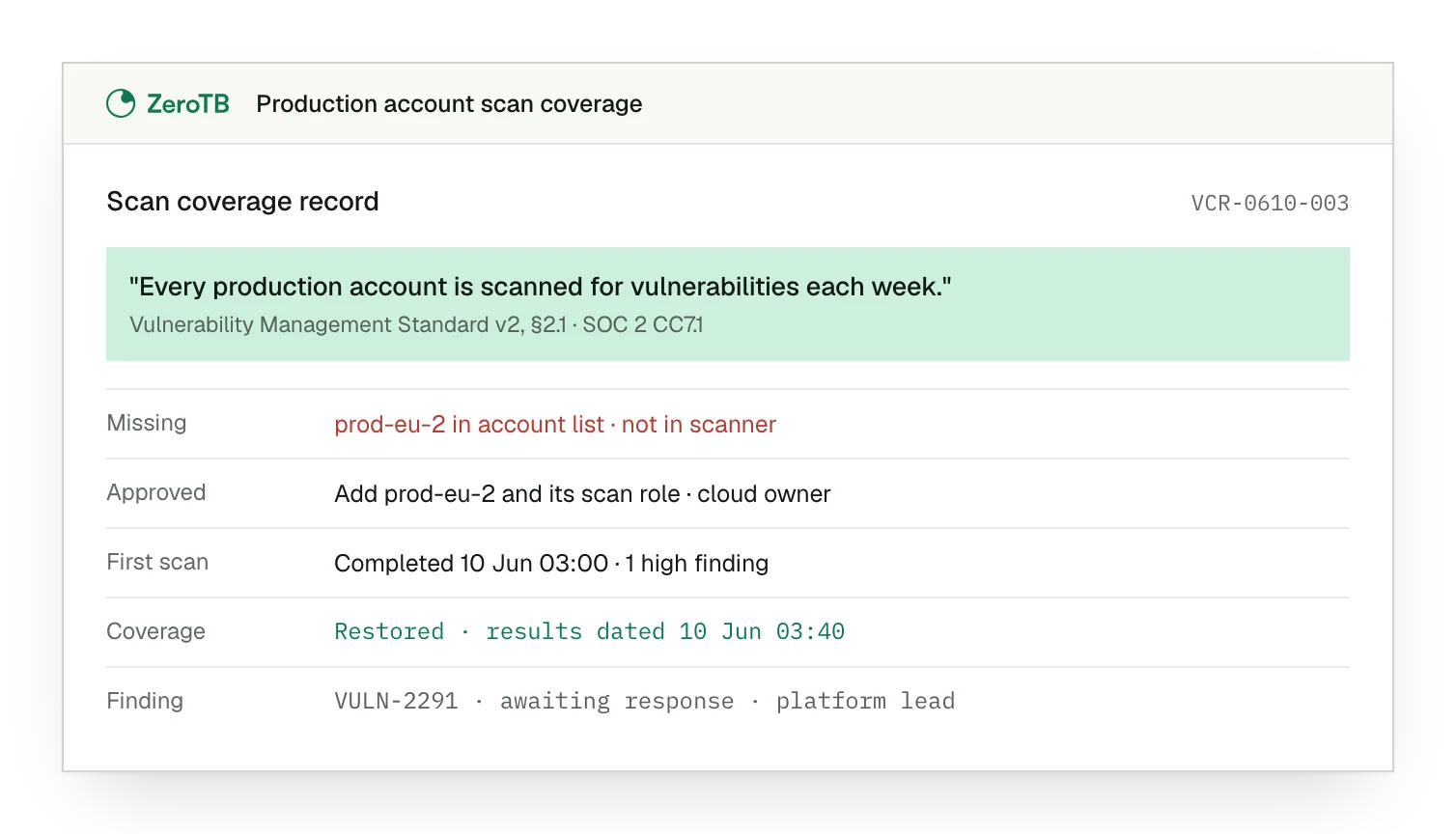
Missing production account. A comparison finds the account in production records and absent from the scanner's inventory.
Approved coverage change. The recorded approval covers the account addition and the access needed to run its checks.
Completed first scan. The run reaches the previously missing account and returns a vulnerability finding for review.
Separate repair status. The dated scan establishes coverage, with the discovered vulnerability still awaiting its own response.
Detection coverage checklist
Read the configuration and detection commitments to establish the expected settings and the systems they cover.
Look for differences between the account records and completed checks, with a reason recorded for each exclusion.
Review the date, access and completion status of each check before drawing a conclusion from its findings.
Identify the owner authorized to approve a correction or retain an exception, including the conditions for reviewing that decision.
Use completed observations to establish coverage, and keep a separate response assigned to each newly discovered weakness.
Sources
- AICPA & CIMA, 2017 Trust Services Criteria with revised points of focus, 2022 revision.
- NIST, SP 800-171r3, section 03.11.02: Vulnerability monitoring and scanning, 2024.
- HHS, Summary of the HIPAA Security Rule, risk analysis and management, accessed November 4, 2026.
- ZeroTB, SOC 2 compliance automation with human approval, 2026.
Related pages
SOC 2 criteria
Read the criteria around CC7.1 and how they fit into the wider SOC 2 program.
Compliance frameworks
Find the requirements for other frameworks and the operating controls that supply evidence for them.
Cloud and infrastructure
Follow configuration requirements into the cloud systems where checks and approved repairs take place.
Start with the Pilot
Talk with our team about detection coverage and the gaps that keep returning. During the eight-week Pilot, we map up to 25 commitments and take two real control gaps through approved correction and verified restoration, with records of the completed work.