Compliance monitoring checks systems and activities against the requirements a company has agreed to meet in policies, reports and customer commitments. The results show which controls are working and where a response is needed. Give each gap an owner who can arrange an approved repair and obtain evidence that it worked.
A passing check describes the condition at the time it ran. Permissions may change an hour later, leaving yesterday's evidence accurate but insufficient for today's question. Monitoring makes those changes visible so the company can respond when a control stops working.
Much of the work crosses team boundaries. Compliance can identify a requirement without having permission to change the system. Engineering can make a correction without knowing which evidence the reviewer needs. Connecting those responsibilities is part of making the monitoring useful.
Requirements and operating controls
The company's approved commitments determine what a check must establish. They may appear in policies, reports or customer contracts. A framework provides the wider context, but the company's control describes how the requirement applies to the systems and work being monitored.
For example, approved accounts and managed devices may both be conditions for accessing company information. An account check leaves the device condition unanswered. The test needs to cover both parts of the commitment before its result can establish that the access meets the rule.
Monitoring scope
Monitoring can establish a result only for the systems and activities it covers. These may include accounts, devices, repositories and cloud settings, along with scheduled human work. Training and access reviews need evidence of completion and decisions appropriate to the requirement.
That scope needs attention as the company changes. An application added after the checks were configured may never appear in their results. Including new systems and activities keeps the monitoring connected to the work the company now does and the commitments that govern it.
Checks with clear outcomes
An owner should be able to understand a failed check from the result itself. Include the condition being tested, the affected system or activity and the observation time. Those details explain the finding and give the investigation a useful starting point.
Choose evidence that answers the question the control asks. An access setting can show that a rule is configured. Testing the access path can show whether it takes effect there. The record needs to explain which of these conclusions the observation supports.
Monitoring frequency
Choose an interval that leaves enough time to respond to a gap. How quickly the condition changes matters, as does the consequence of failure. Permission changes and scheduled reviews have different timing: one can occur at any moment, while the other has a deadline.
NIST's monitoring guidance describes visibility into control effectiveness as information for timely risk response. That connection matters when setting the schedule. The continuous monitoring guide explains how check frequency and the capacity to respond work together in changing systems.
Missing observations
A control needs fresh observations before anyone can judge its current condition. When a connection fails, its last passing result describes an earlier state. An overdue result also leaves a gap in what is known, even if no failure has been detected.
Show those gaps separately from confirmed failures and assign an owner to investigate them. Once observations resume, the record can show what was found and when reliable coverage returned. Keeping the interruption visible preserves an accurate account of the period for later review.
Monitoring without a GRC team
A security or compliance owner can coordinate monitoring for a SaaS company without a full GRC team. Engineering and IT retain approval over their systems, and an outside operator can handle agreed ongoing work. Each finding still needs someone responsible for investigation and verification.
ZeroTB performs that operational work through software and service, checking commitments and preparing corrections within agreed permissions. It verifies the resulting state after approved changes. The company decides material questions and exceptions, while the service carries the work that connects those decisions to completed repairs.
Decisions and approvals
An approval request needs to make the proposed correction understandable to the system owner. It should connect the observed gap to the commitment and explain the intended change. The owner also needs to know how legitimate work will continue afterward.
Some findings call for an exception decision. An account may still serve an approved purpose even though a general rule would remove it. Recording that purpose, its safeguards and review conditions gives future checks a basis for recognizing the exception and reviewing it again.
Verification after a repair
Closure depends on the observed result of the repair. A task marked complete establishes that work was reported as done; a fresh check establishes whether the required condition holds. The owner keeps the gap open when verification fails or observations remain unavailable.
Include the activity the correction was intended to preserve. When an unsafe access path is removed, approved access still needs to work. Testing both outcomes gives the reviewer evidence that the repair meets the requirement without interrupting the work it should permit.
Evidence across the period
Retained evidence should let a reviewer understand the control's history. That means keeping failures as well as passing results, and connecting each repair to the reason it was made. The commitment, observations, approval, action and verification provide the detail needed to follow that history.
A restored control's Verified Control Record holds those details together. ZeroTB keeps the company's commitments, checks, repairs and audit evidence together. During an audit, monitoring evidence can help explain how a control operated over the relevant period, within the systems and activities the assessment covers.
Recurring failures
Recurrence changes the question from whether a repair worked to whether it lasted. A later deployment can undo a corrected setting. Repeated gaps can also reveal uncertainty about who owns the work. Each cause calls for a change in how the control is maintained.
Use time to verified restoration to examine delays between detection and a confirmed result. The record can show time spent awaiting investigation, approval or verification. Consider unresolved gaps and repeated failures alongside that measure, so quick repairs do not obscure work that still needs attention.
Automation and human review
Repeated observations are suitable for automation when the test has a clear condition. Approved logic can compare system settings with that condition each time it runs. People remain responsible for interpreting new commitments, deciding exceptions and approving changes that require a material decision.
For scheduled human work, evidence must show what was done. A notification records that a request was sent. Review records can establish which decisions followed. Software can collect those records and route them, leaving a reviewer to assess the substance against the requirement.
Monitoring tool selection
A real control gap is a useful basis for evaluating a monitoring tool. Examine what the owner receives when it fails, how missing observations appear and what remains after a repair. These details show which parts of the work the tool supports.
Teams with an established repair process may need better observations more than additional operational support. Teams with unresolved findings may need someone to carry the response through to completion. The monitoring tools guide develops that choice through questions about responsibility, approvals and verification.
Example of restoring device access controls
The access commitment in this example has two conditions: approved work accounts and managed devices. A check finds a personal account with access and incomplete endpoint protections. The record keeps both gaps open until the authorized corrections pass verification and approved access still works.
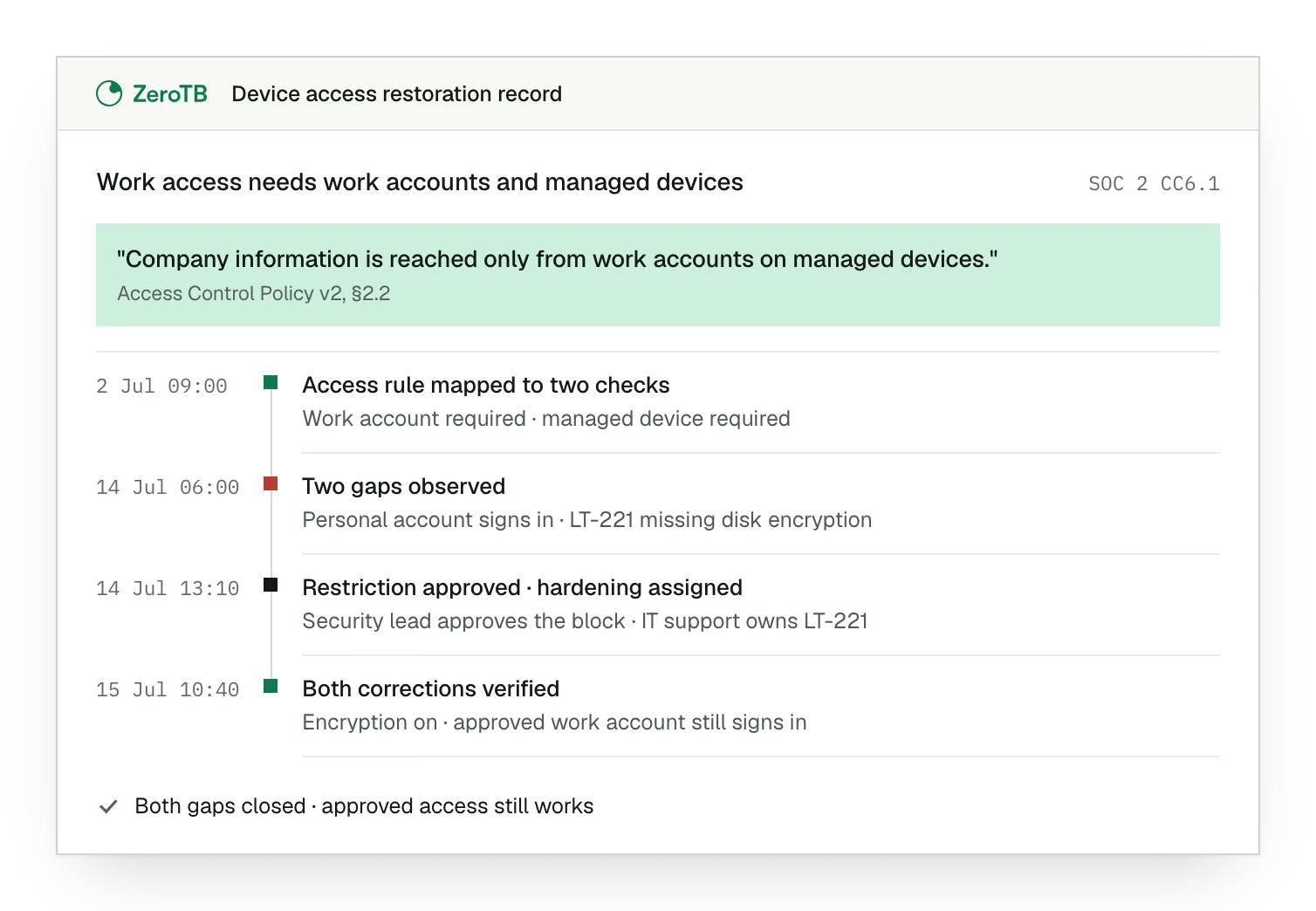
Approved access rule. The policy connects permission to access company information with the account and device used.
Two observed gaps. The personal account has access, while the endpoint falls short of its required protections.
Authorized correction. An approved restriction closes the personal account path, and the assigned owner completes device hardening.
Verified working access. Verification confirms the device protections and checks that approved access works after the restriction.
Monitoring review checklist
Identify the approved commitment and the systems or activities it covers, including recent additions that existing checks may omit.
Inspect what an observation establishes, when it was collected and how the result distinguishes failures from missing information.
Compare the check frequency with the rate of change, consequences of failure and time an owner needs to respond.
Confirm who approves changes and exceptions, and whether the proposed correction explains how necessary work will remain possible.
Review whether completed repairs have fresh verification, retained approvals and an owner for any condition that remains unresolved.
Related pages
Coding-agent compliance
Follow control changes as coding agents alter software and configurations.
Healthtech controls
Connect healthtech commitments with the systems and access they govern.
Compliance monitoring tools
Assess observations, response ownership and verification when choosing monitoring support.
Start with the Pilot
Talk with our team about keeping controls working between audits. The eight-week Pilot maps up to 25 commitments from your report and takes two real control gaps through verified restoration, with evidence from the completed work.