HIPAA technical safeguards govern how technology protects electronic protected health information (ePHI). They cover who can access it, how activity is recorded, whether information stays intact, how identities are checked and how data travels. These five guides explain the standards and the work needed to maintain their controls.
Five technical safeguard standards
Access control
Restrict who and what can access ePHI, including unique identification for users and procedures for emergency access.
Audit controls
Keep records of activity in systems containing or using ePHI, with mechanisms for examining that activity.
Integrity
Protect health information against improper alteration or destruction and assess mechanisms for checking that it remains intact.
Person or entity authentication
Check that a person or entity requesting access to ePHI is who or what it claims to be.
Transmission security
Secure ePHI as it travels across networks, assessing encryption and protections against changes that would otherwise go undetected.
Safeguard drift after system changes
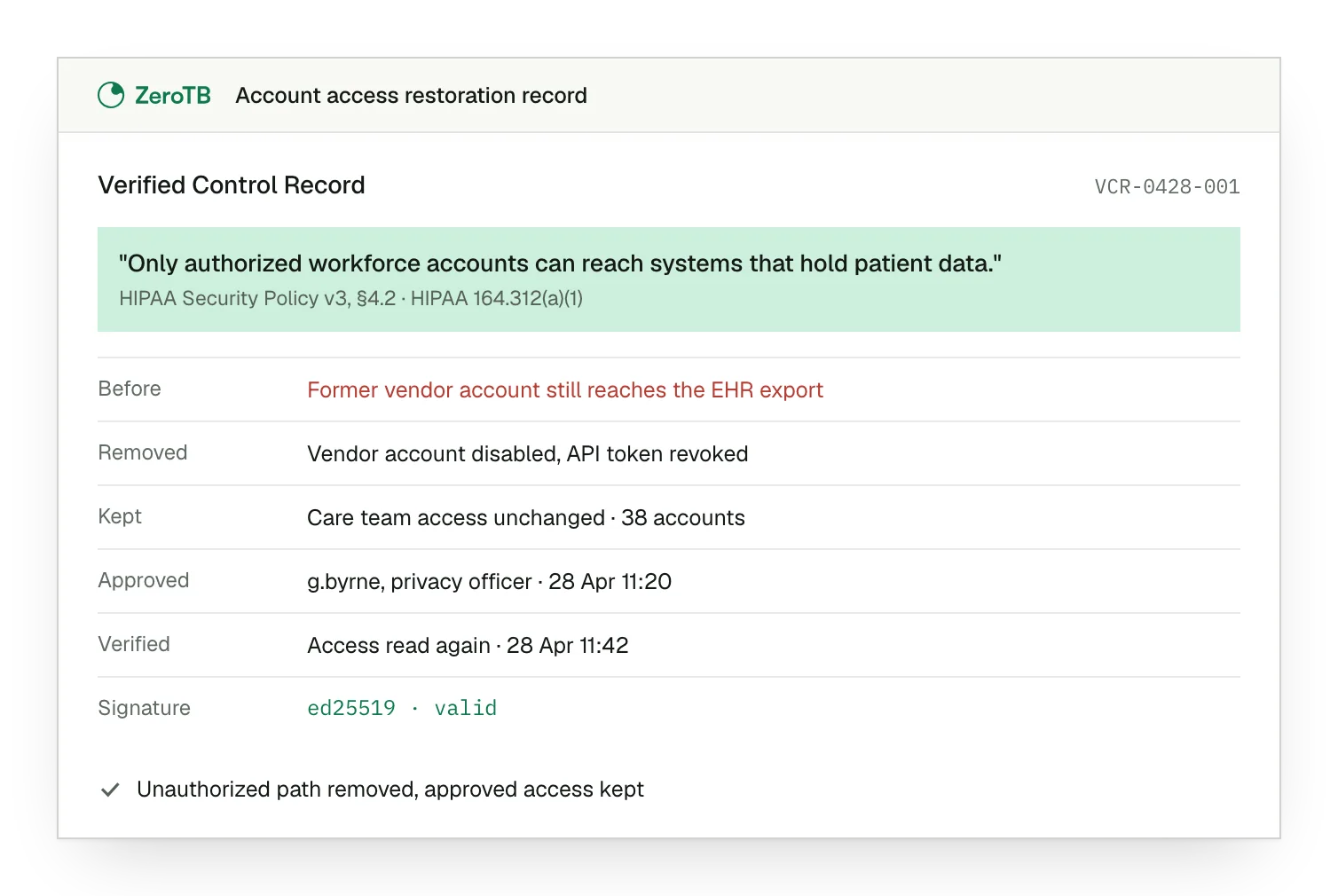
System changes can leave a gap in a safeguard that previously worked. For example, a contractor leaves and an account remains active. The policy still limits access to authorized workers, while that account continues to provide a route to ePHI.
A contractor leaves
An account stays active
Health information remains accessible
Ongoing safeguards with ZeroTB
ZeroTB handles the ongoing work of keeping your technical controls aligned with policy and report commitments. We check systems daily and draft repairs for approval. We then verify the change and preserve its evidence, commitment and approval in a signed Verified Control Record.
Recurring gaps get an assigned owner
Material changes stay under human approval
Completed repairs leave evidence for review
Talk to our team
Discuss the gaps that keep returning in access, logging or system settings, and where ZeroTB could help with the work.
FAQ
What does addressable mean when implementing technical safeguards?
An addressable specification requires a decision based on the risks and circumstances of the organization. Implement it when reasonable and appropriate. Otherwise, the organization must document why and implement an equivalent alternative if reasonable and appropriate. All five standards still apply. Section 164.306 explains the assessment.
Does HIPAA prescribe a particular product for these safeguards?
The Security Rule allows a choice of measures that reasonably and appropriately implement its requirements. Size, complexity, technical capabilities, cost and risks to ePHI inform that choice. The HHS summary describes this approach. The wider HIPAA program also includes administrative and physical safeguards.
How can authentication work while access control still fails?
A successful identity check can admit a person who should have lost access. A former worker may still know the password and satisfy other sign-in checks. Authentication establishes the identity; access control determines which information and functions that identity is allowed to use.
Where do password requirements fit among the safeguards?
Password management belongs to the administrative safeguards at 164.308(a)(5)(ii)(D), under security awareness and training. That specification covers procedures for creating, changing and protecting passwords. The training guide explains it. A password can then form part of the technical authentication used to check an identity.
How does ZeroTB record work on our technical safeguards?
ZeroTB holds the record of commitments, checks, repairs and evidence for the compliance program. ZeroTB takes responsibility for the operational work behind the commitments recorded there. Its Verified Control Record preserves the evidence of a completed repair, so the people reviewing a gap can follow what changed and the verification result.
Can existing SOC 2 controls support these HIPAA safeguards?
An existing control can support both frameworks when it meets each requirement in scope. Approved work accounts are one example of a shared control. ZeroTB can operate that control against both sets of commitments. The HIPAA mapping still needs to reflect the systems and ePHI covered by the requirement.
What access does ZeroTB need to maintain technical controls?
Observation starts with read-only access. When a control needs a change, the permission covers a defined, approved class of actions and remains revocable. We use reviewed pull requests for material changes by default. Direct API actions are available on an opt-in basis within the agreed limits.
Start with the Pilot
The eight-week Pilot maps up to 25 commitments from your report. ZeroTB takes two real control gaps through verified restoration during the engagement. You receive working controls and portable records of the completed repairs.