What does HIPAA 164.312(a)(1) require for access control?
Under HIPAA 164.312(a)(1), access to electronic protected health information (ePHI) is limited to people and software programs with approved rights. Unique user identification and emergency access procedures are required; automatic logoff and encryption and decryption are addressable. Check what each account can do against the rights it was granted.
An approved account can reach more health information than its user needs. A successful login tells only part of the story: the application must also enforce the permissions that the organization intended. Those permissions can change independently of the sign-in settings.
Access control belongs to HIPAA's technical safeguards. Its ongoing work connects policy decisions to behavior in applications, identity systems and emergency procedures. That connection gives a reviewer a way to judge whether today's access still matches the approved purpose.
Authorized access
Technical access must follow the rights approved for each person or program. Under information access management, the organization decides who or what may use ePHI. Applications and integrations then need to enforce those decisions for the people and programs using them.
A role needs clear limits on reading records, changing them and exporting them. Authentication establishes identity. Authorization sets the permitted actions, so checking credentials alone leaves the question of excessive permissions unanswered.
Unique user identification
Each user needs a unique identifier so activity can be traced to that identity. Section 164.312(a)(2)(i) makes unique user identification required. A shared application login can obscure who performed an action even when staff used individual accounts to enter their workstations.
Check the identity that the application records alongside the identity used to sign in. Where an Okta connection supplies the work identity, inspect how the application uses it. Include local accounts in the review so a separate login cannot escape that assessment.
Emergency access
Necessary ePHI must remain accessible during an emergency through an established procedure. Section 164.312(a)(2)(ii) makes that procedure required. It should explain how authorized staff obtain the information when the conditions described in the procedure prevent them from using normal access.
A useful test follows those conditions, including dependencies that may be unavailable. Check who can activate emergency access and how ordinary restrictions resume afterward. Removing an emergency account solely because it has powerful permissions can prevent necessary work; its purpose needs an explicit owner decision.
Addressable safeguards
Automatic logoff and encryption and decryption require an assessment of what reasonably protects ePHI in the organization's environment. Under 164.306(d), an addressable specification must be implemented when reasonable and appropriate. The assessment considers its likely contribution to protecting that information.
When implementation is not reasonable and appropriate, document why and implement an equivalent alternative if reasonable and appropriate. An undocumented choice leaves the reviewer unable to assess its reasoning. Keep the reasoning connected to the affected systems so later changes can be evaluated against the conditions that supported it.
Automatic logoff
An automatic logoff decision needs to describe what happens to an inactive electronic session. The specification concerns ending a session after a predetermined period of inactivity. The interval and behavior should follow the organization's assessment, with enough detail to test the selected protection.
Check the application's behavior after the interval expires, including any session that remains usable on a shared device. A workstation lock and an application session timeout act at different places. Testing the selected arrangement shows whether someone can resume access without the intended sign-in step.
Encryption and decryption
An encryption decision needs to account for the systems holding ePHI and the identities that can decrypt it. Record the selected mechanism and its scope. Then examine the permissions that allow a person or program to use the protected information through an application.
Encryption settings alone cannot explain whether those permissions remain appropriate. A program allowed to decrypt data may retain access after its job changes. Review that authorization alongside the encryption decision, and handle protection during network transfer under the separate transmission security standard.
Permissions after system changes
An unchanged access policy can hide a change in permissions. A copied role may carry extra rights; a new group may grant access the account never had before. Compare the resulting permissions with the authorization for the person or program using that account.
Owners can resolve questions about continued need through user access reviews. Between those reviews, checks need to follow changes in the relevant systems. If a permission cannot be observed, investigate the missing information before treating the previous review as evidence of current access.
Approved corrections
Before permissions change, the system owner must decide which rights still serve an approved purpose. The proposed correction identifies the account or role, its excess rights and the work that must remain possible. The decision can then address the specific permission being changed.
Some powerful rights have a legitimate purpose. Keep the reason and any conditions with the decision to retain them. For rights being removed, trace the source of the grant: deleting a direct permission will not resolve access that a group continues to provide.
Verification before closure
A correction must preserve permitted work while blocking the excess access. The prohibited action should fail, and the work that remains authorized should succeed. Agree those outcomes before changing the grant, then test them in the application or program where the access occurs.
ZeroTB uses the commitment and observed permissions to draft a correction, obtain approval, verify the changed state and retain the result. Failed tests or missing observations prevent closure. Include the emergency route in testing whenever the change could affect that access.
Evidence over time
Evidence needs a date and a clear account of the access tested. Identify the account, application and permission beside each result. A test of one route says little about another, so the record should make the limits of the observation clear.
The Verified Control Record holds the commitment, before-and-after state, action, approval and verification together. Keep the relevant addressable assessment and emergency procedure with the evidence. Responsibility for further checks should also be clear, so the history remains useful when the application changes again.
Access control evidence
Use these records to connect each access requirement to its implementation and the results of checking it.
| Requirement | What an auditor asks for | Where it comes from |
|---|---|---|
| Authorized access | Approved rights and evidence that systems restrict access accordingly | Access policy, permission exports and decisions from access reviews |
| Unique user identification | The method used to identify and track each user | Identity records, application account lists and associated activity records |
| Emergency access | Procedures for obtaining necessary ePHI during an emergency | Approved emergency procedure, assigned responsibilities and records of tests |
| Automatic logoff | The assessment and implementation of session termination or an appropriate alternative | Risk assessment, documented decision, session settings and observed behavior |
| Encryption and decryption | The assessment and implementation of protection for ePHI | Documented decision, encryption configuration and relevant access permissions |
| Verified correction | Evidence that a reported permission gap was resolved | Change approval, before-and-after observations and permitted and denied access tests |
Related framework requirements
| Framework | Control | What it covers |
|---|---|---|
| HIPAA | 164.312(a)(1) | Technical policies and procedures that restrict ePHI access to people and programs with approved rights |
| SOC 2 | CC6.1 | Logical access protections applied to the systems and information covered by the SOC 2 examination |
| ISO 27001 | A.8.3 | Restrictions that apply access rules to information and the assets associated with it |
Example of removing excess permissions
This example follows a support role copied with a bulk-export grant. Staff only have approval to review individual records. The correction removes export access, with separate tests for the prohibited export and the record review that staff still need to perform.
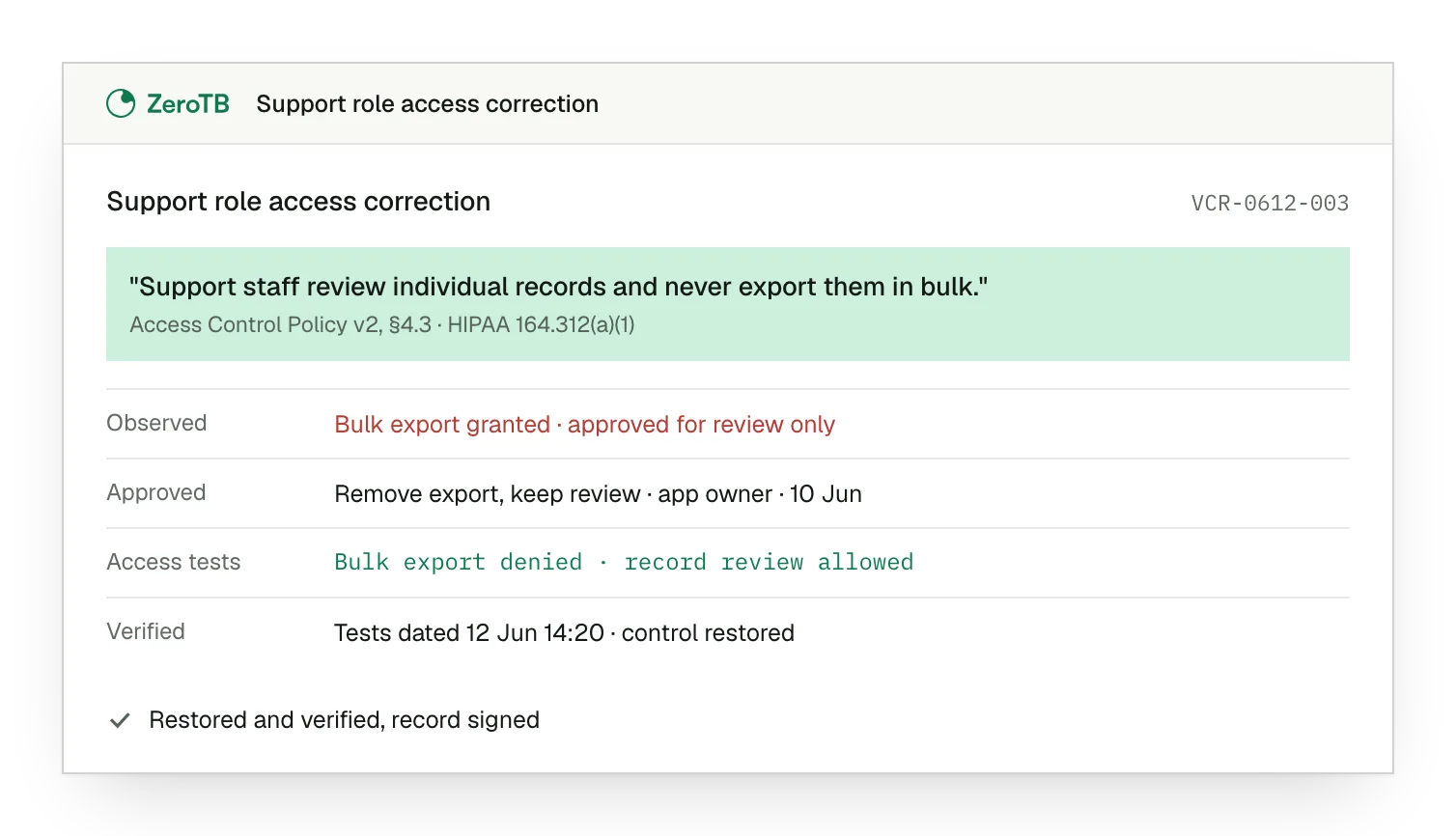
Excess export access. The support role has inherited bulk export, although its approved purpose is individual record review.
Approved role change. The application owner approves removal of the export grant and retention of record-review access.
Verified access results. The corrected role denies a bulk-export attempt and still permits an individual record review.
Recorded control restoration. A reviewer can read the dated tests beside the change and the decision approving it.
Access review checklist
Compare each role's intended work with the information and actions that its current permissions allow.
Review the procedure's dependencies and test whether authorized staff can obtain necessary information under its stated conditions.
Check the reasoning and implementation for logoff and encryption, including any documented alternatives and changed system conditions.
Give the system owner a proposed change that identifies excess access and the legitimate work to preserve.
Verify permitted and denied actions, then retain dated results with the approved change and responsibility for further checks.
Sources
- eCFR, 45 CFR 164.312: Technical safeguards, current text accessed November 4, 2026.
- eCFR, 45 CFR 164.306: Security standards, general rules, current text accessed November 4, 2026.
- HHS, HIPAA audit protocol, July 2018 update.
Related pages
HIPAA safeguards
Read about the administrative, physical and technical safeguards that apply to electronic protected health information.
Framework library
Browse related requirements across the frameworks that a compliance team may need to maintain.
Healthtech control operations
Read about the work of maintaining controls as healthtech accounts, applications and infrastructure change.
Start with the Pilot
Discuss access controls with our team through the eight-week Pilot. We map up to 25 commitments and take two real control gaps through approved correction and verified restoration. Each restored gap has a record of the change, approval and verification.