What does HIPAA 164.312(e)(1) require for transmission security?
HIPAA 164.312(e)(1) requires technical measures to protect electronic protected health information (ePHI) from unauthorized access during network transmission. Encryption and integrity controls are addressable specifications: the organization must assess whether each is reasonable and appropriate. The review should cover every connection in the transfer, with tests after changes that could affect its protection.
Checking the public endpoint leaves an unanswered question about a health information export: where does the data go next? A worker that forwards the export opens another connection. Its settings belong in the same review as the endpoint.
Transmission safeguards
Transmission security applies while ePHI travels over an electronic communications network. It is one of HIPAA's technical safeguards. Under 164.312(e), the assessment must address encryption and measures that detect improper modification of the transmitted information.
The control description needs enough detail for someone to inspect the transfer. It should say what information moves, which connections carry it and what protects those connections. An application-level statement about encryption gives the reviewer no clear boundary for the check. 45 CFR 164.312
Addressable encryption
Addressable encryption requires an assessment of what is reasonable and appropriate for the environment. If encryption meets that test, the organization must implement it. The assessment considers the risks to ePHI alongside the organization's capabilities, infrastructure and the costs of safeguards.
If the organization decides against the specification, it must document why and implement an equivalent alternative when reasonable and appropriate. The decision must still support the transmission security standard. Keep the assessment with the procedure for the affected transfer so its reasoning remains available. 45 CFR 164.306
The complete transfer route
Follow the information from its source to the recipient when defining the review. The route may include a proxy or a worker that forwards an export. An onward connection remains relevant when both services happen to run inside the organization's network.
Start with the route description, then compare it with the destinations configured in the application. For each connection, identify who controls the settings. If another organization operates a service, the review also needs to establish what evidence is available from that part of the route.
Protection between services
TLS protection can stop at an intermediary. A proxy can terminate a Transport Layer Security (TLS) connection, decrypt the request and open a new connection to an application. The settings on that new connection determine how it protects the information it forwards.
Suppose the transmission procedure requires encryption throughout this route. The reviewer needs to inspect the inbound and onward connections separately. Passing a test against the public endpoint leaves a question about the second connection: the test has not exercised its protection.
Encryption and integrity
Encryption and integrity controls address different risks to transmitted health information. Encryption protects confidentiality; integrity controls address improper changes that would otherwise escape detection. The selected mechanisms need to satisfy the organization's decisions for both properties on the connections under review.
The HHS audit protocol also examines how encryption keys are protected and who can create or modify them. Include those responsibilities in the procedure. When a certificate or trust configuration changes, the review should establish whether the intended recipient can still be authenticated.
Changes after review
A transmission check describes the route that existed when the test ran. A later export worker may introduce a destination that the reviewer has never examined. Its connection needs review even if nothing has changed at the existing public endpoint.
Changes to proxies, certificates and transfer code can also affect the safeguards. Inspect the affected connections against the approved procedure when those changes occur. Where the check lacks a current observation, keep the result unresolved until the connection can be examined.
Approval for corrections
The service owner must decide how a correction will preserve the required delivery. Enforcing encryption can stop a transfer if the recipient cannot accept the protected connection. That dependency needs a decision before the change is applied to the running service.
The change request should describe the gap and the transfer expected after correction. It may require an upgrade at the recipient or a different method of sending the information. The owner approves the configuration or code change after considering those requirements.
Tests before closure
A completed change still needs a test of the resulting transfer. Define what successful delivery looks like and which connection failures should stop it. For an encrypted connection, include a test in which the expected certificate validation fails.
Run these tests with synthetic data. The approved route should deliver it, while the unacceptable connection should refuse it without retrying through an unprotected route. If either test fails, or the connection cannot be observed, there is still work to resolve before closure.
Evidence of the restored control
The correction record should connect the observed gap to the result of the approved change. Retain the affected route, the before-and-after settings, the approval and dated test results. A reviewer can then see which connection the evidence covers and why the gap was closed.
HIPAA requires retention of specified policies, procedures and required documentation for six years from creation or the last effective date, whichever is later. Apply that rule to the required records. Set retention for supporting technical evidence through the organization's documented policy. 45 CFR 164.316
Continuing checks
A transmission check needs an owner after the first correction. Someone has to review failures and changes that affect the connections it covers. If the check loses access to a service, its old result cannot establish what is happening there now.
This is ongoing work between compliance and the teams running the services. ZeroTB's cloud and infrastructure work supports approved checks and corrections in those systems. It verifies the resulting state before closure and keeps the evidence with the commitment that prompted the work.
Transmission evidence
Use these records to connect the transmission policy, its implementation and the result of any correction.
| Requirement | What an auditor asks for | Where it comes from |
|---|---|---|
| Transmission scope | The ePHI transfers and connections covered by the transmission policy | Data flow descriptions, service inventories and current destination settings |
| Assessed safeguards | Decisions on encryption and integrity, including reasons for any equivalent alternative | Risk assessment and documented transmission procedures |
| Implemented encryption | Evidence that encryption operates where required and that keys are protected | Connection settings, test results and permissions for managing keys |
| Transmission integrity | The measures used to detect improper modification and evidence of their implementation | Integrity procedures, relevant configurations and verification results |
| Verified correction | The gap, approved change and results that support closing it | Change approval and dated observations in the Verified Control Record |
Framework requirements
| Framework | Control | What it covers |
|---|---|---|
| HIPAA | 45 CFR 164.312(e)(1) | Technical safeguards against unauthorized access while ePHI travels across a network |
| SOC 2 | CC6.7 | Safeguards for information as it is transmitted or otherwise moved |
| ISO 27001 | A.8.24 | Use of cryptography and the rules governing it, including cryptographic key management |
Example of securing an onward transfer
In this example, the review finds an unencrypted connection from an export worker to its recipient. The public endpoint already uses TLS. The approved procedure covers both connections, so the owner approves a correction for the worker and tests its delivery behavior.
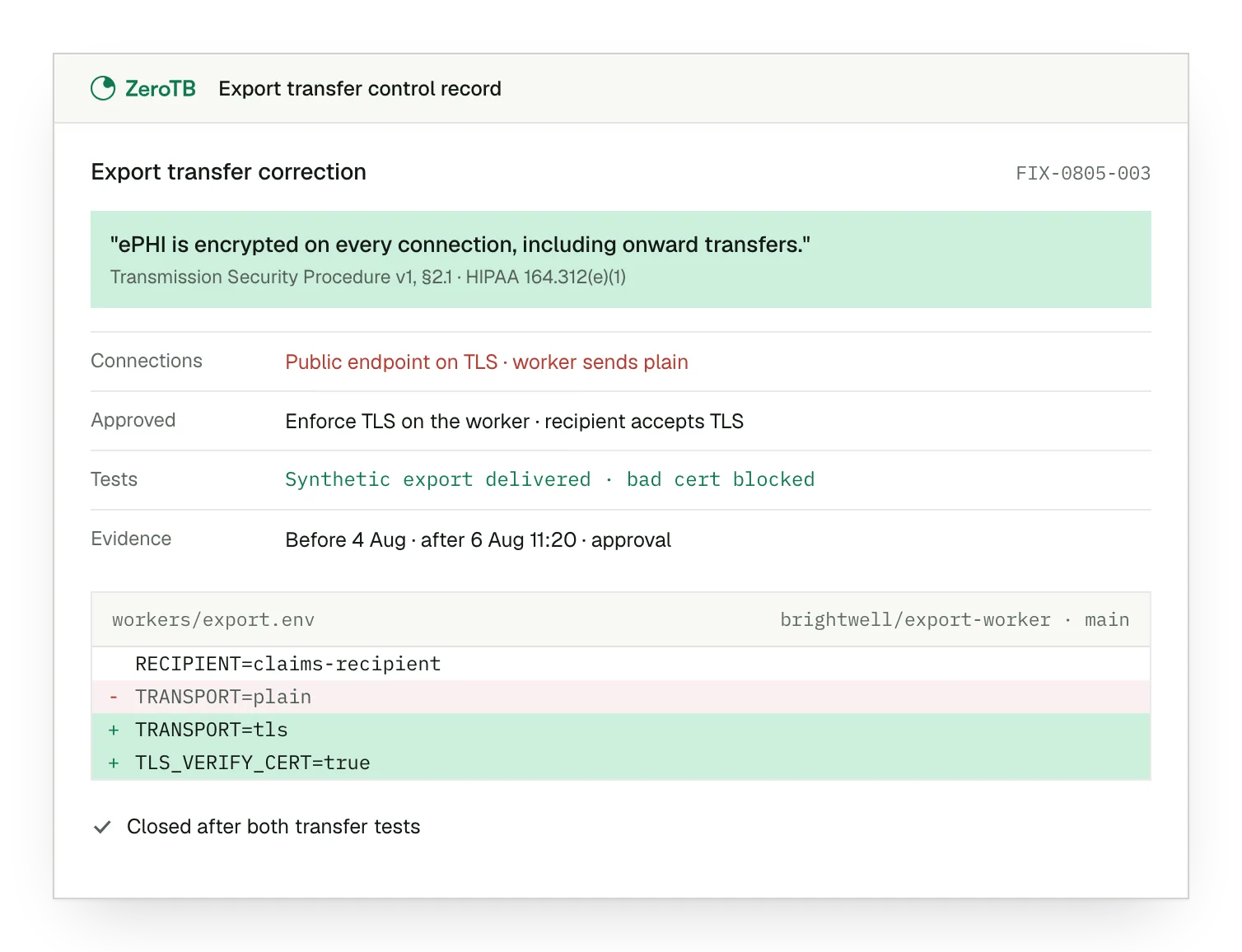
Transfer gap. The worker sends the export without encryption, although the procedure requires protection across both connections.
Approved change. The owner confirms that the recipient accepts TLS and approves enforcement on the worker's connection.
Paired tests. A synthetic export reaches the recipient, and a failed certificate check stops a second transfer.
Closure evidence. The dated results identify the tested connection and sit alongside the approval for its correction.
Transmission security review checklist
Identify the source and recipient, then follow the connections through any service that forwards the information.
Check the approved encryption and integrity decisions against the route, including the reasons for an equivalent alternative.
Confirm how the recipient will accept the protected transfer, then obtain the service owner's decision on the correction.
Agree which results will demonstrate protected delivery and rejection of an unacceptable connection after the change.
Store the route, approved change and test results together, with an owner responsible for reviewing subsequent changes.
Sources
- eCFR, 45 CFR 164.312: Technical safeguards, current text accessed November 4, 2026.
- eCFR, 45 CFR 164.306: Security standards, general rules, current text accessed November 4, 2026.
- eCFR, 45 CFR 164.316: Policies, procedures and documentation requirements, current text accessed November 4, 2026.
- HHS, HIPAA audit protocol, updated July 2018, transmission security sections.
- HHS, Encryption under the Security Rule, accessed November 4, 2026.
- AWS, HTTPS listeners and TLS termination, documentation accessed November 4, 2026.
- NIST, SP 800-52 Rev. 2: Guidelines for TLS implementations, 2019, certificate validation guidance.
Related pages
Technical safeguards
Explore the other HIPAA standards that protect access to electronic health information and its use.
HIPAA framework
See how technical, physical and administrative safeguards contribute to the wider HIPAA security program.
Compliance frameworks
Find the related controls and requirements that apply across the compliance programs your organization manages.
Start with the Pilot
Talk with our team about the eight-week Pilot. We map up to 25 commitments and take two real control gaps through verified restoration, with approved changes and a record of the resulting protection.