What does HIPAA 164.312(d) require for person or entity authentication?
HIPAA 164.312(d) requires procedures to check the identity claimed by anyone seeking access to electronic protected health information (ePHI). Person or entity authentication covers automated processes as well as people. A review should establish how each proves its identity, including during recovery, and whether a correction passes the agreed tests.
An authentication policy may describe employee sign-in in detail and say little about the services accessing the same health information. Those services can retain old credentials through changes in ownership or application settings. Reviewing both kinds of access reveals where the identity checks need attention.
Authentication scope
The scope includes each way a person or process requests access to ePHI. In its authentication entry, the HHS audit protocol asks about identified systems and applications, implemented procedures and automated processes. An employee directory accounts for only part of that scope.
The application may have a local login, a service connection or a recovery method with its own identity check. Reviewers need to know what proof each accepts. They can then compare these routes with the policy and identify any route the documented procedure leaves unexplained.
Access rights
An account can authenticate correctly and still have excessive permissions. Its identity check establishes who is making the request. The permissions govern what that identity can read or do afterward. Both protections matter, and a successful sign-in test cannot settle the permissions question.
HIPAA access control addresses the rights given to people and software. Restricting those rights can reduce exposure while leaving a weakness in authentication unchanged. A reviewer should be able to tell which protection a change corrected and which question, if any, still needs a decision.
Authentication methods
The regulation leaves room to select authentication suited to the environment. Section 164.306 provides that flexibility, while section 164.312(d) sets the identity-verification obligation. Neither makes one authentication product the answer for every system. The choice needs to address the risks of the access point.
NIST's implementation guide discusses multifactor authentication (MFA) and asks how methods will be maintained. This makes available support part of the choice, alongside the protection provided. Password management has a separate home in HIPAA's security awareness and training standard; it does not replace this wider review of authentication.
Service identities
The review should identify the process behind a service credential. If several integrations present the same credential, the credential alone cannot distinguish them. Separate identities give the reviewer a clearer basis for evaluating each connection and changing one without changing all of them.
That requires more than the account's name in an inventory. The useful record connects the process using the credential, the application accepting it and the owner who approves changes. When an integration moves to another owner, the review should establish who now controls its credential.
Recovery access
Recovery procedures need to establish identity before they restore access. A strong normal sign-in method can lose its protection if a recovery route accepts weaker proof. Include the reset or recovery procedure in the same review as the account it can restore.
Recovery also serves a real availability need. Before restricting a recovery account, the owner needs to decide how authorized staff will regain access when the primary route fails. The correction can then preserve an approved recovery method, with evidence of how that method verifies the person requesting access.
Changes after review
An unchanged identity policy does not mean the application still enforces it everywhere. Updates can introduce local logins, and temporary exceptions can remain after a migration ends. A review limited to the central settings would miss changes in how the application itself accepts an identity.
Connections through Okta or Google Workspace need to be considered alongside any independent application login. The same person may be able to use either route. Comparing both with the approved method shows whether the intended identity protection reaches the access that remains available.
Approved corrections
A correction needs to preserve the legitimate work that depends on the affected identity. Replacing a service credential can interrupt every process that uses it. The proposed change should identify those dependencies and explain how each approved process will authenticate after the change.
The responsible owner can then approve the replacement, its sequence and any temporary overlap needed during migration. An unresolved dependency is a reason to investigate before disabling the credential. Record retained exceptions with their purpose and review conditions so they remain visible after the immediate repair.
Verification tests
Verification needs to show that the system accepts valid proof of identity and rejects invalid proof. For a credential replacement, test the replacement and confirm that the retired credential no longer works. A successful configuration change alone leaves the second result unanswered.
Tests should also cover the approved task that depends on authentication, using a safe test arrangement for the affected system. Record which route was tested and when. If the result is unavailable or the observation predates the change, keep the gap open until current evidence supports closure.
Evidence without credentials
Authentication evidence should explain the result without exposing the means of access. Record the identity, relevant configuration, route and observed outcome. Keep passwords, tokens and private keys out of routine evidence records; the reviewer needs to understand the test without obtaining a usable credential.
For a correction handled by ZeroTB, the Verified Control Record connects the commitment, observed gap, approved action and verification result. Those connections let a reviewer follow the decision through to the changed state. The record should identify the affected route precisely enough to distinguish it from other access.
Continuing coverage
Ownership needs to continue after the immediate authentication gap is closed. A later migration or integration change may affect the same routes, and recovery procedures can change independently. The owner needs both scheduled reviews and triggers that call for a review when those changes occur.
Where SOC 2 and ISO 27001 cover the same systems and protections, an authentication result may also serve those requirements. Each use still needs its own scope. Evidence from one application says nothing about the result of an untested recovery route or a second application's identity checks.
Authentication evidence
Use these records to explain the authentication procedure, its actual coverage and the result of a correction.
| Requirement | What an auditor asks for | Where it comes from |
|---|---|---|
| Defined procedures | The approved authentication methods and the systems and applications to which they apply | Authentication policies linked to the current inventory of systems that handle ePHI |
| Person authentication | Evidence that the relevant applications apply the approved method when a person requests access | Identity-provider settings, application configurations and dated observations of the relevant sign-in routes |
| Entity authentication | The automated processes seeking access and evidence of how each establishes its identity | Service-account inventories, credential references without secrets, and records from the accepting application |
| Recovery authentication | The procedure for verifying a person requesting recovery and evidence that the procedure operates | Approved recovery procedures, application settings and records of controlled recovery tests |
| Verified correction | The gap, approved change and results showing that accepted and rejected identities behave as intended | Change records and dated tests linked to the affected route in the control record |
Related framework requirements
| Framework | Control | What it covers |
|---|---|---|
| HIPAA | 45 CFR 164.312(d) | Verification of a claimed identity when a person or entity seeks access to ePHI |
| SOC 2 | CC6.1 | Logical access protections for systems and information, including the authentication used within the defined scope |
| ISO 27001 | A.8.5 | Secure authentication methods and procedures suited to the access restrictions that the organization establishes |
Example of replacing a shared service credential
Two integrations share a credential in this example, and one is being retired. The remaining integration receives a separate credential. Testing first establishes that its work can continue, then confirms that the application rejects the shared credential after its removal.
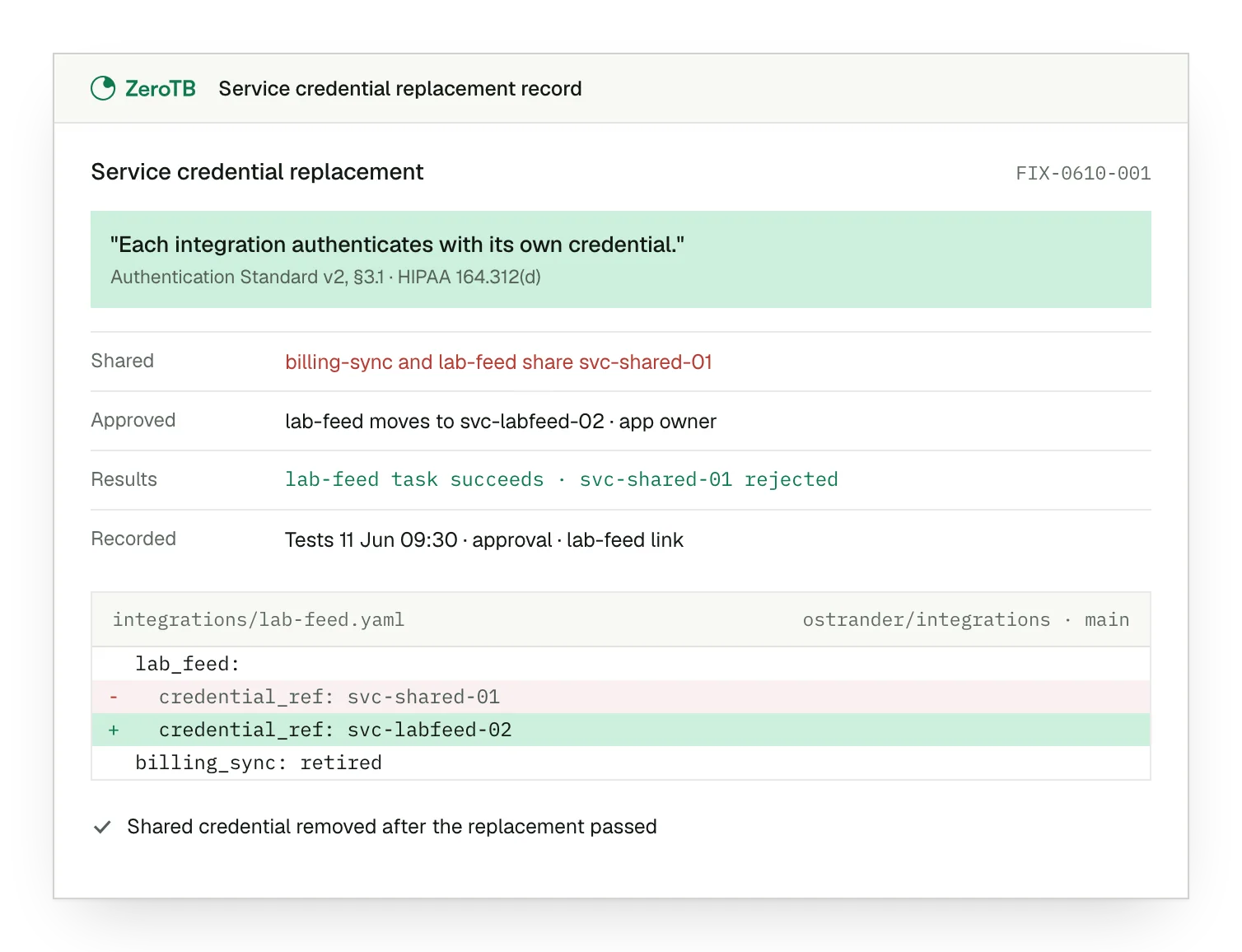
Shared credential. Both integrations currently authenticate to the ePHI application with a credential they share.
Approved replacement. The owner approves moving the continuing integration to a separate credential before removing the shared one.
Confirmed results. The application accepts the replacement credential for the continuing task and rejects the removed credential.
Recorded correction. The approval and dated test results identify which service connection the correction has restored.
Authentication review checklist
Identify an ePHI application and the people, automated processes and recovery routes whose identities it needs to verify.
Compare the method approved for each route with the method the application currently accepts, including retained exceptions.
Confirm which approved tasks depend on the affected identity before the owner decides how its authentication should change.
Agree what must succeed and what must fail, then use current results to judge the completed correction.
Check that the record connects the affected route, approval and observed result without containing credentials or unnecessary health information.
Sources
- eCFR, 45 CFR 164.312: Technical safeguards, current text reviewed November 2026.
- eCFR, 45 CFR 164.306: Security standards, general rules, current text reviewed November 2026.
- HHS, HIPAA audit protocol, person or entity authentication, July 2018 update.
- NIST, SP 800-66 Rev. 2: Implementing the HIPAA Security Rule, section 5.3.4, February 2024.
Related pages
Technical safeguards
Find the standards alongside authentication that govern access, activity records and protection of electronic health information.
HIPAA Security Rule
See where technical safeguards sit within the wider administrative and physical protections of a HIPAA program.
Compliance frameworks
Browse related requirements and control guidance across the frameworks used to manage systems and their operation.
Start with the Pilot
Talk with our team about the Pilot and the authentication gaps affecting your systems. The eight-week engagement maps up to 25 commitments, takes two real control gaps through verified restoration and records the approved changes with their results.