What does HIPAA integrity under 45 CFR 164.312(c)(1) require?
HIPAA integrity under 45 CFR 164.312(c)(1) requires policies and procedures to protect electronic protected health information against improper alteration or destruction. Its supporting specification addresses electronic checks for unauthorized changes. After a safeguard fails, test the repair and separately assess information exposed to change, so closing the system gap leaves any unresolved data investigation visible.
A healthtech team may discover that a processing job can overwrite records outside its approved scope. Removing that access stops further updates through the same path. It also leaves a question for the data owner: which records did the job change before the repair?
Integrity protection
The integrity standard covers the procedures that protect electronic protected health information, or ePHI, from improper changes and destruction. Where policy limits which operations can update records, the system needs to enforce that limit. Reviewers need evidence that the protection described in the policy operates.
Authentication of information and authentication of an account answer different questions. Authenticating ePHI concerns whether the information remains intact; person or entity authentication establishes who seeks access. Even a correctly identified account can have excessive rights, so the review needs to examine what that account can change.
Addressable mechanisms
Section 164.312(c)(2) calls for electronic mechanisms that help establish whether ePHI has suffered unauthorized alteration or destruction. This is an addressable specification. Section 164.306 requires an assessment of whether implementation is reasonable and appropriate in the organization's environment, followed by implementation when those conditions apply.
An organization that decides against implementation must document why. It must also implement an equivalent alternative when reasonable and appropriate. That record needs to connect the decision to the risks in the actual system. Later reviewers can then examine whether the reasons still apply.
Changes to health information
Updates and deletions both belong in a review of the operations that can change ePHI. People may initiate those operations directly, or software may perform them through a processing job. In either case, the operation should have a defined, authorized purpose.
For a job that updates one set of records, permissions to write elsewhere deserve examination. Deletion rights need their own justification if the job only makes updates. The approved scope gives the tester this result: the job can perform its intended updates, and attempts to change unrelated records are blocked.
Checks and their coverage
An integrity check needs a defined purpose and a clear boundary around the information it examines. The reviewer needs to know which records, operations or storage locations the result covers. That boundary also explains which information the result leaves unexamined.
The mechanism must distinguish the changes it is intended to detect from expected updates. A check designed around an older data format may need revision after an application change. Its coverage and interpretation should remain understandable to the person deciding what a failure means.
Drift after system changes
Changes to an application can leave previously adequate protection covering only part of its work. A migration may leave a job with temporary write permissions. A revised application may write to a new location. A reviewer relying on the previous assessment could miss either change.
Checks of cloud and infrastructure controls need to follow those changes. Reviewers need observations of the permissions now in effect and the places where the job now writes. If current observations are missing, the earlier review cannot resolve whether the protection still holds.
Approval before correction
The system owner decides which operations a correction must preserve. Removing all write rights could stop the excessive updates and also stop the job's legitimate work. Before approving the repair, the owner needs to see which updates will remain possible and which will be blocked.
ZeroTB drafts a fix against the approved commitment, then verifies the state after the authorized change. The responsible data owner handles the decision about any information already affected. Their assessment determines whether records need correction and supplies findings alongside the repair tests.
Verification after correction
A permission repair needs tests that cover both permitted and prohibited updates. For the processing job, a successful authorized update establishes that necessary work can continue. A blocked attempt to update unrelated records establishes that the unwanted path has been closed.
An approved test environment and suitable data let the team check behavior without damaging live health information. The evidence should identify the environment, test and time. If either test fails, the correction needs more work. If a result is missing, the reviewer still lacks evidence for closure.
Assessment of affected information
Testing the repaired permission cannot establish what happened to records before the repair. The data owner needs a separate assessment of the information the job could have reached. The time when the excess rights became active provides a starting point for identifying the relevant activity.
Activity records may show which operations ran and which records they touched. Gaps in those records limit what the assessment can establish. The findings should identify the information examined and the activity still unaccounted for. That makes any remaining investigation clear after the system repair is complete.
Recovery decisions
Recovery requires a decision about which version of the information to use. A backup may provide that version, but its existence does not prove that the current records are intact. The owner needs findings about the suspected changes before deciding whether that copy can support recovery.
An older copy may omit valid updates since the backup. Those updates matter when deciding whether to restore records or correct selected values. The data owner then checks the results of the selected correction. The permission test remains evidence about the safeguard, with a separate result for the corrected information.
Evidence and continued checks
The record should give the safeguard repair and the data investigation their own conclusions. One finding may establish that the job can no longer make unauthorized updates. Another may explain what happened to the information while that path was open, or leave the investigation ongoing.
The Verified Control Record connects the safeguard's correction to its approval and verification results. Later changes to permissions, processing or storage need further checks against the requirement. Dates and scope let the next reviewer see what was established and which subsequent changes need attention.
Integrity evidence
The evidence below connects the policy to implemented protection, then follows the response to a detected problem.
| Requirement | What an auditor asks for | Where it comes from |
|---|---|---|
| Defined integrity protection | The policy in force for the affected information, including protection against updates and deletions outside its approved use | Integrity policies and procedures, with the systems and operations in scope |
| Suitable electronic mechanisms | The mechanism in use, the information it covers and the decision supporting its implementation | The risk assessment and documented implementation decision, including any alternative measure |
| Protection in operation | Results showing how the safeguard prevents or detects the unwanted operations covered by policy | System settings, outputs from the integrity mechanism and test results |
| Response to detected changes | The response to the finding, with the information examined and any investigation still open | Investigation records and the data owner's findings, including work still open |
| Verified safeguard correction | Approval of the repair and tests showing the intended behavior afterward | Observations before and after the repair, its approval and dated tests |
Related framework requirements
| Framework | Control | What it covers |
|---|---|---|
| HIPAA | 45 CFR 164.312(c)(1) | Protection against improper alteration or destruction of ePHI, with electronic mechanisms addressed under 164.312(c)(2) |
| SOC 2 | CC8.1 | System change management, including the approval and testing used when correcting an integrity safeguard |
| ISO 27001 | A.8.26 | Application security requirements, including integrity protections defined for an application that handles ePHI |
Example of restricting a processing job
This example separates a completed permission repair from an ongoing investigation. A job retains excessive write rights after a migration. The owner approves removing those rights, tests establish the intended access, and the data owner continues examining the job's earlier activity.
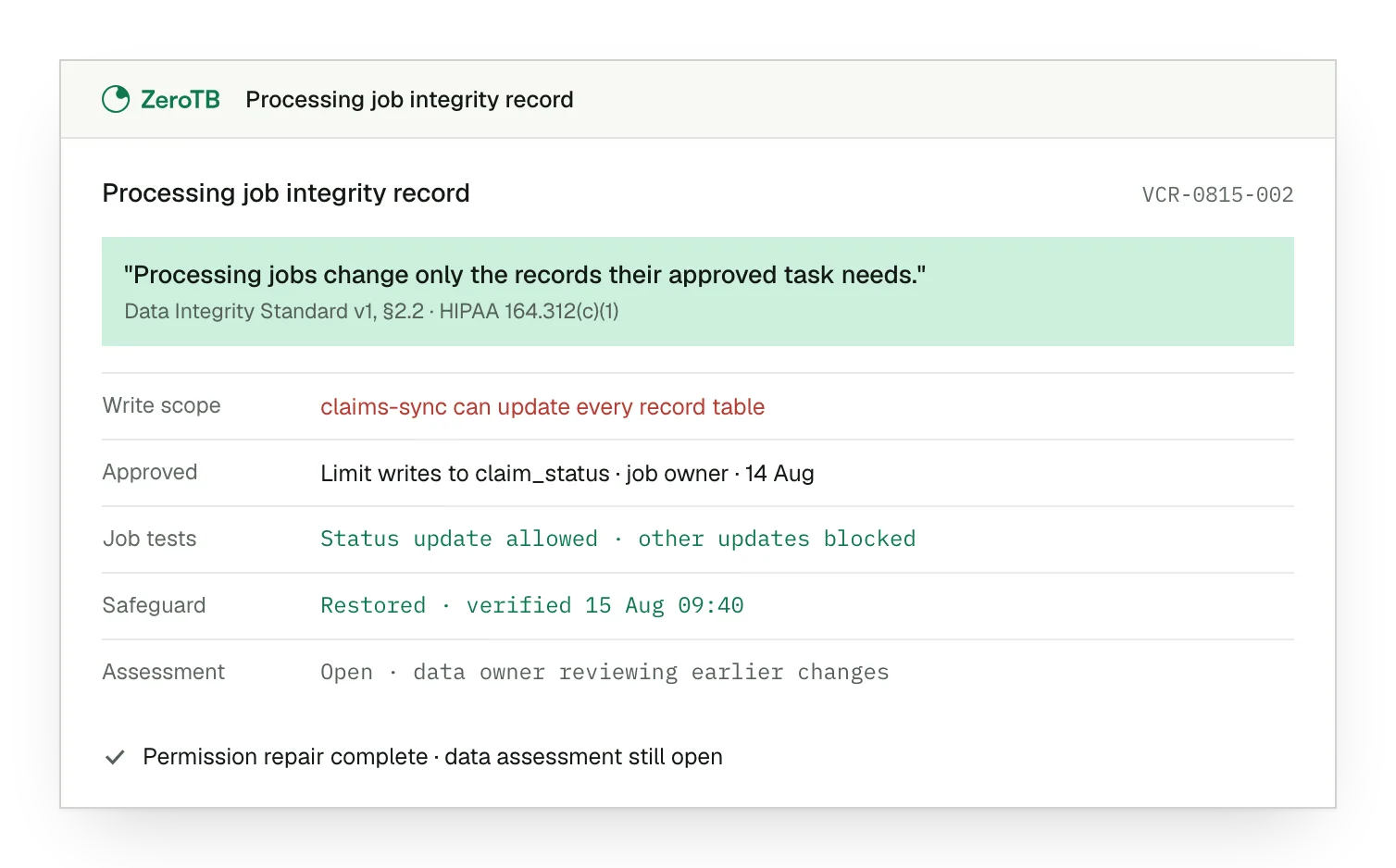
Excessive write rights. After the migration, the job can still update records outside its approved day-to-day work.
Approved permission change. The owner confirms the updates that must continue and approves removal of the extra rights.
Verified job behavior. The test results show an authorized update succeeding and an update outside scope being blocked.
Open data assessment. The two statuses show the repair complete and the investigation into earlier changes still open.
Integrity review checklist
Review where ePHI can be updated or deleted, including processing jobs and the permissions they use.
Check which information the integrity mechanism examines and whether current formats and locations remain within its scope.
Decide which operations must remain possible and which permissions or processing behavior the correction should remove.
Review evidence that the unwanted operation is blocked and that the authorized operation still works after correction.
Confirm who decides whether affected information needs correction, and retain those findings separately from evidence of safeguard restoration.
Sources
- Office of the Federal Register, 45 CFR 164.312: Technical safeguards, current text reviewed November 4, 2026.
- Office of the Federal Register, 45 CFR 164.306: Security standards, general rules, current text reviewed November 4, 2026.
- HHS, HIPAA audit protocol, July 2018 update, integrity provisions.
Related pages
HIPAA technical safeguards
Read how the neighboring technical standards address access, recorded activity, identity and information in transit.
HIPAA Security Rule
Review the safeguard groups that organize the wider HIPAA Security Rule program.
Compliance frameworks
Find control guidance for the other frameworks covered by the same compliance program.
Start with the Pilot
Talk with our team about the integrity safeguards you want to review. The eight-week Pilot maps up to 25 commitments and takes two real control gaps through approved correction and verified restoration. Each repair leaves a record of the result.