SOC 2 CC7.5 covers the work a company plans and carries out to recover after a security incident. That includes restoring operations, communicating progress and applying lessons from the incident. Before recovery ends, the responsible owners need results showing that the affected service meets the conditions for normal use.
A database is running again, but the application still reads an old copy. This is the kind of gap a recovery check should catch. Within SOC 2 CC7, CC7.5 concerns the affected operation, including the systems and information people need to resume work.
Recovery commitments
The company's recovery commitments establish what must work before normal operation resumes. Its policies and report identify the systems and processes covered by the control. The incident plan needs to translate that scope into conditions the recovery team can check in practice.
An application owner, for example, may accept recovery only when users can read the expected records through their permitted accounts. That decision gives the team a test with an observable result. The owner approves what the check means before anyone uses it to close recovery.
Recovery scope
Recovery scope needs to include the services that depend on the affected system. Restoring a database leaves questions about its application and the accounts used to administer it. The recovery team needs to know which of those parts the incident affected.
There is also a decision about order: some activities need to resume before others. NIST's recovery guide connects those priorities to business needs and system dependencies. Where several teams own parts of a service, this gives them a common reason for the recovery sequence.
Drift after the audit
A change in production can make a previously tested recovery procedure unreliable. Suppose an application moves to a different database, while the runbook retains the old destination. Following the instructions would restore that old copy, leaving the current application without the records it needs.
Periodic exercises can expose this problem before an incident forces the team to use those instructions. They also test recovery when a key person is unavailable. After a system change, the procedure's owner should review the affected steps and test any correction to the instructions.
Recovery conditions
A useful recovery check states what must work and what result would prevent closure. The condition should describe something the team can observe, such as an application retrieving the expected records through the approved access path after restoration of its database.
This gives the approver a clear basis for a decision. A test that cannot reach the application leaves its condition unknown. Completing an infrastructure task does not resolve that uncertainty. Keeping those results separate prevents an unfinished check from becoming a successful recovery decision.
Data restoration
The recovery test needs to establish whether restored data is fit for use. A successful backup job records an earlier activity, before anyone tried to restore the information. That status alone leaves the team without a result for the operation it wants to resume.
NIST's incident response guidance recommends checking recovery assets before use, then checking the restored systems. For the database example, the application needs to retrieve expected records. This would expose a connection to the wrong copy even if the intended database had been restored successfully.
Service dependencies
People may still be unable to use an application that has passed its own startup checks. Sign-in can fail, permissions can block access, or a connected service can remain unavailable. Recovery checks need to reach those parts of the operation too.
One way to check is to follow the work a user needs to resume. Signing in and retrieving a record through the application exercises that access path. An administrator opening the database through a maintenance tool tests a different route into the data.
Return to service
The return-to-service decision belongs with the people accountable for the affected operation. They need the validation results and any unresolved conditions before they approve normal use. A record of that decision should explain which operation was accepted and on what evidence.
Some decisions concern limited operation while other recovery work continues. In that case, the permitted activity and remaining restrictions need clear boundaries. The control record should preserve those limits so that a partial recovery decision cannot later appear to cover the entire service.
Recovery communication
Teams receiving a recovery update need to know what work can resume. CC7.5's points of focus include communications about the incident, recovery actions and prevention. The update to management and other relevant parties should reflect the checks completed so far.
For example, an available application may still contain records awaiting validation. That limitation matters to the people about to use it and belongs in the recovery update. Saving the message beside the decision also shows a later reviewer what recipients knew at that point.
Lessons and follow-through
Lessons from an incident become useful when they change the recovery process. The review should identify the cause of the incident and obstacles encountered during restoration. Those findings can lead to changes in configurations, instructions or checks that the team uses next time.
Each improvement needs an owner and a way to establish that it worked. An updated runbook can be checked in a later exercise using the affected recovery path. Keeping that result with the original finding shows whether the change addressed the weakness discovered during recovery.
Evidence of recovery
A reviewer should be able to follow the recovery decision from the record itself. The record needs the original commitment, the gap found, the approved change and the check afterward. Together, these explain why the owner accepted the operation as restored.
For a corrected control gap, ZeroTB retains those details in a Verified Control Record. The reviewer can compare the earlier observation with the result after the change and see who approved it. That connection makes the evidence useful beyond the incident team's immediate memory.
Recovery evidence
The records below help an auditor examine the recovery decision against the work and checks that preceded it.
| Requirement | What an auditor asks for | Where it comes from |
|---|---|---|
| Scope of recovery | A list of affected services and the conditions for their return | Incident plan, company policies and service records |
| Work completed | The recovery actions taken and approval for material changes | Completed runbook steps, change records and incident timeline |
| Operation checked | Results showing whether data, access and connections met the recovery conditions | Recorded tests of the restored operation |
| Decisions communicated | Approval to resume service, including restrictions explained to relevant parties | Recovery decision log and copies of status updates |
| Lessons applied | Corrections linked to incident findings, with a check of the result | Assigned improvements, completed changes and subsequent exercises |
Related framework requirements
| Framework | Control | What it covers |
|---|---|---|
| SOC 2 | CC7.5 | Recovery from security incidents, with communication and improvements based on the incident |
| ISO 27001 | A.5.27 | Use of lessons from information security incidents to improve controls |
| HIPAA | 164.308(a)(7) | Contingency planning for systems containing electronic protected health information, including data recovery |
Example of verifying a restored application
In this example, a check of the application catches a recovery gap that the database status misses. The restore has finished, but the application reads an old copy. After the owner approves a connection change, a new check finds the expected records.
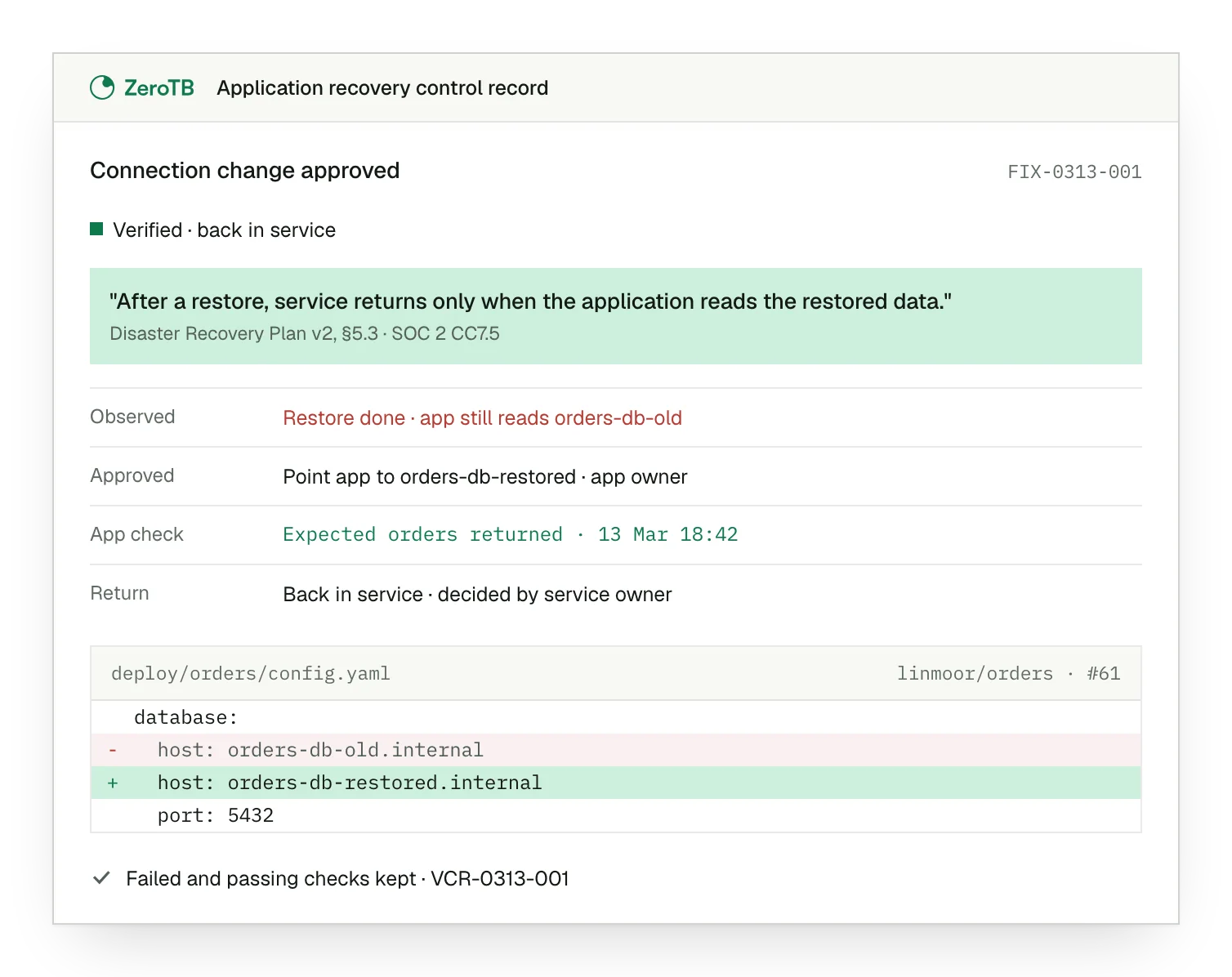
Wrong database connection. The database restore is complete, but the application still reads records from an outdated copy.
Approved connection change. The proposed correction points the application to the restored database and has its owner's approval.
Application check passed. The new check uses permitted access and retrieves the expected records through the application.
Recovery evidence retained. The earlier failure and successful check sit beside the approval and the return-to-service decision.
Recovery review checklist
Identify the recovery requirement and the conditions the owner accepts as evidence that the affected operation works.
Follow the affected application through its data, access paths and connections to identify the scope of recovery checks.
Compare recorded observations with the recovery conditions, including any failed checks or conditions that remain unknown.
Check that the return-to-service approval identifies the operation accepted, the supporting results and any restrictions that remain.
Connect each recovery weakness to an owner, a corrective action and a later check of the changed process.
Sources
- AICPA & CIMA, 2017 Trust Services Criteria with revised points of focus, 2022 revision; official redline, CC7.5.
- NIST, SP 800-61r3: Incident response recommendations, 2025, recovery recommendations.
- NIST, SP 800-184: Guide for cybersecurity event recovery, 2016, recovery planning and validation.
- HHS, October 2026 OCR cybersecurity newsletter, contingency planning.
Related pages
SOC 2 criteria
Explore the wider criteria and the role of system operations within a SOC 2 program.
Compliance frameworks
Follow the control libraries for the frameworks that apply to the systems your organization operates.
How ZeroTB works
See how approved corrections lead to verified results and a record of the restored control.
Start with the Pilot
Talk with our team about the eight-week Pilot. We map up to 25 commitments and take two real control gaps through approved correction and verified restoration. The records show the work and its results.