SOC 2 CC3 covers risk assessment: what could prevent the company from meeting its objectives, and how it decides to respond. There are four criteria, covering objectives, risk analysis, fraud and significant changes. Each guide below explains one part of that work.
Four risk assessment criteria
CC3.1
Clear objectives
Clear objectives give the company a basis for identifying risks to the outcomes it needs.
CC3.2
Risk analysis
Risk analysis weighs threats to those objectives and informs decisions about how the company will respond.
CC3.3
Fraud risk
Fraud assessment considers how deliberate misuse or deception could prevent the company from meeting its objectives.
CC3.4
Significant changes
Changes in the business or its environment can alter risks and the controls needed to address them.
Outdated risk assumptions
A risk assessment can lose its relevance when the service changes and the recorded assumptions stay the same. A service that starts handling sensitive data faces different consequences from unauthorized access. Controls chosen for its earlier use may leave that exposure untreated.
The service handles sensitive data
Earlier assumptions remain unchanged
New exposure goes untreated
Controls behind risk decisions
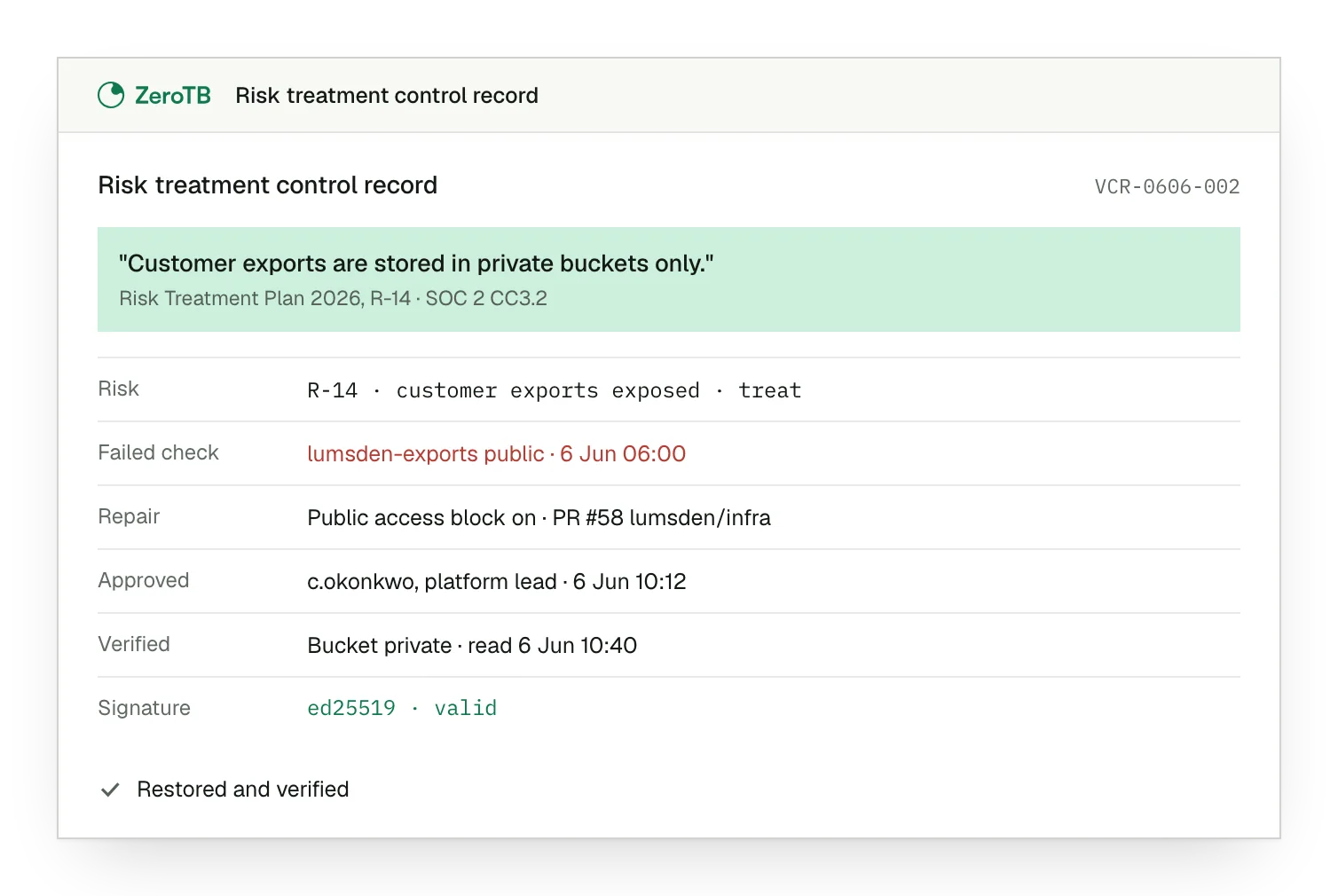
ZeroTB carries the control work through from the written commitment to a verified repair. We read the commitment, check the system and draft a fix for approval. After the repair, we check the result again and preserve a signed Verified Control Record.
Risk acceptance stays with management
Controls are checked against approved commitments
Each repair leaves evidence for review
Talk to our team
Talk with us about the control gaps behind your risk assessments and the work involved in keeping those controls effective.
FAQ
Who decides whether a risk is acceptable under CC3?
Management decides which risks the company accepts and which require treatment. Security, engineering and business owners contribute the system knowledge and potential consequences. ZeroTB uses approved commitments to operate the relevant controls. Decisions about acceptable risk and legitimate exceptions remain with your team.
What evidence helps explain our CC3 decisions?
The assessment should show which objectives were at risk and why the company chose its response. Review records explain later decisions. Evidence from the relevant controls shows whether the treatment is working. These records support assessment against the AICPA Trust Services Criteria.
Where can we find a SOC 2 risk assessment template?
See the CC3.2 risk assessment guide for a practical structure. It covers the risks, their significance and the response to each one. Linking those entries to objectives helps reviewers understand why a risk matters and follow the reasoning behind the treatment decision.
When should a CC3 assessment be reviewed?
The schedule comes from your program; changes can also trigger a review before that date. A change in objectives, data flows or permissions may affect the assumptions behind an accepted risk. The review establishes whether the existing decision and treatment still make sense for the service.
How does CC3 connect to other SOC 2 criteria?
CC3 concerns the assessment that informs the choice of controls. CC5 covers control activities, and CC9 covers mitigation of business interruptions and risks from business relationships. One risk can therefore lead to work under several criteria. The SOC 2 overview explains the wider set.
Can ZeroTB keep evidence of work on our risk controls?
Yes. ZeroTB keeps the commitments, checks and repair evidence together. ZeroTB adds ongoing work on the controls described in your policies and reports. The resulting records show the commitment, system state, action, approval and verification. Reviewers can trace how a particular control gap was resolved.
Start with the Pilot
The eight-week Pilot maps up to 25 commitments from your report and takes two real control gaps through verified restoration. You receive working controls and portable evidence records to support reviews of the completed work.