SOC 2 CC3.3 requires a company to consider fraud when assessing risks to its objectives. The assessment covers how people could manipulate reporting, misuse assets or abuse authority, including the pressures and opportunities involved. Connect relevant scenarios to safeguards, then check that those safeguards continue to work as responsibilities and systems change.
An access review can appear complete even when the administrator approved their own changes. Within SOC 2 risk assessment, CC3.3 asks how deliberate misconduct could undermine the company's objectives. The useful result is a clear connection between a fraud scenario, the response chosen and evidence that the response works.
Fraud scenarios
CC3.3 brings deliberate misconduct into the assessment of risks to the company's objectives. Its scope includes misleading reports, misuse of assets and corruption. In a software business, relevant scenarios can include fabricated review evidence, concealed incidents and unauthorized changes to sensitive records.
A useful scenario explains what someone could do, what gives them the opportunity and which objective the action could undermine. That detail makes the response easier to evaluate. An entry that says only "fraud risk" leaves the reviewer to infer the action and the safeguard.
Pressure and rationalization
A fraud assessment considers why someone might misuse authority and how they could justify doing so. Delivery targets or pressure to report a clean review can influence decisions. Such circumstances help explain a possible scenario; they do not establish that misconduct occurred.
The assessment also considers attitudes that could make an improper action seem acceptable, such as treating skipped approvals as routine. Connecting these circumstances to a specific process helps management choose a response. A general statement about employee integrity leaves that connection unexplained.
Conflicting duties
Conflicting duties can let one person make an improper change and conceal it. Someone who grants privileged access, approves the access review and edits its evidence can influence the whole record. A second approval may offer little protection if that person controls the approver's account too.
The assessment therefore needs to consider actual permissions alongside job descriptions. Separate roles on an organization chart can still share administrative access in a system. Comparing those rights with the review workflow reveals whether the stated separation exists where people perform the work.
Management override
Management override deserves its own scenario because authority can bypass an otherwise sound approval process. A senior decision-maker might authorize an exception or direct someone to skip a review. The assessment should explain how such decisions become visible and who can question them.
An emergency exception can have a legitimate purpose, but its record still needs to explain the reason, scope and subsequent review. Where the decision-maker has a conflict, another appropriate reviewer needs to assess the action. Seniority alone does not resolve that conflict.
Changes after the audit
Staff and system changes can create opportunities that the last fraud assessment did not consider. A departure may leave one administrator responsible for both changes and approvals. A replacement workflow may give that administrator permission to edit evidence that was previously protected.
These changes give the team a reason to revisit the affected scenario and its safeguards. CC3.4 addresses changes that could weaken controls. Linking the change to the assessment helps the reviewer see which earlier assumptions about responsibilities or permissions no longer hold.
Separation in small teams
Separate conflicting decisions wherever practical, then assess the duties that still have to remain together. A small team may need an administrator to perform several operational tasks. The response can place approval or review with someone outside those tasks, using records of the administrator's activity.
The risk that remains depends on what the review can detect and how soon it occurs. A review after an action may reveal misuse after damage has happened. Management needs that distinction when deciding whether review alone is adequate or whether permissions must also change.
Independent review
An independent reviewer needs evidence that the person under review cannot silently rewrite. A summary prepared by the administrator may omit the very action being assessed. Access to original activity records lets the reviewer compare what happened with the approvals that should explain it.
The review needs a defined scope and a route for unresolved differences. Missing records or an unavailable reviewer leave work outstanding. Retaining the review result, the evidence examined and any follow-up decision shows whether independent scrutiny occurred during the period being assessed.
Approved corrections
A correction should remove the identified opportunity for abuse while preserving legitimate work. ZeroTB reads the approved commitment, checks the current state and drafts a fix for human approval. After the approved action, it verifies the result and retains the record of the restoration.
For conflicting duties, the proposed change might remove self-approval rights or route review to an independent owner. The owner decides whether the proposed arrangement addresses the risk. Decisions about suspected misconduct and acceptance of remaining risk stay with the people responsible for those matters.
Evidence of operation
A completed change needs evidence that the safeguard operated. For a revised approval rule, a useful test checks whether self-approval is blocked and the independent reviewer can still act. The result should identify the account roles and workflow tested, with dated observations.
The Verified Control Record keeps the commitment, before-and-after state, action, approval and verification together. Sensitive investigation details can remain in a restricted case file referenced by the control record. The reviewer needs enough evidence to assess the correction without distributing the full investigation.
Fraud risk evidence
The records below connect the assessed fraud risk to the safeguard and its observed operation.
| Requirement | What an auditor asks for | Where it comes from |
|---|---|---|
| Fraud assessment | Relevant scenarios, affected objectives and the reasons for the chosen responses | Approved risk assessment and records of management's decisions |
| Conflicting duties | Who can perform, approve and review sensitive actions, including access to evidence | Role assignments, permission exports and documented duty conflicts |
| Controlled exceptions | The purpose, authority, scope and review of departures from the normal process | Exception approvals and records of subsequent review |
| Independent scrutiny | The actions examined, source evidence, reviewer and decisions on unresolved differences | Activity records, review results and follow-up decisions |
| Verified correction | The original gap, approved action and evidence that the revised safeguard works | Change records and dated tests of blocked and permitted actions |
Related requirements in other frameworks
| Framework | Control | What it covers |
|---|---|---|
| SOC 2 | CC3.3 | Assessment of fraud risks that could undermine the company's objectives |
| ISO 27001 | A.5.3 | Separation of conflicting duties and responsibilities to reduce opportunities for misuse |
| HIPAA | 164.308(a)(1) | Assessment and management of security risks to electronic protected health information |
Example of restoring independent approval
An independent approval step closes a gap when an administrator can approve evidence of their own access changes. In this example, the owner removes self-approval rights and assigns review to a separate role. Testing establishes that the revised workflow enforces that separation.
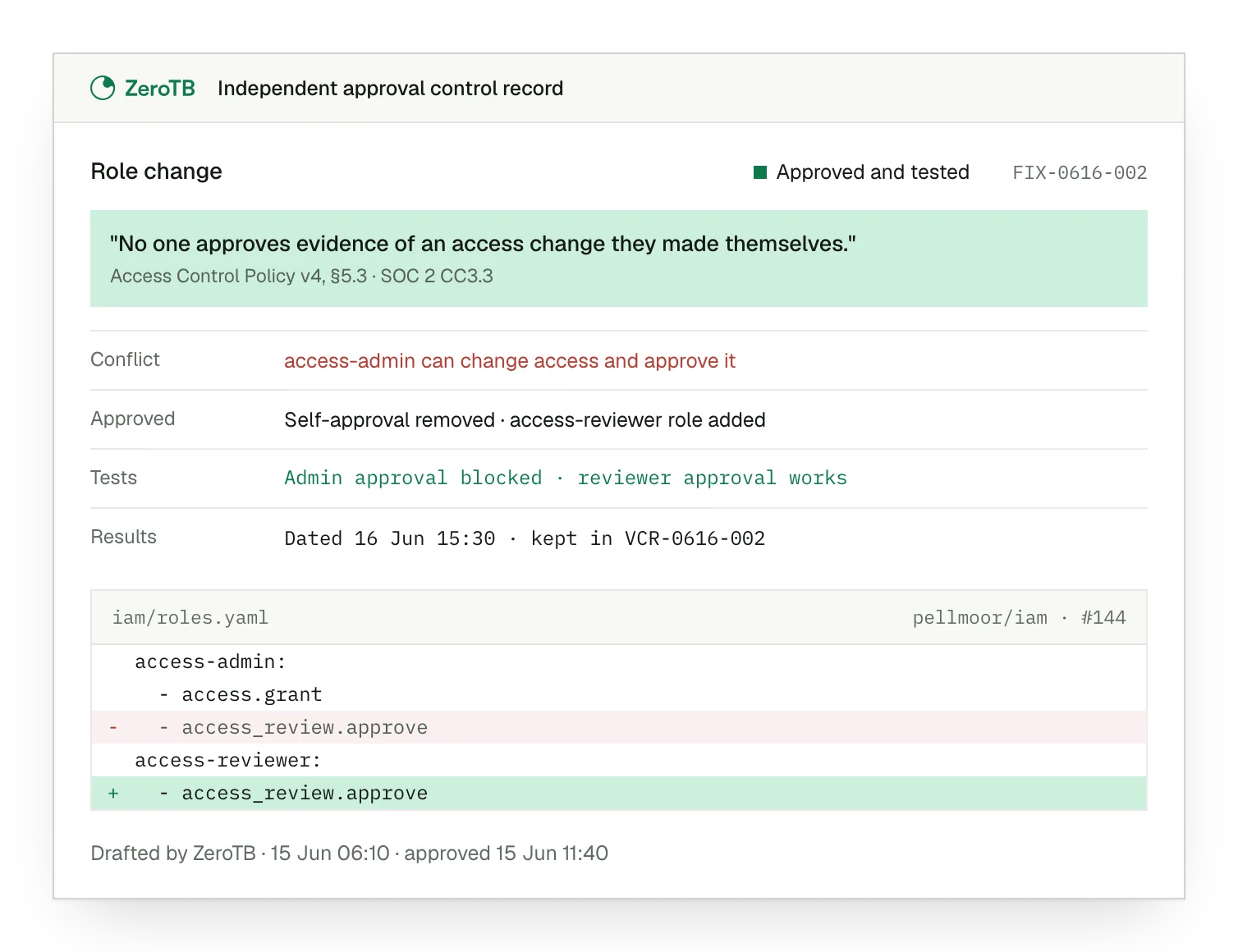
Conflicting permissions. The administrator can change privileged access and approve the evidence of that same change.
Approved role change. The owner approves removing self-approval rights and assigning the review to a separate role.
Tested approval paths. A test blocks the administrator's approval while allowing the independent reviewer to complete the review.
Retained test results. The dated test results remain with the approved change and the original duty conflict.
Fraud risk review checklist
Describe the improper action, the opportunity to perform it and the company objective it could affect.
Examine who can act, approve and alter evidence, then compare those permissions with the intended separation.
Decide which duties to separate, what independent review can achieve and who may accept the risk that remains.
Test a prohibited action and a permitted action through the changed workflow, retaining the results of both.
Keep decisions with their evidence and reconsider the affected scenarios after changes to roles, permissions or workflows.
Sources
- AICPA & CIMA, 2017 Trust Services Criteria with revised points of focus, 2022 revision.
- ISO, ISO/IEC 27002:2022, information security controls, 2022.
- HHS, Guidance on risk analysis, 2010.
- ZeroTB, SOC 2 compliance automation with human approval, 2026.
Related pages
SOC 2 criteria
Explore the requirements that connect fraud assessment with the rest of a SOC 2 program.
Compliance frameworks
Find guidance on related controls across SOC 2, ISO 27001 and HIPAA.
Governance, risk and compliance
See how approved risk decisions connect to controls that keep operating between audits.
Start with the Pilot
Talk with our team about the safeguards that need attention. The eight-week Pilot maps up to 25 commitments and takes two real control gaps through verified restoration, with records of the approved changes and their results.