SOC 2 CC3.2 asks a company to identify what could prevent it from meeting its objectives and assess how to manage those risks. The risk assessment should explain the likelihood and impact of each scenario. Review the assumptions when systems change, and check that a treatment works before reducing the assessed risk.
The service has changed since the last assessment. Does its risk register still describe what happens there? New integrations, data and permissions can make earlier judgments unreliable. This is where the assessment under SOC 2 CC3 needs attention between scheduled reviews.
Objectives and assessment scope
Start with what the company has committed to achieving. An objective gives the assessor something concrete to test: which failures could prevent the service from meeting it? Follow its dependencies across systems and processes to determine where the assessment needs to look.
The system inventory supplies part of that picture. Process owners explain the work that crosses system boundaries, including steps carried out by people or outside providers. Discuss those connections before settling the scope, because a service can depend on work that its own inventory does not describe.
Credible risk scenarios
A useful risk entry explains how a threat could exploit a weakness and affect an objective. "Unauthorized access" leaves several questions unanswered. An entry becomes assessable when it identifies the affected information, the route to it and the harm that access could cause.
Consider internal mistakes and failures alongside deliberate attacks and external events. Each scenario needs enough detail for its owner to judge whether existing safeguards address it. Group scenarios when they share a cause and response; separate them when different systems, consequences or owners require different decisions.
Likelihood and impact
Likelihood and impact ratings need reasons that another reviewer can follow. Likelihood describes how plausible the scenario is within the assessment's chosen period. Impact describes the harm if it occurs. Defined scales help reviewers compare risks without giving the same word several meanings.
A rating should point to the observations and assumptions behind it. If the team lacks evidence about a dependency, record that uncertainty and the information needed to resolve it. NIST's risk assessment guidance provides a method for examining threats, vulnerabilities, likelihood and impact.
Inherent and residual risk
Existing controls change the assessment only when their protection applies to the scenario. Inherent risk describes exposure before considering those controls; residual risk describes what remains with them in place. Record which controls support the residual rating and why they reduce the likelihood or impact.
A planned safeguard belongs with the proposed treatment until its effect has been checked. For an existing safeguard, the assessment needs current evidence that it covers the affected system. A policy approval alone leaves open whether the system behaves as the risk assessment assumes.
Risk assessment template
A SOC 2 risk assessment template should preserve the reasoning from objective to treatment decision. Start each entry with a risk identifier, objective, system or process, threat and weakness. Record the potential consequence so the owner can understand what the rating describes.
Include likelihood, impact, rating rationale, existing controls, inherent risk and residual risk. Add the treatment decision, risk owner, action owner, review date and conditions for reassessment. Link supporting evidence and record who accepted remaining exposure. With these fields, a later reviewer can follow the decision without repeating the investigation.
Changes between reviews
A new use for an existing system can change its risk. For example, an integration assessed for public content might later receive confidential records. The old access scenario still exists, but its consequences have changed. Reconsider the rating against the information now available to that account.
The assessor may only learn about this through a release, supplier review or incident investigation. Those processes need a way to refer changed assumptions for assessment. CC3.4 concerns changes that affect controls; CC3.2 provides the risk analysis that helps the owner decide what response is appropriate.
Risk decisions and ownership
The risk owner decides how much exposure to accept and which response to authorize. The action owner carries out the resulting work. These responsibilities may belong to different people, particularly when a business decision requires an engineering change across several systems.
An acceptance decision should explain the remaining exposure, the reason for accepting it and the conditions for review. When treatment is required, the decision needs an accountable owner and a due date. Governance, risk and compliance connects these decisions to the controls and responsibilities that implement them.
Review depth and timing
Review effort should follow the significance of the risk and the uncertainty in its assessment. A familiar scenario with current evidence may need a focused update. New sensitive data, unclear dependencies or conflicting observations warrant closer examination before the owner relies on an earlier rating.
The review schedule should reflect the company's commitments and how quickly the relevant circumstances change. Scheduled reviews provide a recurring opportunity to reconsider the assessment. Event-driven reviews address material changes between those dates. The assessment should identify which events require a decision before the scheduled review.
Verified treatment
The risk owner needs a result before treating a correction as effective. Compare the current observation with the approved commitment to establish what has failed. The proposed correction must explain the change and its expected result so the owner can judge whether to approve it.
Once the change is approved and completed, check that condition again. Leave the gap open if the check fails or the observation is missing. ZeroTB's Verified Control Record holds the commitment, before-and-after observations, action, approval and result together. That evidence supports the owner's next judgment about residual risk.
Assessment history
Assessment history should explain why the company changed a risk decision. Keep the earlier assessment alongside the changed assumptions, revised judgment and evidence used in the review. This history lets a reviewer distinguish a change in actual exposure from a change in scoring practice.
Completing a treatment and accepting the remaining risk are separate decisions. The treatment record explains what changed and how it was checked. The updated assessment explains the exposure that remains, who accepted it and when that judgment needs another review. Both records should refer to the same risk.
Risk assessment evidence
A reviewer should be able to follow the assessment through these records and understand the decisions made along the way.
| Requirement | What an auditor asks for | Where it comes from |
|---|---|---|
| Defined scope | Which objectives were assessed and how the team established the scope | Approved scope, system inventory and process records |
| Identified risks | Which scenarios the team considered and what harm each could cause | Risk register, incident reviews and relevant threat information |
| Explained ratings | Why the team chose each rating and what protection it credited to controls | Rating method, assessment rationale and current control observations |
| Authorized responses | The authorized decision, the person responsible for action and the next review conditions | Risk approvals, treatment plans and accepted exception records |
| Completed treatment | Evidence of the approved change and the check used to judge its effect | Change records, dated verification results and updated assessment entries |
Related framework requirements
| Framework | Control | What it covers |
|---|---|---|
| SOC 2 | CC3.2 | Identifying and analyzing risks to objectives as a basis for deciding how to manage them |
| ISO 27001 | A.5.7 | Gathering and assessing threat information that can inform risk judgments and protective action |
| HIPAA | 164.308(a)(1) | Security management, including risk analysis and risk management for electronic protected health information |
Example of reassessing an integration
In this example, confidential records have entered an integration assessed for public content. That change increases the harm an unauthorized account could cause. The updated assessment identifies the exposure, and the owner decides to restrict access before reviewing the risk that remains.
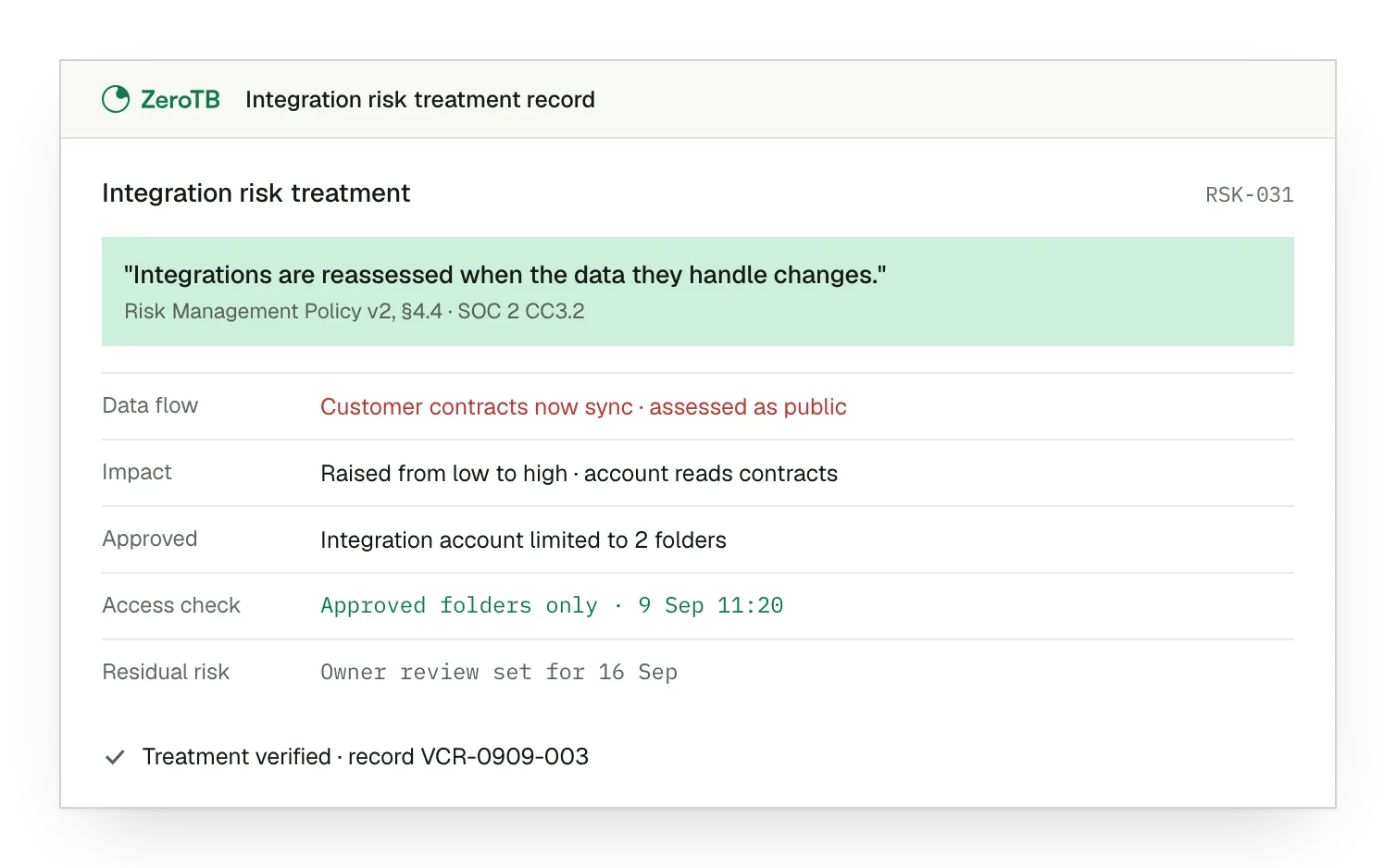
Changed data use. Confidential records now pass through an integration whose assessment still assumes it handles public content.
Revised risk judgment. The revised impact rating reflects the confidential information an unauthorized account could now read.
Approved access correction. The approved change limits the integration account to the records its work requires.
Verified treatment result. The permission check shows access is restricted, giving the owner evidence for another risk review.
Risk assessment review checklist
Look for systems or data flows that have changed since the assessment and identify which assumptions those changes affect.
Read the reasons behind a material rating and check whether the cited controls still protect the affected system.
Check who can accept the remaining exposure and whether the recorded decision covers the circumstances the company faces now.
Read the results attached to a completed action and confirm they demonstrate the condition the owner approved.
Find the next review date and the events that would require a decision before then.
Sources
- AICPA & CIMA, 2017 Trust Services Criteria with revised points of focus, 2022 revision.
- NIST, SP 800-30 Rev. 1: Guide for conducting risk assessments, 2012.
- HHS, Guidance on risk analysis, accessed November 4, 2026.
- ZeroTB, SOC 2 compliance automation with human approval, 2026.
Related pages
SOC 2 criteria
Read about the other criteria that shape how a company selects, operates and reviews its controls.
Compliance frameworks
Browse the control library for requirements that concern the same systems under other compliance frameworks.
Governance, risk and compliance
See how risk decisions inform the work of the people responsible for controls across the company.
Start with the Pilot
Talk with our team about the risk treatments that need continuing attention. During the eight-week Pilot, we map up to 25 commitments and take two real control gaps through verified restoration. Each correction keeps its approval and evidence together.