SOC 2 CC3.4 asks a company to identify and assess changes that could weaken its controls. A new service, supplier or operating model can change what those controls need to cover. The review should establish which controls remain suitable, which need revision and how the company will check the revised controls.
Existing checks may continue to pass after an acquisition, even though they cover only the original company. CC3.4 brings that changed scope into SOC 2 risk assessment. It gives the review a practical question: do the controls still cover the business as it operates now? The answer determines what needs to change and who decides.
Material changes
CC3.4 concerns changes that affect the suitability of existing controls. The source of a change may be outside the company, such as its operating environment, or inside it. Business activities, leadership, technology and supplier relationships all belong in the assessment when they affect how controls work.
Consider what the control relied on before the change. A service may now handle different data, or a departing manager may leave nobody responsible for exceptions. Project size alone says little about these effects. A small operational change can remove a safeguard that the company still needs.
Review triggers
A change needs to reach the control owner while there is still time to assess its effects. Acquisition planning and supplier selection are useful review points. They bring the proposed arrangement into view before it becomes routine, when the people responsible can consider how the controls will work.
The review can be proportionate to the change. Existing procedures may cover routine work whose assumptions have stayed the same. A new dependency or operating model requires another look at those assumptions. Keep the reason for the chosen review route with the decision so someone else can understand it.
Control scope
A passing check says little about systems it never examines. After a business change, the check may still work for every account on its original list. The unanswered question is whether that list includes all the accounts now covered by the company's commitment, including those introduced by the change.
Compare the systems, accounts, data and processes covered before the change with those covered afterward. This defines the scope of the assessment. An acquisition may add a workforce that uses a separate identity system; its accounts need a place in the review even while the systems remain separate.
Changed risks
A useful assessment explains what the change does to the risk. With a new supplier, information may go somewhere different and another party may operate a safeguard. The owner needs to understand those dependencies before deciding whether the controls already in place remain suitable for the changed arrangement.
The assessment may leave some controls unchanged and lead to revisions in others. Record why a check, its scope or its procedure needs to change. An accepted exception also needs its reason and review conditions recorded, so a later change prompts someone to consider whether that exception still fits.
Control ownership
Responsibility for assessing a risk does not always include authority to change the affected system. A compliance owner may identify the problem while an application team holds the permissions needed to correct it. The assessment needs to connect the decision with someone who can perform the work.
A reorganization can break that connection even when the technology stays the same. Check who now approves the response, who performs it and who reviews the result. People responsible for the business consequences retain decisions about acceptable risk and exceptions; a system observation supplies evidence for that judgment.
Approved responses
A proposed response should say which part of the control needs correction. If a new system is missing from a check, the work may be to extend coverage. If a responsibility has changed, the procedure may need a new owner. Each response follows from the gap the assessment found.
ZeroTB reads the commitment and checks it against the observed state, then drafts a fix for approval. It checks the result after the approved action. The Verified Control Record keeps that result with the commitment, before-and-after state, action and approval, so the reviewer can follow what happened.
Verification conditions
Testing must cover the part of the business that the change affected. Adding accounts to a list is one part of extending a control; the reviewer also needs evidence that the control works for those accounts. Decide what the test must establish before the correction goes ahead.
For a leaver control, test whether departed workers have lost the access the commitment covers. If the correction affects current workers too, check that they can still use their approved access. Keep the dated results beside the approval so the reviewer can see whether both conditions were met.
Incomplete observations
Missing observations leave a question about control coverage unresolved. A disconnected source may hide an entire newly added system, while an old export may describe accounts that have since changed. Without current evidence, the reviewer cannot conclude that the control covers the expanded environment.
A missing observation and an observed failure need different responses. The first calls for restoring visibility or obtaining current evidence; the second needs a decision about the failing control. Keep these states distinct in the review record, including who owns the next action and what would resolve the uncertainty.
Continuing checks
Further changes can leave a repaired control with the same coverage problem. The revised process needs an owner responsible for later additions to its accounts, systems or services. That owner needs a route for raising changes that the existing check cannot handle within its current scope and assumptions.
Continuous control monitoring supplies current observations from the systems it covers. Leadership changes, new commercial dependencies and external conditions also need management's attention, even when no system setting changes. Those reviews help determine whether the approved operating conditions still make sense for the business the company is running.
Evidence for change reviews
The records should let a reviewer follow the change from the reason for assessment to the owner's decision and the result.
| Requirement | What an auditor asks for | Where it comes from |
|---|---|---|
| Identified change | The change that started the review and when it became known | Acquisition plans, supplier decisions, service proposals or records of changed operating conditions |
| Assessed scope | The scope before and after the change, including newly added systems or people | Scope comparisons and inventories linked to the affected control commitments |
| Risk decision | The owner's reasons for keeping or revising a control and accepting any exception | Risk review records, owner decisions and any approved exceptions |
| Approved response | The approval for the response and the person responsible for the work | Change records or approved actions linked to the assessment |
| Verified result | The test results that support closure or explain why the gap remains open | Verification results and the record of the correction |
Related framework requirements
| Framework | Control | What it covers |
|---|---|---|
| SOC 2 | CC3.4 | Assessment of business and environmental changes with a potential effect on controls |
| ISO 27001 | A.5.8 | Security within project management, including work that changes the business or its systems |
| HIPAA | 164.308(a)(8) | Technical and nontechnical evaluations in response to changes affecting electronic protected health information, as well as periodic evaluation |
Example of extending leaver checks
The company in this example has acquired a business with a separate identity system. Its leaver check still examines only the original workforce. Extending the check brings the acquired accounts into scope, with tests of departed workers' access and the approved access that current workers retain.
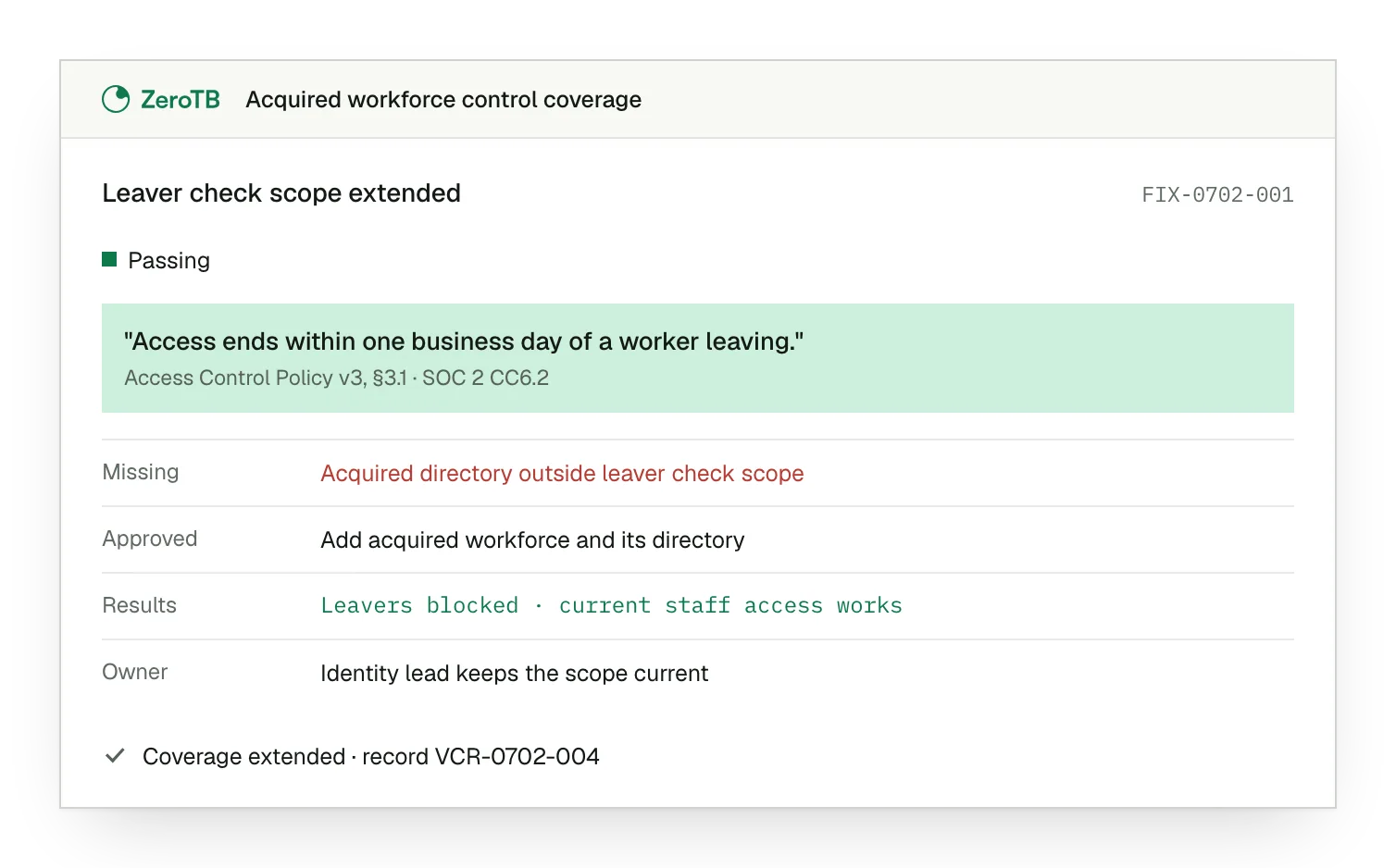
Missing workforce coverage. The leaver check omits accounts in the acquired business's separate identity system.
Approved scope change. The owner approves adding the acquired workforce and its identity system to the check.
Access results checked. Tests show departed workers' access removed and current workers' approved access still working.
Continuing responsibility assigned. An assigned owner keeps the check's scope current as the acquired business changes accounts.
Change review checklist
Describe what changed in the business and which systems, people or activities now fall within the commitment.
Identify the assumptions the change affects, then record which risks or responsibilities the owner needs to reconsider.
Approve the proposed correction with the responsible owner, including the conditions for any exception that remains.
Check whether the revised control works across its new scope, leaving gaps open when the evidence is incomplete.
Keep the assessment with its approval and results, and identify who maintains coverage when the business changes again.
Sources
- AICPA & CIMA, 2017 Trust Services Criteria with revised points of focus, 2022 revision.
- ISO, ISO/IEC 27001:2022 overview, 2022.
- HHS, HIPAA audit protocol, updated July 2018.
- ZeroTB, SOC 2 compliance automation with human approval, 2026.
Related pages
SOC 2 criteria
Read about the wider criteria and how they relate to the controls the company operates.
Compliance frameworks
Find related controls in the library and follow their requirements across the frameworks the company uses.
Governance, risk and compliance
See how risk decisions reach control owners and the teams responsible for correcting the gaps they find.
Start with the Pilot
Our eight-week Pilot maps up to 25 commitments and takes two real control gaps through approved correction and verified restoration. Talk with our team about changes in the business and the controls that need attention as a result.