SOC 2 CC3.1 requires the company to set objectives clear enough to assess what could prevent it from achieving them. Start with the service promises, define their scope and agree what departures management will accept. A changed promise also calls for a review of the objectives, risks and controls based on it.
The last risk assessment may still use an agreement that the company has since replaced. If its objectives describe the old promise, the assessment can miss what matters now. SOC 2 CC3 starts with this problem: CC3.1 concerns the objectives used to assess risk.
Objectives for risk assessment
CC3.1 makes clear objectives the starting point for identifying and assessing risks. An objective describes an intended outcome in terms that people can use to judge a threat. It gives the risk assessment a specific service condition to protect.
An audit milestone alone leaves that condition undefined. A team can complete its audit tasks without explaining which loss, interruption or unauthorized activity would prevent the service from meeting its commitments. Clear objectives help different reviewers recognize the same potential failure and discuss its consequences.
Service commitments
Service promises give an objective its purpose. They may appear in customer agreements, company policies or the SOC 2 report. The corresponding system requirements describe what has to happen in the systems and processes for the company to keep those promises.
Keep the source and version beside the objective so a reviewer can trace the wording to the agreement behind it. If two documents describe the promise differently, ask the responsible owners to settle the meaning. That decision gives the assessment a consistent starting point.
Scope and dependencies
The objective's scope determines which systems, data and activities the risk assessment must consider. A service name alone may leave the boundary unclear. Describe the relevant operations and information so reviewers can identify which parts of the service could prevent the intended outcome.
Include dependencies that affect that outcome, including responsibilities held by suppliers. A supplier's role may change how the company meets a commitment while leaving the commitment itself unchanged. Recording who does what helps the reviewer identify whether the company or the supplier needs to act.
Risk tolerance
Risk tolerance gives reviewers a common basis for deciding which departures from an objective need action. Management needs to explain the acceptable variation in the context of the company's commitments. That explanation helps reviewers make consistent decisions about the significance of a risk.
Use a measurable limit where the commitment supplies one, and describe other decision conditions clearly. An internal target that allows a wider departure than a customer agreement needs attention. The people authorized to decide what the company promises and accepts must resolve that difference.
Changes after the audit
A change in the service promise can make an objective outdated while its controls continue to work. Recovery expectations are one example. An agreement may call for a different recovery outcome, yet the next assessment still considers only the failures relevant to the earlier promise.
The checks may show passing results because they still test the earlier condition. The team needs to compare the current promise with the objective behind those checks. That comparison reveals whether the results say anything useful about the recovery outcome the company now owes.
Objective ownership
The objective needs a management decision about its meaning and limits. The service owner can explain the operating constraints, including what suppliers do. Someone with authority to accept risk then needs to decide how those constraints affect the outcome the company is prepared to promise.
Software can put the clauses and observations together for that conversation. It can also identify an unanswered question or propose an interpretation. If that interpretation changes the outcome or scope, it needs human approval before anyone uses it as the company's agreed position.
Objective correction
A correction needs to show the owner what changed in the underlying commitment. Place the previous objective beside the proposed revision, including its outcome, scope and limits. The owner can then decide whether the revised wording expresses the promise the company needs to meet.
Once approved, the objective needs its source, owner and approval date, together with the reason for the revision. Everyone assessing the risk can refer to that version. ZeroTB uses approved commitments as the basis for checks and retains the decisions behind corrections; people authorize material changes.
Dependent risk decisions
A revised objective needs to reach the risk decisions and controls that depend on it. CC3.2 addresses identifying and assessing risks. Its assessment needs to consider the revised outcome before the team can decide whether the existing response remains sufficient.
Some revisions clarify wording without changing the required controls; others reveal work that the service needs. Record that distinction and the reason for the decision. Where a control must change, assign the action to its owner and retain the connection to the objective that prompted it.
Verification and closure
Approval establishes the revised objective; verification establishes whether the required follow-up work is complete. A reviewer should be able to trace the new objective into the affected assessment and control decisions. An operational correction also needs evidence that the resulting state meets its approved condition.
Keep these conclusions separate in the record. The objective review may be complete while a recovery test or other control action remains open. A Verified Control Record preserves the commitment, before-and-after state, action, approval and verification for a completed restoration, so reviewers can inspect what was checked.
Ongoing review
A planned review date is only one reason to revisit an objective. A contract revision or a change to a system or supplier can also alter its assumptions. The review process needs a way to send those changes to the person responsible for the objective.
Keep the earlier versions so the next reviewer can see which objective applied at the time of a decision. Record why the team changed the wording or kept it. When another team takes responsibility, that history helps it find unfinished actions and understand the choices already made.
Evidence for objective reviews
A reviewer needs to see where the objective came from and what the company decided because of it.
| Requirement | What an auditor asks for | Where it comes from |
|---|---|---|
| Clear objectives | What the service must achieve and which promise each objective addresses | The approved objectives, with the relevant agreement, policy or system requirement beside them |
| Defined scope | Which operations and information the objective covers, including dependencies | Service descriptions and inventories, with records of who holds each internal or supplier responsibility |
| Risk tolerance | What management will accept if performance departs from the objective | Approved limits and decision conditions, with the reasons management accepted the risk |
| Assessment links | Which risks the team considered and why it selected each response | The assessment, linked to the version of the objective used for those decisions |
| Reviewed corrections | What changed, who approved it and which control actions remain open | Previous and revised objectives, approval records, assigned actions and results of completed checks |
Related framework requirements
| Framework | Control | What it covers |
|---|---|---|
| SOC 2 | CC3.1 | Objectives clear enough to identify and assess risks to the intended outcomes |
| ISO 27001 | A.5.1 | Approved and reviewed information security policies that give direction to the organization's security work |
| HIPAA | 164.308(a)(1) | Security management, including analysis and management of risks to electronic protected health information |
Example of resolving an outdated objective
A revised objective can be ready for use before the related control work is complete. Here, a changed recovery promise prompts management to approve a new objective. The assessment now uses that objective, but the service owner still needs to test recovery.
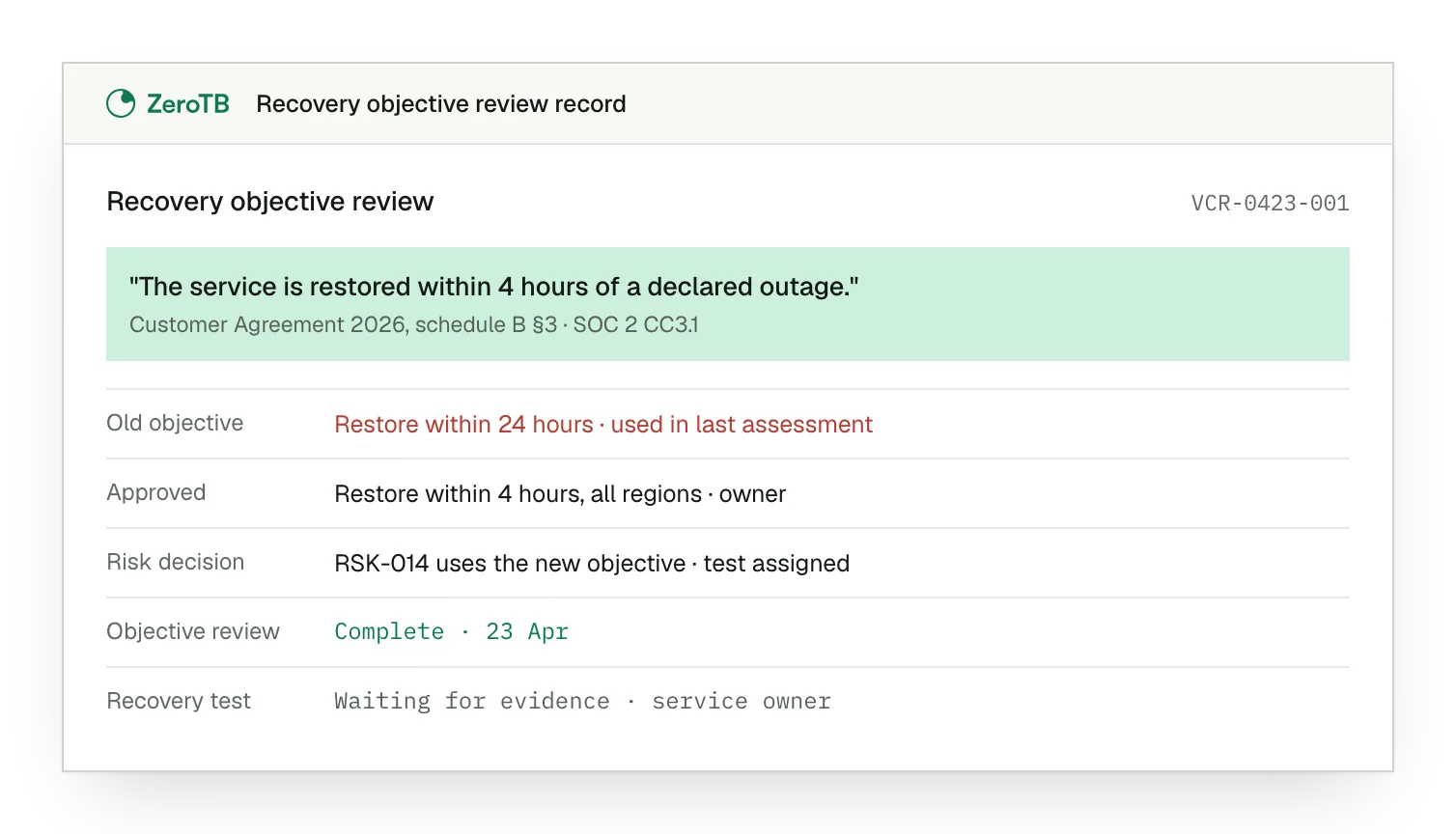
Changed recovery promise. The agreement now describes a recovery outcome missing from the objective used in the last assessment.
Approved objective revision. The owner has approved the new outcome and scope against the changed agreement shown beside it.
Updated risk decision. The assessment uses the new objective and assigns the recovery test to the service owner.
Separate completion states. The review is complete, but the test still awaits evidence that recovery meets the approved condition.
Objective review checklist
Read the current agreement or policy alongside the objective. Check whether both describe the same outcome, scope and limits.
Find the approval for the objective's meaning and the decision about which departures from the outcome management accepts.
Open the assessment linked to the objective and inspect the reasons for changing controls or retaining the existing response.
Check the results of the required control work. An approved objective can still have actions waiting for verification.
Sources
- AICPA & CIMA, 2017 Trust Services Criteria with revised points of focus, 2022 revision.
- HHS, Guidance on risk analysis, accessed November 4, 2026.
- ZeroTB, SOC 2 compliance automation with human approval, 2026.
Related pages
SOC 2 criteria
Explore the wider requirements that connect objectives, risk assessment and the controls protecting the service.
Compliance frameworks
Read the control guidance for the other frameworks that apply to the company's work.
Governance, risk and compliance
Connect management decisions with the work needed to keep approved controls operating between audits.
Start with the Pilot
The eight-week Pilot maps up to 25 commitments and takes two real control gaps through approved correction and verified restoration. Talk with our team about where current commitments and control work need to connect.