What does ISO 27001 A.8.5 require for secure sign-in?
ISO 27001 A.8.5 concerns secure authentication when people or services access systems and information. Choose authentication methods according to the access risk, then check where those methods are enforced. Include fallback accounts and recovery, and test both blocked and permitted entry after correcting a gap.
An application can offer company sign-in and a separate local login on the same page. The first may enforce multifactor authentication (MFA), while the second accepts a password alone. Both lead into the application, so both matter when assessing the approved authentication requirement.
Authentication requirements
A.8.5 concerns how systems establish that a person or service requesting access is who it claims to be. The method should fit the information being accessed and the consequences of someone impersonating an authorized account. The approved authentication policy gives the review its starting point.
State the required method for each relevant kind of access, including administration and unattended services. Authentication establishes identity; permissions determine what that identity can do afterward. Keep that distinction clear when reviewing a failure, because a stronger login alone cannot correct excessive permissions.
Sign-in routes
An application's authentication review starts with the ways people can enter it. Company single sign-on (SSO) may handle most employee access, with local accounts available to administrators. Password resets and recovery deserve attention too, because they can change the credentials that the application accepts.
Record which accounts can use each route and where its rules are enforced. The application owner can then explain why an alternative route exists. If it remains necessary, the review needs to establish how it is protected; otherwise, the owner can consider removing it.
Enforced sign-in rules
Check whether the application requests the factors that its sign-in policy requires. An account can be enrolled in MFA and still use a route that never asks for it. Read the account's assigned policy and exclusions, then test the resulting behavior.
Where an application accepts passwords, review the settings against the approved password requirements, including its response to failed attempts. The test record should identify the route and account used. That detail explains which protection was observed and prevents one successful test from standing for every account.
Account recovery
A recovery review follows the account through the reset and into its next sign-in. It should establish how the process checks the requester's identity before accepting a replacement factor. The reviewer then checks whether the account still has to meet its approved authentication requirements.
NIST's account recovery guidance describes recovery methods and notifications that can reveal fraudulent recovery. This is technical guidance for designing the process. During testing, follow that process to completion and attempt sign-in, so the evidence shows what protection applies to the recovered account.
Emergency access
A fallback account can be necessary when the identity provider fails. Its purpose is to let an administrator recover service during that outage. Before removing the account or changing its authentication, check whether the proposed correction would also prevent that recovery work.
If the account stays, its owner must approve the safeguards and permitted use. Record who controls its credentials and the conditions for reviewing its continued need. A forgotten setup account may have no recovery purpose, but that distinction needs an owner decision before access changes.
Service authentication
An unattended service needs an authentication method that suits how it runs. Employee sign-in checks cannot establish whether a service key or other machine credential is properly controlled. Identify the service using the credential, its owner and the systems that accept it.
Review how the credential is issued, protected, replaced and revoked. Before changing it, establish which dependent jobs must continue to run. Verification should demonstrate that the intended service can authenticate after the change and that the retired credential no longer provides access where it was removed.
Changes between reviews
The identity policy can stay unchanged while an application's sign-in protection weakens. A new account exclusion or a changed recovery setting may be enough. The reviewer needs application settings as well as relevant identity records from Okta or Google Workspace to understand the access now available.
Choose a check schedule and owner for the commitment, taking account of the system's risk and changes that warrant another review. A lost connection or stale observation leaves a question unanswered. Obtain current evidence before deciding whether the route still provides the required protection.
Approved corrections
The application owner needs to see the failure and the access that a correction must preserve. That makes the proposed change reviewable: it may remove a route, adjust its authentication or retain an exception with approved safeguards. The decision belongs with the record of the gap.
ZeroTB checks connected systems against the approved commitment and drafts the fix. People approve material changes before they proceed. After checking the result, it keeps the observations, action, approval and outcome in the Verified Control Record, where the reviewer can follow what happened to the original gap.
Verification before closure
Test the changed route before closing the gap. The expected results should already be agreed: unwanted entry fails, and necessary access works under the approved conditions. Where a repair changes recovery, include a test of the account after it has recovered access.
Keep the account type, route, test time and outcome with the change approval. These details establish what the test proves without exposing passwords or recovery secrets. If either result fails, or testing cannot establish it, leave the gap open for the owner to resolve.
Authentication evidence
Keep the rule, account scope and test results close enough that a reviewer can follow why the authentication gap was closed.
| Requirement | What an auditor asks for | Where it comes from |
|---|---|---|
| Defined authentication scope | The authentication rule and the systems and accounts included in it | The approved policy, system inventory and lists of application accounts |
| Enforced sign-in protection | The policy assigned to the tested accounts and the observed sign-in results | Identity-provider settings, application configuration and dated results from sign-in tests |
| Protected account recovery | The identity check used during recovery and the account protection afterward | The recovery procedure and reset approval, followed by a sign-in test |
| Controlled fallback access | The purpose of the exception and the decision to keep it | Approved exception records and the procedure for using emergency access |
| Verified correction | The observed failure, approved repair and tests showing the protection after repair | The approval and dated observations retained with the completed change |
Related framework requirements
| Framework | Control | What it covers |
|---|---|---|
| ISO 27001 | A.8.5 | Establishing identity through authentication appropriate to the access risk |
| SOC 2 | CC6.1 | Logical access security for the systems and information included in the examination |
| HIPAA | 45 CFR 164.312(d) | Confirming the identity of a person or entity requesting access to electronic protected health information |
Example of restoring protected account recovery
In this example, an administrator completes account recovery and can then enter with a password alone. The approved rule requires MFA. The control record follows the recovery change through approval and testing, showing that the administrator regains access with the required protection.
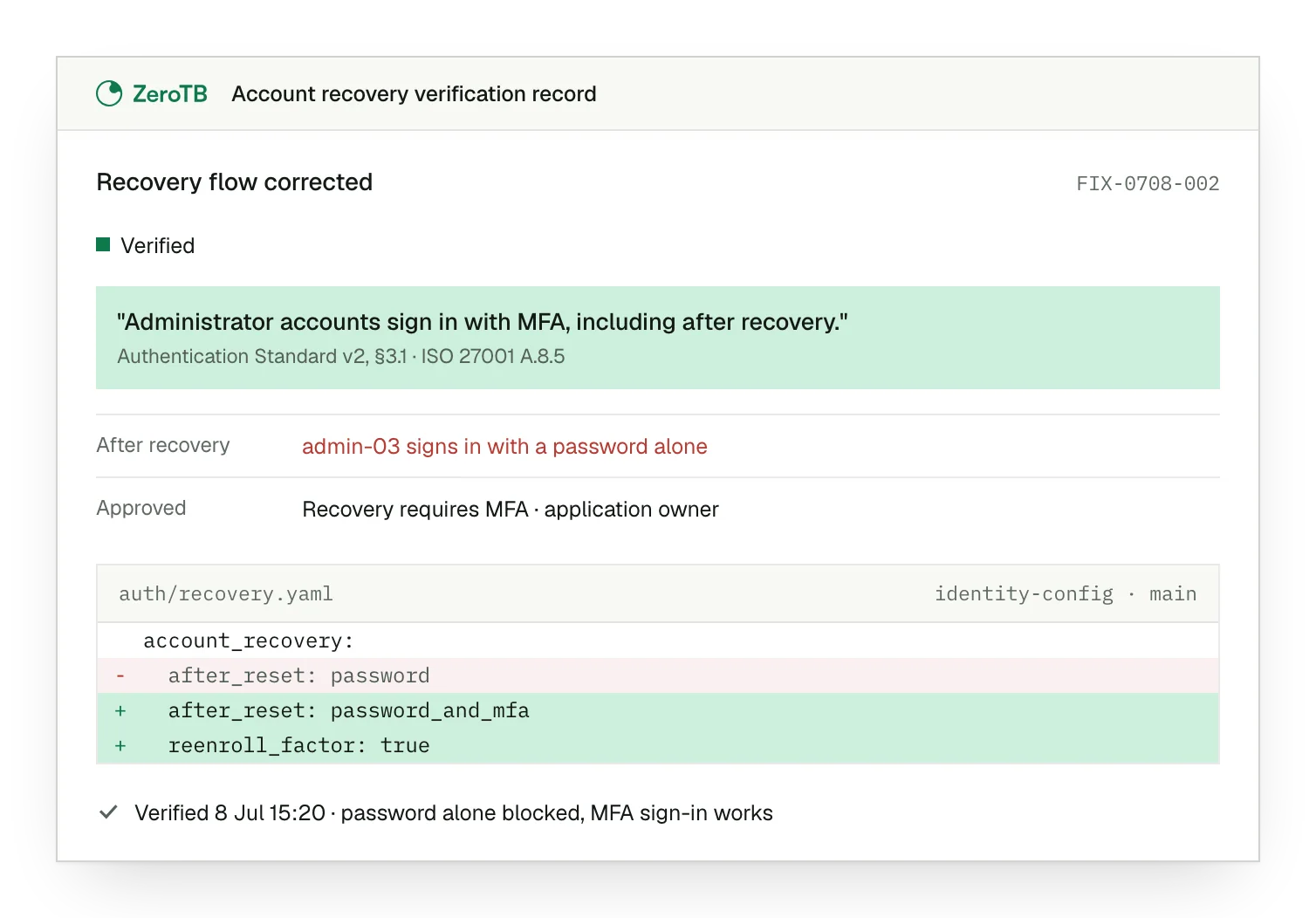
Recovery gap. After recovery, the administrator enters with a password alone despite the MFA rule on the account.
Approved correction. The application owner approves changing recovery so the account must use the factors its rule requires.
Verified access. Testing after the change blocks password-only entry and confirms that the administrator can enter using MFA.
Secure sign-in checklist
Choose the authentication rule to inspect, including which applications, account types and access risks the rule addresses.
Inspect normal sign-in alongside recovery, fallback and service routes. Use current observations from each system that enforces the rule.
Show the owner what failed and the proposed correction, specifying which access needs to work afterward.
After the approved change, test blocked and permitted entry. Retain the results with the approval and responsibility for subsequent checks.
Sources
- ISO/IEC, ISO/IEC 27002:2022 overview, 2022.
- NIST, SP 800-63B-4: Authentication and authenticator management, 2025.
- AICPA & CIMA, Trust Services Criteria with revised points of focus, 2022 revision.
- HHS, Summary of the HIPAA Security Rule, accessed November 2026.
Related pages
Technological controls
Read the other guides in this series on protecting information through the systems a company operates.
ISO 27001
See where authentication fits within the information security program and the controls chosen to address its risks.
Compliance frameworks
Browse the framework guides to understand related requirements and the controls that can support more than one review.
Start with the Pilot
Talk with our team about keeping authentication controls working. In the eight-week Pilot, we map up to 25 commitments and take two real control gaps through approved correction and verified restoration. The resulting records show what changed and how it was verified.