What does ISO 27001 A.8.3 require for limiting access to information?
ISO 27001 A.8.3 requires limiting access to information and application functions according to the access rules your organization has approved. A review needs to establish what each role may do, then check the permissions that allow it. After a correction, test that unwanted access stops and approved access still works.
The removal ticket is closed, but the person can still open the folder. Somewhere, a second permission is allowing access. Finding that permission and proving the restriction works is the practical work behind an A.8.3 review.
Approved access
A.8.3 connects the access rules your organization approves with the information people can use. A successful sign-in establishes an identity. The application must also restrict that identity to the information and functions its role permits, including restrictions on changes to the information.
Begin with the rule adopted for the information under review. A broad statement about authorized access needs enough detail to support a decision about an account. The reviewer should be able to explain why that account may read, change or export the information.
Information and actions
A useful access rule identifies the information, the permitted audience and the actions each role can perform. Permission to read a document can differ from permission to edit it, export its contents or change who else can open it.
An unclear rule leaves the reviewer guessing whether a permission is appropriate. Resolve that decision with the information owner before proposing a change. The resulting rule gives the application owner an expected state to enforce and gives the reviewer a specific outcome to test.
Effective permissions
Removing a direct permission does not always remove access to the information. The account may also belong to a group with access, or inherit access from a parent folder. Effective permissions describe what all those grants allow the account to do.
Follow each grant to its source before proposing a correction. This is where a group-membership export can be incomplete: it describes the groups, while the application may have its own direct grants and sharing settings. Include those routes when assessing the access that remains.
Shared links
A sharing link can keep information available after a named user's permission has been removed. The review therefore needs to establish who can use the link and what it permits. Its audience must fit the same access decision as the folder's named members.
Where a link allows a wider audience, ask the owner which collaboration still needs to work. Restrict the link to that approved audience or remove it through the agreed change process. Test the resulting access without assuming that an updated member list settled the issue.
Application permissions
Application permissions determine what an account can do after it signs in. A person may have an approved reason to view information while lacking approval to change or export it. Review the relevant actions within the application as well as access to the application itself.
NIST's access enforcement guidance describes enforcement at system, application and service levels. For a practical review, identify the level that controls the action in question. Test that action against the approved role so the result addresses the actual restriction.
Changes between reviews
Access can drift when a role, group or folder changes after the last review. An earlier approval may describe a narrower audience or a different job. Compare the current permissions with the current decision about who needs the information.
Use user access reviews to revisit those decisions as responsibilities change. Between reviews, inspect changes that affect the relevant grants and sharing settings. This keeps a previous approval from being treated as evidence that a later configuration still follows the rule.
Owner decisions
Someone responsible for the information must decide whether access is still needed. An administrator can identify the permission and change it, but may not know the business reason for keeping it. The information owner resolves that question before the application owner implements the decision.
Some permissions will remain as approved exceptions. Record why each exception is needed, who owns it, its safeguards and the condition for reviewing it again. A later reviewer should be able to understand that decision without reconstructing a conversation between the owner and administrator.
Correction scope
The permission responsible for the exposure determines where to make the correction. A broad group change may remove access from several folders, including ones outside the finding. Check those effects with the application owner before deciding how narrowly to make the change.
Describe both the unwanted access and the work that must continue. Those details let the owner assess the proposed action before approving it. If the change would prevent required work, revise the proposal and retain the reason with the approval so the decision remains understandable.
Verification results
A permission change needs an access test to establish its effect. Use the account, information and action covered by the rule to check the restriction. Then test the access that should remain, since a correction that prevents approved work also needs attention.
Keep dated results for both tests. If another route still allows the restricted action, investigate it before closing the gap. If testing is unavailable or the observation is stale, the current result remains uncertain. Resolve that uncertainty before recording the control as restored.
Evidence continuity
Keep enough context with the evidence to explain why the permission changed. A reviewer should be able to start with the access rule, identify the original exposure and follow the approved change to its result. A permission export alone cannot explain that sequence.
ZeroTB's Verified Control Record connects the commitment, before-and-after state, action, approval and verification. In an access case, the tests show what the changed permission now allows. Keep the blocked and permitted results together so the record also shows that the approved work remains possible.
Continued checks
A restored restriction needs further checks when the permissions or the information's audience change. Assign responsibility for observing those changes and investigating a mismatch. The owner should know which system provides the observation and where an unresolved finding goes for action.
A missing observation leaves the current state unknown. Keep that distinction visible when an application disconnects or its permission data becomes stale. Restoring the observation is part of maintaining the control because an earlier successful test cannot establish what a changed system allows today.
Evidence for access restrictions
The evidence should let a reviewer trace the access rule through the change and its tested result.
| Requirement | What an auditor asks for | Where it comes from |
|---|---|---|
| Defined access | Which information and actions each role may use | Approved access policy and role decisions for the information under review |
| Effective restrictions | How an account gets access through each available route | Direct permissions, group membership, inherited rights and application sharing settings |
| Approved exceptions | Why an exception remains, who owns it and when it returns for review | Exception decisions linked to the affected permission and its safeguards |
| Controlled correction | What exposed the information and which change the owner approved | Permission observations and the approved change record for the affected route |
| Verified result | What failed as intended and which approved actions still worked | Dated access tests linked to the rule, account context and resulting permissions |
Related framework controls
| Framework | Control | What it covers |
|---|---|---|
| ISO 27001 | A.8.3 | Enforcing the approved rules for access to information and the application functions used to handle it |
| SOC 2 | CC6.1 | Protecting logical access to the systems and information included in the SOC 2 examination |
| HIPAA | 164.312(a)(1) | Restricting access to electronic protected health information through technical controls in entities subject to HIPAA |
Example of restricting a shared folder
This example starts after a direct permission has been removed. The former recipient can still open the folder through a broader link. The correction restricts that link to the authorized group, with tests for the person removed and a member who should retain access.
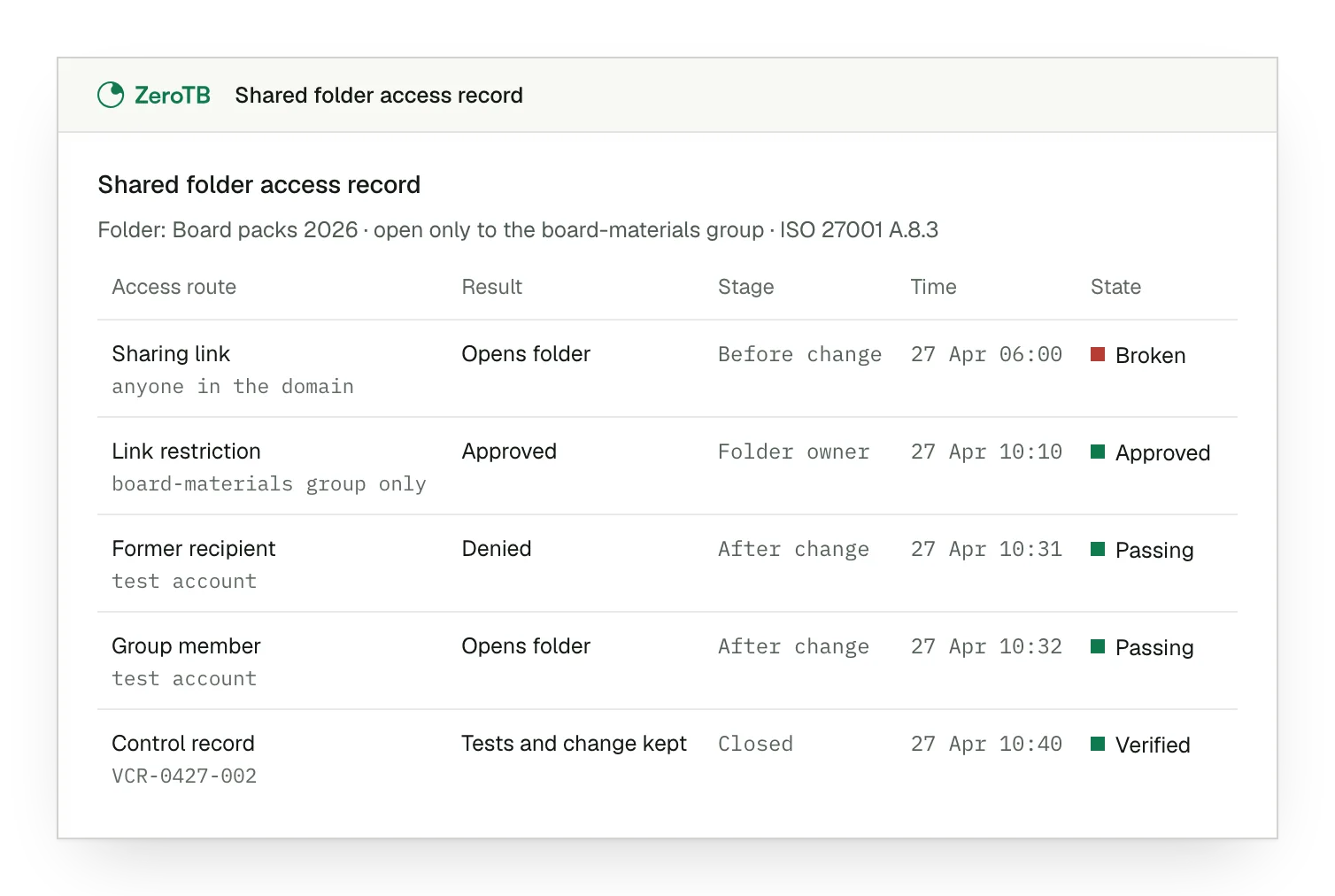
Remaining access route. The direct grant is gone, but opening the sharing link still reveals the folder.
Approved link restriction. The owner approves changing the link so only the authorized group can use it.
Paired access results. A test with the former recipient fails; an authorized group member still opens the folder.
Recorded verification. Both dated tests appear beside the approved change and the resulting link restriction.
Information access checklist
Establish which roles may use the selected information and which actions the rule permits for each role.
Locate the direct grants, groups, sharing links and application permissions that determine access to this information.
Decide which access must remain, then approve the permission change that removes the exposure without blocking required work.
Test the restricted action and the access that should remain, recording the date, account and information for each.
Identify who will check later permission changes and where that person can find the decision and verification evidence.
Sources
- ISO/IEC, ISO/IEC 27002:2022 standard overview, 2022.
- NIST, SP 800-53 Revision 5, AC-3 access enforcement, 2020.
- HHS, Summary of the HIPAA Security Rule, reviewed August 7, 2026.
- ZeroTB, Continuous control monitoring guide, 2026.
Related pages
Technological controls
See the other guides in the same Annex A theme as this information access control.
ISO 27001
Read the framework guide for context on the security program these individual controls support.
Compliance frameworks
Find the SOC 2 and HIPAA control guides alongside the ISO 27001 control library.
Start with the Pilot
Discuss the access gaps your team encounters between audits. Through the eight-week Pilot, our team maps up to 25 commitments and takes two real control gaps through approved correction and verified restoration. You receive the evidence from that work.