SOC 2 CC9.1 concerns the steps a company takes to limit business disruption and protect its objectives. A disaster recovery plan needs to cover the service as it operates today, including its dependencies. Exercise that plan, resolve the gaps it exposes and retain the results of the recovery checks.
An exercise may follow the recovery plan correctly and still miss a dependency added since the plan was written. That leaves a practical question unanswered: can the service recover? CC9 risk mitigation connects the answer to the business objectives at risk.
Disruption scope
Start with the activity the business needs to continue, then consider what could interrupt it. Losing infrastructure is one possibility. A provider outage, an inaccessible facility or the absence of someone with essential access can also prevent the service from recovering.
The plan needs to explain how the company would respond to the disruptions within its scope. Each response should lead to an observable outcome, such as resuming the activity the service supports. That outcome gives the exercise participants something specific to test and the reviewer a basis for judging success.
Recovery priorities
The effect of an outage determines which services need to recover first. A recovery time objective expresses the intended limit on downtime. A recovery point objective expresses acceptable data loss in time, such as the age of the data available for restoration.
NIST's contingency-planning guide explains how these objectives inform recovery choices. For a particular service, the approved plan supplies the targets against which to read a test result. If recovery takes longer than agreed, the owner needs to decide what changes or what remaining risk to accept.
Service dependencies
A service can remain unavailable after its own infrastructure has recovered. An external dependency may still prevent customers from completing the activity the service supports. Recovery planning therefore needs to follow the service through its dependencies, including the order in which they become usable.
The dependency map should distinguish what the company can restore from what it needs a provider to restore. That distinction affects the recovery procedure, escalation contacts and available alternatives. Vendor risk management supplies related context when the recovery assumption depends on another organization's service.
Backup and recovery
A successful backup confirms only part of the recovery path. The recovery exercise must establish whether the saved data can support the intended service after restoration. Application configuration, access and external connections can still prevent use even when the data itself has been recovered.
Define the expected service behavior before interpreting the result. A database restore can establish that a copy is usable, while a service test establishes whether the application works with it. Recording both outcomes makes the remaining gap visible when the broader recovery check fails.
People and recovery access
A recovery procedure is usable only if the response team can reach its instructions and carry them out. Access may have changed since the last exercise, or the person listed in the plan may have left. Either can delay an otherwise workable recovery.
Instructions stored behind an unavailable login service illustrate the problem. The team needs another approved way to obtain them and reach the systems involved. The owner decides the safeguards for that emergency route. Its availability then becomes one of the assumptions to check during the exercise.
Changes between exercises
The last exercise may have covered every dependency that existed when it ran. Adding a provider or changing a procedure can make that coverage incomplete. The result remains a record of the earlier service, so the control owner needs to review what has changed.
That review connects the change to the relevant recovery assumption. A change of owner may require updated contacts and access; a new connection may require a further exercise. These decisions belong with the company's wider governance, risk and compliance work, including the risks it has agreed to accept.
Exercise coverage
An exercise result is useful only when its scope matches the question being tested. A tabletop exercise examines how people would respond to a scenario. A technical recovery test examines whether systems and data can be restored under the conditions included in the test.
Record the dependencies included in the exercise and any that were assumed available. If a provider connection was excluded, the result leaves that connection untested. That boundary helps the reviewer decide whether the evidence supports the service's recovery commitment or whether a further check is needed.
Corrective decisions
An exercise finding needs an owner, an approved response and a clear condition for closure. A missing recovery step calls for different work from a failed access route. The proposed correction should name the failed assumption and explain how the action addresses it.
The owner then decides whether to approve that action or accept a remaining limitation with a review condition. Keep the decision with the finding. Otherwise, a completed exercise task can conceal an unresolved dependency, and the next reviewer has to reconstruct why the team stopped work.
Verification before closure
The correction is complete when a fresh check demonstrates the intended recovery behavior. After a change, repeat the relevant part of the exercise and compare the outcome with the approved condition. A changed procedure needs evidence that it can be followed successfully.
A failed retest keeps the gap open. An unavailable result also leaves the outcome unresolved, even if the corrective action was completed. The record should name the remaining issue and the owner of the next action. This keeps work moving after the first attempted correction.
Evidence over time
A reviewer needs to understand the result without reconstructing the exercise from memory. The record should bring together the scenario, expected outcome, actual result and decision. It should also distinguish a correction that passed its check from a limitation the owner agreed to retain.
The Verified Control Record holds the commitment, before-and-after state, action, approval and verification. In a recovery review, these details explain why a gap was closed. The exercise date and tested dependencies help the next owner decide whether that result still applies after a service change.
Recovery evidence
These records connect the disruption risk, the recovery decision and the observed result for review.
| Requirement | What an auditor asks for | Where it comes from |
|---|---|---|
| Disruption scope | The business activities at risk and the scenarios addressed by the plan | Risk assessment and approved continuity or disaster recovery plans |
| Recovery objectives | The service priorities and expected recovery outcomes used to judge the exercise | Approved service commitments and the recovery plan |
| Dependency coverage | The systems, providers, people and access included in the recovery procedure | Current dependency map, recovery instructions and owner records |
| Exercise results | The scenario, expected outcome, actual result and dependencies excluded from testing | Dated exercise reports and supporting recovery observations |
| Corrected gaps | The failed assumption, approved correction, retest result and any accepted limitation | Change approvals and verification evidence linked to the exercise finding |
Framework requirements
| Framework | Control | What it covers |
|---|---|---|
| SOC 2 | CC9.1 | Responses to business disruption risks that could prevent the organization from meeting its objectives |
| ISO 27001 | A.5.30 | Technology readiness to support continuity, including maintaining and testing recovery arrangements |
| HIPAA | 164.308(a)(7) | Contingency arrangements for electronic protected health information, including backup, recovery and secure emergency operations |
Example of restoring dependency coverage
The recovery check needs to include the connections the service now uses. In this example, an application gains an external dependency after its recovery plan was written. Testing that dependency reveals the gap, and a revised procedure allows the service check to pass.
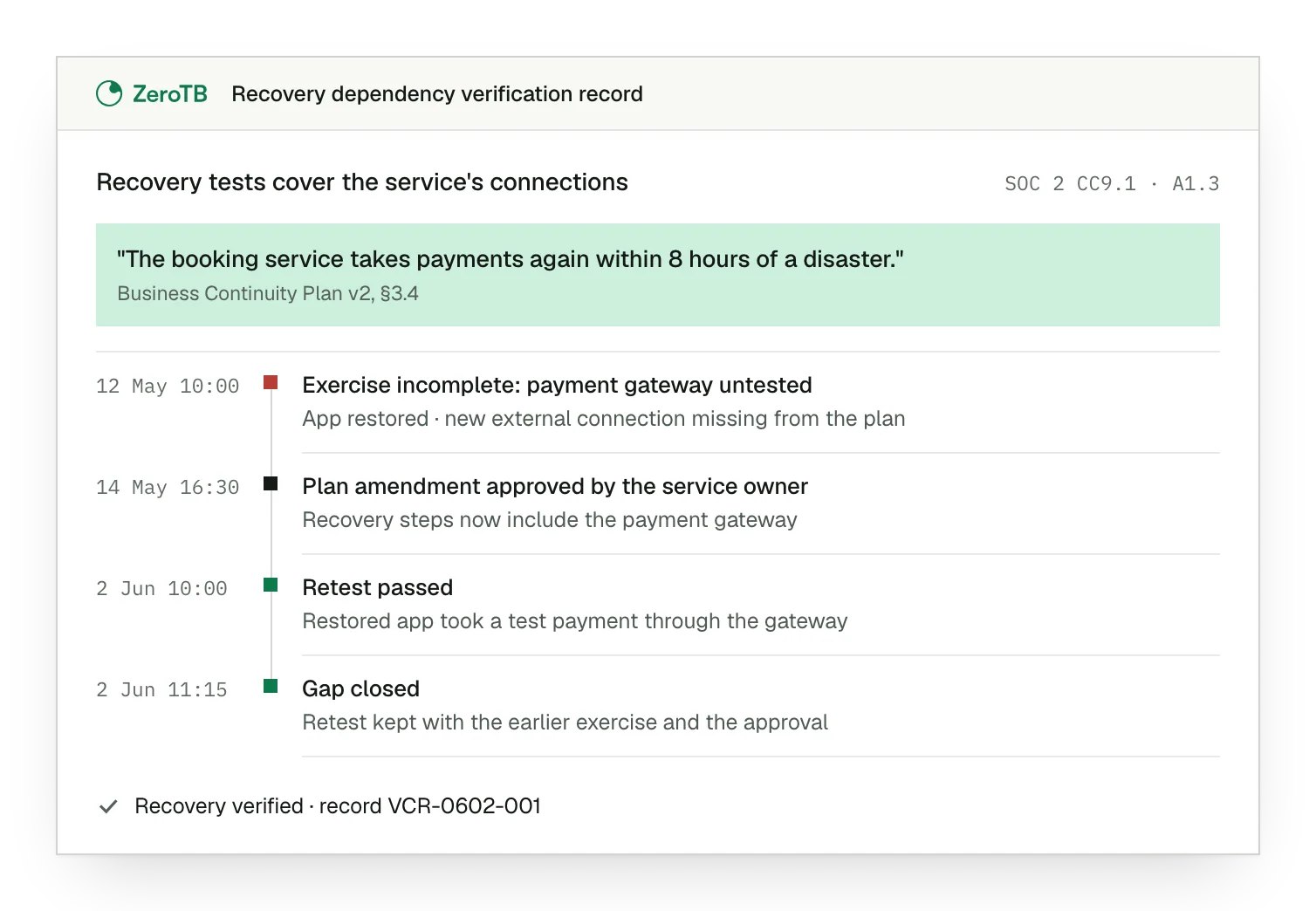
Missed dependency. The application is restored, but the exercise leaves its newly added external connection untested.
Approved plan change. The owner approves a revised procedure that includes the connection needed to recover the service.
Service retested. With the connection included, the restored application successfully completes the activity selected for the test.
Gap closed. The owner can review the successful retest together with the earlier gap and approved change.
Disruption planning checklist
Select a recovery commitment and identify the business activity, dependencies and expected outcome within its scope.
Check whether the current service still matches the dependencies, people and access covered by the last exercise.
Assign the failed assumption to an owner who can approve a correction and define any retained limitation.
Repeat the affected check after the approved change and compare the result with the agreed recovery condition.
Retain the scenario, observations, approval and retest together, with an owner responsible for reviewing later changes.
Sources
- AICPA & CIMA, 2017 Trust Services Criteria with revised points of focus, 2022 revision.
- NIST, SP 800-34 Rev. 1: Contingency planning guide for federal information systems, 2010.
- HHS, HIPAA audit protocol, contingency plan, 2018 update.
- ZeroTB, SOC 2 compliance automation with human approval, 2026.
Related pages
SOC 2 criteria
See where CC9.1 sits among the other criteria covered by the SOC 2 program.
Compliance frameworks
Follow related requirements across the frameworks that apply to the systems and activities in scope.
Governance, risk and compliance
Read about the work that connects control requirements with decisions, corrections and the evidence they produce.
Start with the Pilot
Discuss the recovery commitments that are difficult to keep current. In the eight-week Pilot, our team maps up to 25 commitments and takes two real control gaps through approved correction and verified restoration. Each completed restoration leaves a record for review.