SOC 2 CC9.2 covers the risks that arise when a company uses vendors and business partners. Vendor management starts with understanding what the supplier does for the business and what could go wrong. Keep that assessment current as services change, and check the results of any corrective work the owner approves.
An approved supplier may have access today that nobody considered during its original review. The vendor name has stayed the same; the service has changed. This guide looks at how to keep the risk decision relevant to current use within SOC 2 CC9.
Current vendor use
A vendor approval should describe the service your company actually uses. The assessment should explain what information the vendor receives, which systems it can reach and which business activities depend on it. These details define what the reviewer is accepting.
A company may use several services from the same supplier under different arrangements. A review of one service may leave another outside its scope. Connecting each use to a service owner makes it easier to resolve those differences and identify who can authorize a change.
Risk-based review
The consequences of a vendor failure should determine how closely the company reviews the relationship. Losing a service that operations depend on deserves particular attention. So does giving a supplier access to sensitive information, even if the service itself is easy to replace.
NIST's supply chain guide uses business importance, data sensitivity and system access to help prioritize suppliers. These factors give the reviewer a reason for choosing a simpler or more detailed assessment. They also explain why the same vendor may need closer review after its role changes.
Vendor assurance reports
A vendor's SOC 2 report helps a reviewer judge the service only when its scope matches the planned use. Check which service it covers, the reporting period and any exceptions. An available report can still leave important questions about your particular use unanswered.
The review should explain how relevant findings affect the decision to use the vendor. It should also identify customer responsibilities described in the report. Saving the document without that assessment leaves the next reviewer unable to see why the company considered the relationship acceptable.
Shared responsibilities
The review needs to identify which safeguards the vendor provides and which your company must operate. The agreement and assurance materials help establish that division. Customer responsibilities need owners who can decide how those safeguards will work in the systems your company controls.
For example, a service may support restricted access while the customer determines which accounts receive it. The vendor's description of that feature does not establish how the customer configured access. The review needs evidence of the relevant settings before it can rely on that safeguard.
Changes after approval
When an integration sends more data than it used to, the original vendor approval may no longer cover it. The register can still show the service as approved. The assessment must reflect the actual use before the owner can rely on that decision.
Regular reviews provide one opportunity to find the difference. A change made between reviews also needs to reach someone with authority to assess its risk. With the integration change linked to the vendor record, that person can compare the earlier scope with the new exposure.
Decisions on new exposure
The service owner needs a risk decision when current use exceeds the approved scope. Possible responses include restricting the new use, adding safeguards or accepting a defined exception. The choice depends on why the business needs the change and which risks it can accept.
The decision should explain the permitted use after review and any conditions attached to it. If the owner chooses an exception, record who accepts the remaining exposure. An approval that says only “reviewed” leaves engineers and future reviewers unsure which use the owner has accepted.
Approved corrections
A correction should state what will change and how the team will recognize a successful result. An access gap may require a configuration change. An unclear responsibility may require an updated agreement. Each needs an owner with authority over the affected system or arrangement.
The proposed action should connect the observed gap to the intended result and reach the approver before work proceeds. After approval, the responsible team makes the change and checks its effect. Keeping this sequence together prevents a risk decision from ending as an unresolved instruction.
Verification before closure
The evidence for closure should show that the correction worked. After restricting a data transfer, the reviewer needs to see which information now reaches the vendor. The check should also establish whether the reporting that the business still needs continues to work.
An agreement change has a different test: do the completed terms cover the missing responsibility? A task marked complete cannot answer either question. The Verified Control Record keeps the commitment, observed states, action, approval and check together. Missing or stale observations leave the result unresolved.
Exceptions and review ownership
An owner who accepts an exception needs to leave a decision that another reviewer can understand. The record should say which use is allowed, what safeguards apply and when the approval ends. Those details explain the risk the company has agreed to retain.
The next change may affect that decision, so someone must own the further review. Keep the review conditions with the vendor record, where that owner can find them. The record should also distinguish work already completed from supplier issues that still require attention or a decision.
Vendor review evidence
Keep enough evidence for a reviewer to understand the use that was approved and what happened when it changed.
| Requirement | What an auditor asks for | Where it comes from |
|---|---|---|
| Defined relationship | The service under review, its access and the reason for the assigned risk level | The service entry in the vendor register, with its assessment |
| Reviewed assurance | The conclusions drawn from the report, including its scope, period and exceptions | The report and the reviewer's notes on its relevance |
| Assigned responsibilities | The safeguards each party provides, including the responsibilities left to the customer | Agreements and assurance reports, checked against customer system settings |
| Current risk decision | The changed use, the decision it required and any conditions attached to approval | The owner approval linked to the service change and reassessment |
| Completed corrective work | The original gap, approval for the correction and evidence that it worked | Dated checks retained with the completed change or agreement |
Framework mapping
| Framework | Control | What it covers |
|---|---|---|
| SOC 2 | CC9.2 | Risks the company takes through its use of vendors and business partners |
| ISO 27001 | A.5.22 | Review of supplier services, including changes to their information security arrangements |
| HIPAA | 164.308(b)(1) | Assurances from business associates about protecting electronic protected health information, supported by the applicable written arrangements |
Example of restoring approved vendor access
Here, a reporting integration has started sending support messages along with approved aggregate usage data. The service owner decides that the vendor should receive only the aggregate data. Removing the message fields resolves the gap only after a test confirms the transfer and reporting still work.
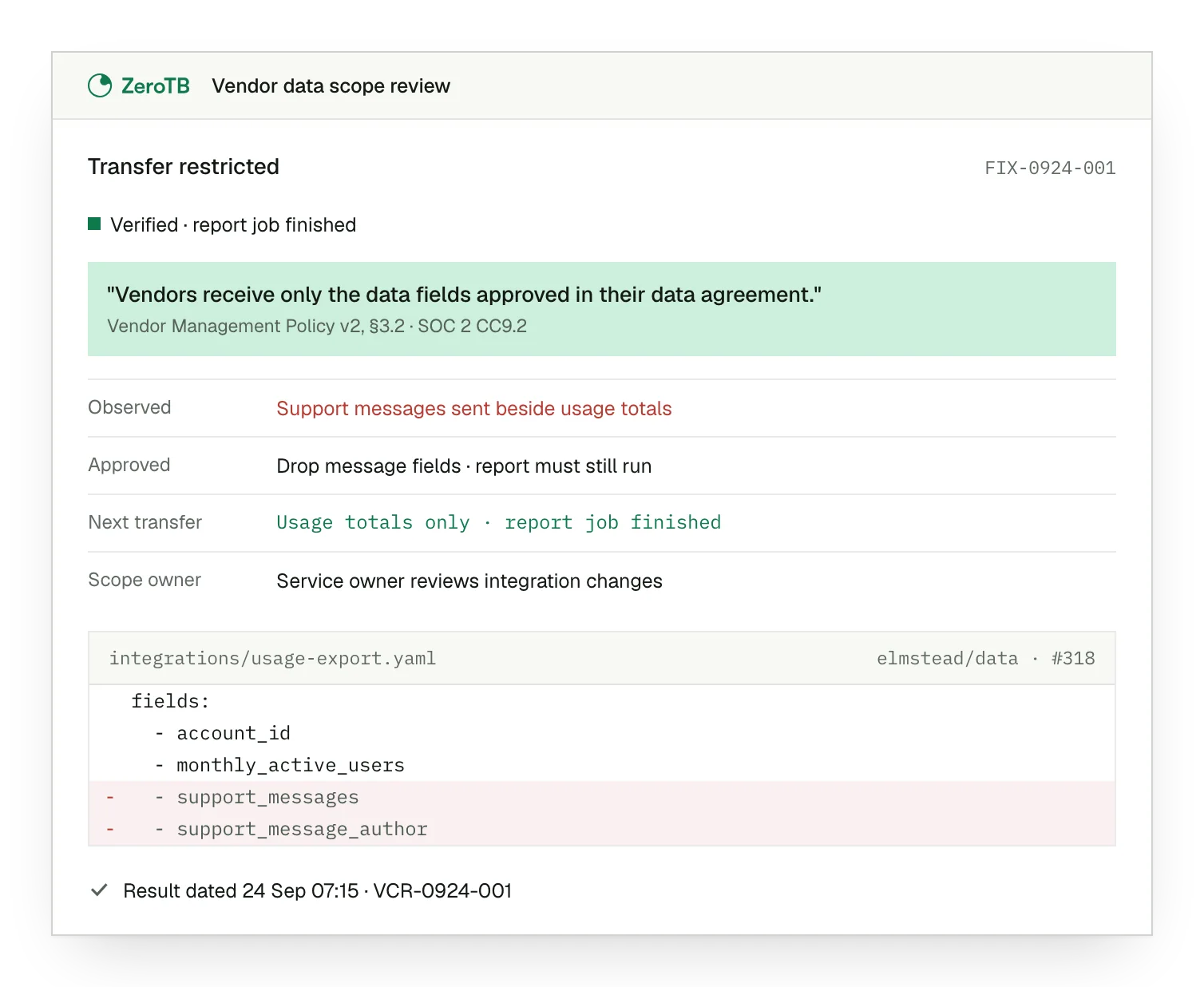
Changed data scope. Support messages appear in the transfer beside the aggregate usage data the vendor was approved to receive.
Approved transfer restriction. The owner's approval specifies which fields to remove and requires the aggregate report to remain usable.
Verified reporting result. A later transfer excludes the message fields, and the reporting job still finishes successfully.
Ongoing review ownership. Future changes to the integration go to the service owner for another check against the approved scope.
Vendor review checklist
Compare the assessment with the service as used today, including the information and systems the vendor can access.
Review the report's scope and period, then consider its exceptions and the responsibilities it leaves with the customer.
Ask the owner to decide how to address use that has expanded beyond the original approval.
Use the agreed result to check the completed change and decide whether the gap can close.
Identify who will review subsequent changes and the conditions under which accepted exceptions need a new decision.
Sources
- AICPA & CIMA, 2017 Trust Services Criteria with revised points of focus, 2022 revision.
- NIST, SP 1305: Cybersecurity Framework 2.0 supply chain risk management guide, 2024.
- HHS, Summary of the HIPAA Security Rule, accessed November 4, 2026.
- ZeroTB, SOC 2 compliance automation with human approval, 2026.
Related pages
SOC 2 criteria
Read the wider framework and see where vendor oversight fits within the common criteria.
Compliance frameworks
Explore the requirements that connect vendor review work across SOC 2, ISO 27001 and HIPAA.
Governance, risk and compliance
Connect vendor risk decisions with the wider process for keeping controls operating between audits.
Start with the Pilot
The eight-week Pilot maps up to 25 commitments and takes two real control gaps through approved correction and verified restoration. Talk with our team about where vendor oversight fits within the controls you need to keep working.