SOC 2 CC4.1 addresses the evaluations an organization uses to judge whether controls are present and working. Those evaluations may run within everyday work, through separate reviews or through both. Start by checking what they cover: a review completed on schedule can still miss a control in a newly added system.
The difficult part of evaluating a control is knowing what a result allows management to conclude. Under CC4 monitoring activities, the evaluation method itself needs attention. Its scope, source records and treatment of exceptions all affect how much confidence a passing result deserves.
Evaluation scope
The evaluation starts with the objective of the control being examined. Policies and report commitments explain what the company expects to happen. The reviewer then needs to know where that expectation applies: which systems, people or processes fall within the assessment, and which period the evidence covers.
For a privileged access review, a list from the main identity provider may cover only some of the relevant applications. The scope needs to account for the others. Keep the reasons for exclusions alongside the population being tested, where the reviewer can examine both before reaching a conclusion.
Ongoing and separate evaluations
Ongoing evaluations form part of routine work, while separate evaluations give a reviewer a distinct opportunity to assess the controls. They can address different questions. A regular check may detect a changed setting; a separate review can question whether that setting remains an adequate test of the objective.
Use the method that fits the question and the available evidence. Continuous control monitoring can provide observations for conditions with clear rules. Decisions about assumptions, responsibilities and exceptions need a reviewer who understands their effect on the control. A combined approach can use both kinds of evidence.
Changes in coverage
An evaluation can miss a failing control when its population no longer matches the systems in use. Applications, accounts and workflows can change while the review keeps using an old list. A history of completed reviews then leaves part of the current environment unexamined.
Compare the evaluation population with current system records. Investigate additions, removals and differences before deciding that the scope is complete. When an application is excluded, retain the reason for that decision. The next reviewer should be able to distinguish an approved exclusion from an overlooked system.
Reliability of observations
A passing result is useful only when the underlying observation is current and complete enough for the decision. A failed connection can leave yesterday's value on display. The evaluation needs to distinguish a fresh observation from a retained value whose source is no longer available.
Record when the observation was collected, which source it came from and what it covered. If the source omits part of the population, explain that limit in the conclusion. Restore the source or obtain other suitable evidence before treating the missing information as a passing result.
Control design and operation
A control can run exactly as written and still leave its intended risk untreated. The evaluation therefore considers both the design of the control and its operation. A review that confirms completion needs to examine whether the completed work could achieve the control's objective.
For an access review, that means examining the information available to the approver and the decisions recorded against it. An approval without enough information to judge access may reveal a design problem. Decisions that never reach the affected systems may reveal a problem in how the control operates.
Evaluation frequency
How often to evaluate a control depends partly on how quickly its conditions change. An automated check can observe a changing technical setting between scheduled reviews. A decision about policy or responsibility may be better examined separately, especially after the process or its owner has changed.
Frequency cannot repair an incomplete method. If a review omits an application, running it again tomorrow still leaves that application unexamined. Revisit the method when systems, controls or risks change, and explain the timing chosen. The compliance monitoring guide discusses how these choices relate to the people responsible for responding.
Reviewer judgment
The reviewer needs enough knowledge and objectivity to challenge the test and interpret its results. Operational owners can explain how a control works and provide its records. The evaluation also needs room to question their assumptions, the selected population and the basis for accepting exceptions.
For a separate evaluation, consider whether the reviewer can assess the work without relying entirely on the person who performed it. Access to source records helps the reviewer examine that person's conclusion. Where a specialist contributes, record what they examined and which questions they could resolve.
Exceptions and follow-up
An exception needs a decision about its effect on the control objective. A missing record, an approved variation and a confirmed control failure can require different responses. The evaluation should explain the distinction so management can see which issues affect its conclusion about effectiveness.
Give unresolved findings an owner and a defined next action. For an accepted exception, retain the reason, any safeguards and the conditions for another review. Keep those decisions with the evaluation, so a later reviewer can see which issues remained open when management reached its conclusion.
Correction and verification
Correcting an evaluation means examining how the gap entered its method. An omitted application needs to be reviewed, and the process for adding applications needs attention too. After changing that process, compare the revised review population with current records to establish whether it now includes the intended systems.
ZeroTB reads approved commitments, checks the systems they apply to and drafts a fix when it finds a gap. People approve the change. A further check establishes the result before closure, with the action and its evidence recorded together. The evaluator can use that evidence when assessing the corrected control.
Evaluation conclusions
The conclusion needs to explain what the evaluation established about the controls. State the period and scope examined, then connect the results to the judgment about effectiveness. If a source was unavailable or a finding remains open, explain how that affected the judgment.
A Verified Control Record holds the commitment and the state before and after a correction, together with the action, approval and verification. Link that evidence of restoration to the finding it addresses. The evaluator can then see which part of the conclusion depends on the corrected control.
Evidence for control evaluations
The records below explain what was tested and give an auditor a basis for examining the evaluation's conclusion.
| Requirement | What an auditor asks for | Where it comes from |
|---|---|---|
| Defined scope | Which population and period were examined, and why anything was excluded | The evaluation plan, policies, report commitments and current system inventory |
| Suitable evaluation method | Why the tests chosen can establish whether the control achieves its purpose | Written test procedures and the reviewer's reasons for selecting them |
| Evidence of performance | Which observations support the results, including when each observation was made | Source exports, test results and the records completed during the review |
| Assessed exceptions | Which findings changed the conclusion or required further work | Assessment notes, decisions on exceptions and actions assigned to an owner |
| Verified correction | What changed after the finding and how the revised method was tested | Approval of the correction and the evidence collected when the evaluation was repeated |
Related framework requirements
| Framework | Control | What it covers |
|---|---|---|
| SOC 2 | CC4.1 | Evaluation of the controls themselves, to establish whether they are present and working |
| ISO 27001 | A.5.35 | Independent review of the information security approach, including how the organization carries it out |
| HIPAA | 164.308(a)(8) | Periodic technical and nontechnical evaluation of how policies and procedures meet the Security Rule |
Example of restoring evaluation coverage
In this example, the quarterly review finished before anyone noticed that a new application was missing from the list. Its accounts still need examination. The evaluator also needs evidence that the revised method will include new applications in later reviews.
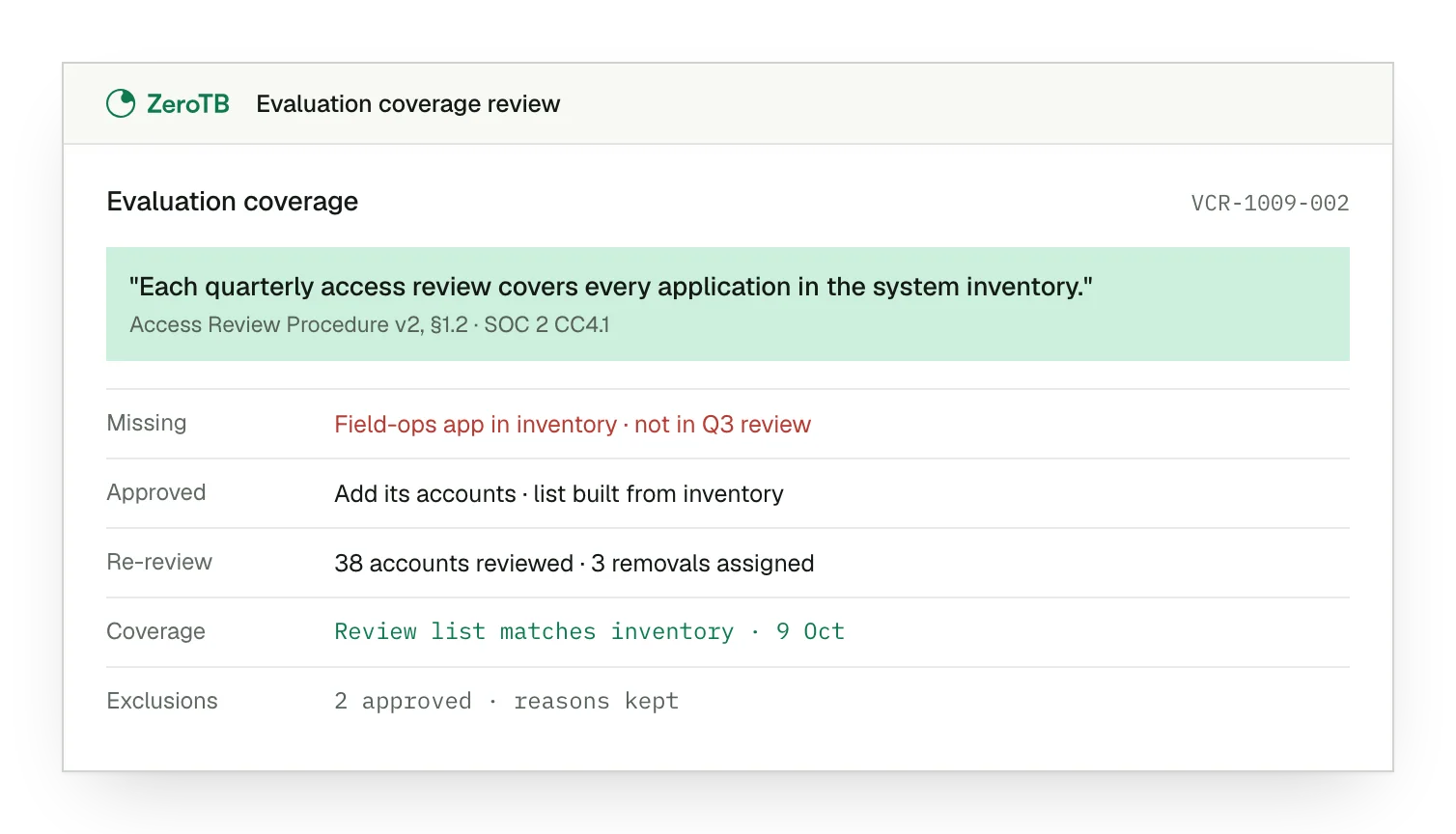
Missing application. An application appears in the system inventory, but its accounts are absent from the completed review.
Approved scope correction. The owner agrees to include those accounts and approves changes to how the review list is maintained.
Repeated evaluation. The accounts receive a fresh review, which records access decisions and assigns any further work.
Verified coverage. The evaluator checks the revised list against the inventory and retains the reasons for approved exclusions.
Control evaluation checklist
Identify the commitment being evaluated and the evidence needed to judge whether the control achieves its purpose.
Compare the review scope with current system records and explain additions, removals and any approved exclusions.
Check source coverage and collection dates before relying on results, especially where connections or systems have changed.
Follow a finding through its assessment and assigned action to see whether the response addresses the control objective.
Confirm that a corrected evaluation covers the intended population, then retain its results and the reviewer's conclusion.
Sources
- AICPA & CIMA, 2017 Trust Services Criteria with revised points of focus, 2022 revision.
- HHS, Security Rule evaluation and certification, 2013.
- ZeroTB, Continuous control monitoring, 2026.
- ZeroTB, SOC 2 compliance automation with human approval, 2026.
Related pages
SOC 2 criteria
Read about the other criteria that shape a SOC 2 program alongside its evaluation of controls.
Compliance frameworks
Find guidance for commitments that fall under SOC 2, ISO 27001 or the HIPAA Security Rule.
Continuous control monitoring
Follow how a system observation becomes a finding that an owner can investigate and resolve.
Start with the Pilot
Talk with our team about the controls behind the evaluations. During the eight-week Pilot, we map up to 25 commitments and take two real control gaps through approved correction and verified restoration. The results come with records of the work.