SOC 2 CC4 covers the evaluation of controls and the communication of deficiencies. A review may establish that a control has stopped working. The next question is who receives that finding and takes responsibility for correction. CC4.1 and CC4.2 address those two parts of the work.
The two CC4 criteria
CC4.1
Control evaluations
Check whether controls work through ongoing evaluations and separate reviews, with scope and frequency suited to the risks.
CC4.2
Control deficiencies
Send findings to the people responsible for timely correction, including management or the board where appropriate.
Findings without a verified result
Closing a repair ticket can leave an important question unanswered: does the control work now? A review may record the weakness in one place and the repair in another. Until someone checks the result, management cannot establish whether that repair resolved the finding.
Review finds a weakness
Repair ticket closes
Control remains untested
Verified repairs with ZeroTB
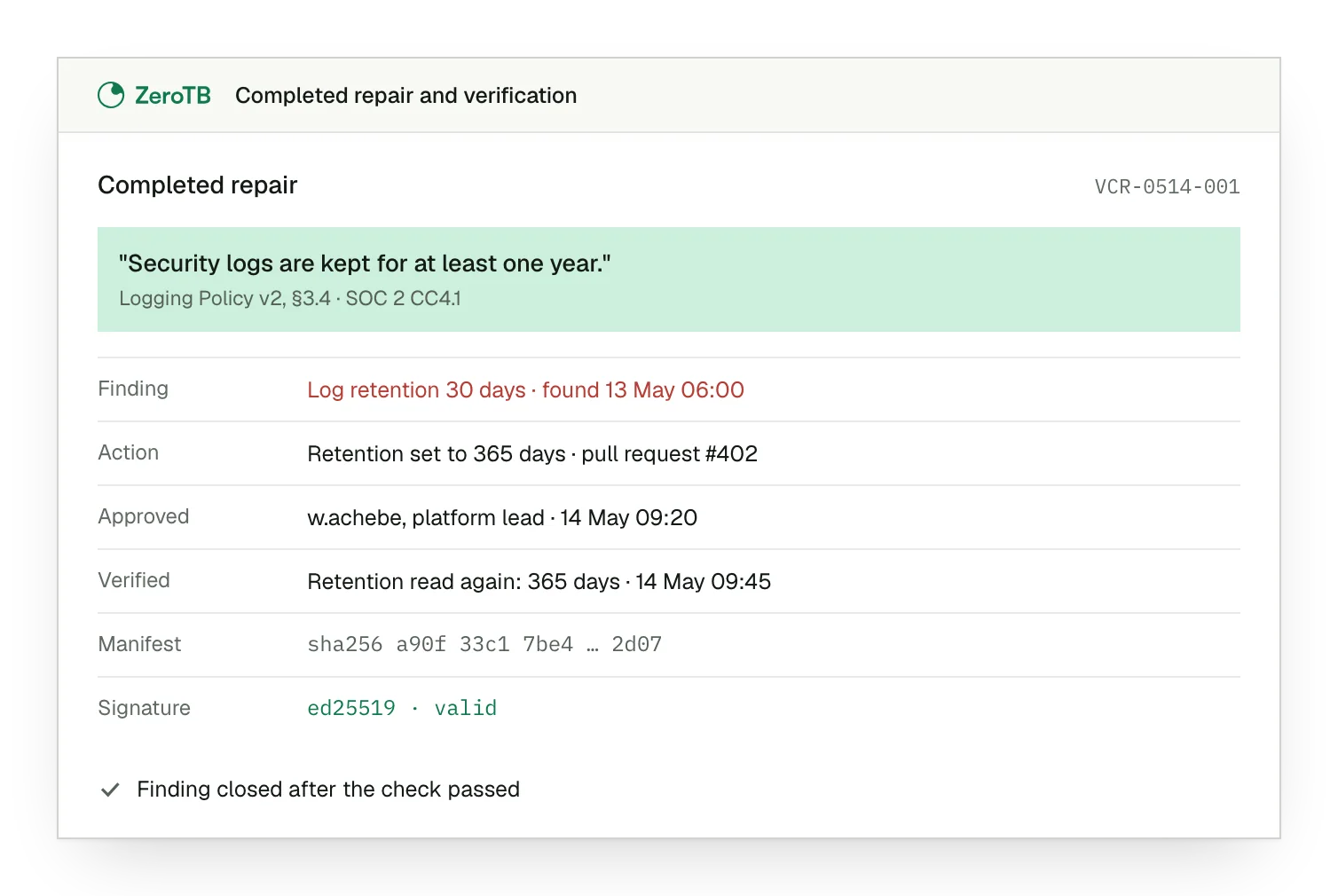
ZeroTB takes a finding through the repair and checks that it worked. We read your commitments, run daily checks against your systems and draft fixes for approval. After the approved change, we verify the control's state and retain the evidence in a signed Verified Control Record.
Our team handles the repair work
People retain authority over material changes
Completed repairs produce evidence for review
Talk to our team
Talk with us about findings that remain open, the repairs behind them and where your team needs help checking the results.
FAQ
How often should we evaluate controls under CC4?
Frequency depends on risk and on changes to the business or its systems. The AICPA's Trust Services Criteria address ongoing and separate evaluations. A recurring finding is one reason to reconsider the schedule: the next routine review may leave the same weakness unexamined for too long.
How does CC4 differ from monitoring under CC7?
CC4 examines whether controls are working. CC7 system operations covers the detection of vulnerabilities and unusual activity, incident assessment, response and recovery. An incident investigation sits under CC7. A review of whether the incident process worked is part of evaluating controls under CC4.
Who should receive a control deficiency?
The responsible owner needs the finding in time to correct the weakness. People assessing it need enough knowledge of the control to understand what failed. Significant findings also go to senior management or the board where appropriate. This connects the operational response with oversight.
What happens when a monitoring connection stops providing evidence?
The evidence gap stays visible. ZeroTB distinguishes unknown, stale and disconnected states, so an unavailable observation cannot become a healthy result. A reviewer looking at the control can see that it still needs a current check, even if an earlier check passed.
Can we review CC4 findings and repair evidence in ZeroTB?
Yes. ZeroTB keeps the findings and repair evidence with the commitments and checks. ZeroTB carries out the control work and keeps its repair evidence in ZeroTB. When someone reviews a finding, that evidence shows the work behind the status recorded in your program.
What evidence does a completed repair leave for a CC4 review?
Each completed repair leaves a signed Verified Control Record. It holds the commitment, the state before and after, the action, the approval and the verification. Management or an auditor can inspect that history to see the weakness, what changed and the basis for closing the finding.
Start with the Pilot
The Pilot covers eight weeks of work: mapping up to 25 commitments from your report and taking two real control gaps through verified restoration. It leaves you with working controls and portable evidence records of the completed repairs.