What does ISO 27001 A.8.15 require for recording events in logs?
ISO 27001 A.8.15 addresses recording events in logs, protecting those logs and analyzing the records. The practical test is whether relevant activity leaves evidence that someone can retrieve and understand. Check a known action from source to storage, then repeat the check when changes could affect that path.
An availability check can miss a logging failure. The application keeps serving requests while the central store receives no new events. By the time an investigator searches for those events, the records may be gone. Testing delivery helps reveal that failure while there is still a path to repair.
Logging scope
A.8.15 starts with the activity that needs a record. The logging commitment identifies the systems and event types in scope, giving the reviewer something specific to check. A newly deployed service needs the same attention as the services present at the last audit.
Each source needs an owner and a destination for its records. Compare the service inventory with the sources sending events to that destination. Where a service appears in only one list, establish whether the commitment covers it and whether its collection path works.
Event context
A log entry needs enough detail to explain the action it records. An investigator should be able to identify the source, time, responsible identity and outcome. The affected resource matters too: it tells the investigator which account, file or setting the action concerned.
NIST's audit-record guidance describes the information these records need. Compare a safe test action with its stored event to see whether that information survives collection. Check how the timestamp and identity appear to someone using records from several systems to investigate the same activity.
Collection gaps
An application can generate logs that never reach central storage. A broken forwarding configuration leaves events on the source while the service continues operating. The service owner may see no interruption; the person searching the central logs sees a gap in the record.
When an expected event is absent, first look for it at the source. If it exists there, follow its delivery through the collector to the store. If it never appeared locally, investigate event generation. This distinction directs the repair to the owner of the failing component.
Cloud event coverage
The events visible in a cloud account may cover only part of the logging commitment. AWS CloudTrail event history contains 90 days of management events for an AWS Region. Seeing that history establishes neither application-event coverage nor retention beyond that period.
For an AWS control review, compare the configured collection with the required events, accounts, Regions and retention period. Application events may need their own path to storage. Follow those events separately so a cloud log with recent entries does not hide a missing application source.
Protected records
Log records need protection from the people and systems whose activity they describe. Permissions that allow someone to change or delete the record of their own actions weaken its value. Review who can read, write and remove records at the destination.
The collection path also needs protection. A reviewer should examine changes to forwarding settings alongside access to stored events, because either can affect the evidence. Keep the applicable settings with the review result, so a later change can be compared with the approved state.
Retention choices
Retention should match investigation needs and the commitments that apply to the system. Choose the period from those requirements and record the reason. Collecting more detail for longer increases storage needs and can expose sensitive information that has no useful role in an investigation.
A configured retention period also needs a retrieval check. Test the oldest required records using the investigator's approved access. If the commitment includes archived records, confirm that the retrieval method also works for that part of the history.
Log review
Logging should leave records that someone can examine and use in an investigation. Agree who reviews them and where suspicious activity goes for a response. NIST's log-management guidance treats this continuing work as part of operating the logging arrangement.
The related A.8.16 monitoring control concerns watching systems for unusual behavior. Logs supply evidence for that work. A reviewer who discovers an absent source needs to identify which investigations depend on it, while the responsible owner investigates the collection failure.
Approved repairs
A logging repair needs an owner who can approve the affected system change. The proposed correction should identify the broken path, the intended destination and the settings that will change. This lets the owner assess the effect on both collection and normal service operation.
Use a reviewed configuration change when the fault sits in forwarding or storage permissions. If the application never generates the required event, the correction belongs with its application owner. Record the approved action and the expected test result before treating the repair as complete.
Verification tests
Test a repair by finding a new, usable event at the intended destination. Perform a safe action that the logging commitment covers, then trace its record through collection. Retrieve the stored event and compare its contents with the action performed at the source.
Keep the test time and retrieved event with the approval and observations from before the change. Together they show what the repair achieved. If the expected event is still absent or lacks required context, the test has not established that the logging path works.
Missing history
Restoring collection does not recreate events that were never recorded. The evidence should distinguish the period of missing records from the point when delivery resumed. If local records survive, assess whether they can recover part of the history and document what remains unavailable.
A passing test supports a conclusion about the repaired path. It cannot establish what happened during an earlier gap with no records. Keep that gap and its effect on any investigation in the record, even when the team confirms that logging works again.
Continuing ownership
Logging responsibilities cross the boundaries between the application, collector and store. A deployment in any of them may affect delivery. Agree which owner responds to a missing source and which changes call for another test, including changes made after a successful repair.
This is work ZeroTB carries from the commitment through checks, proposed fixes, approval and verification. The Verified Control Record preserves the gap and the resulting state. For a logging owner, that gives a basis for reviewing a repair and recognizing a later interruption through further checks.
Evidence for logging
The evidence should let an auditor follow a required event from its source to storage and inspect any correction.
| Requirement | What an auditor asks for | Where it comes from |
|---|---|---|
| Defined scope | The systems and event types included in the commitment | Approved logging policy, inventory and configured sources |
| Useful event context | An event that explains who did what, when and with what result | A safe test at the source and the record retrieved afterward |
| Working collection | Recent records from the sources that should send them | Source logs, collector status and searches of the destination |
| Protected records | Permissions to read, modify or delete logs and change forwarding | Access settings and the history of approved configuration changes |
| Retention and review | Older records that remain readable, with evidence that review takes place | Retention configuration, retrieval checks and review records |
| Verified restoration | The repair's approval and outcome, including any history still absent | Change records, dated test results and the documented gap |
Related framework requirements
| Framework | Control | What it covers |
|---|---|---|
| ISO 27001 | A.8.15 | Logging relevant activity, protecting its records and making them available for analysis |
| SOC 2 | CC7.2 | Monitoring for unusual system activity; logs provide some of the evidence for that work |
| HIPAA | 45 CFR 164.312(b) | Recording and examining activity in information systems that contain or use electronic protected health information |
Example of restoring event delivery
In this example, a service writes events locally but has stopped sending them to the central store. Repairing the forwarding configuration restores delivery. The control record separates the successful test of that repair from the earlier period with missing central records.
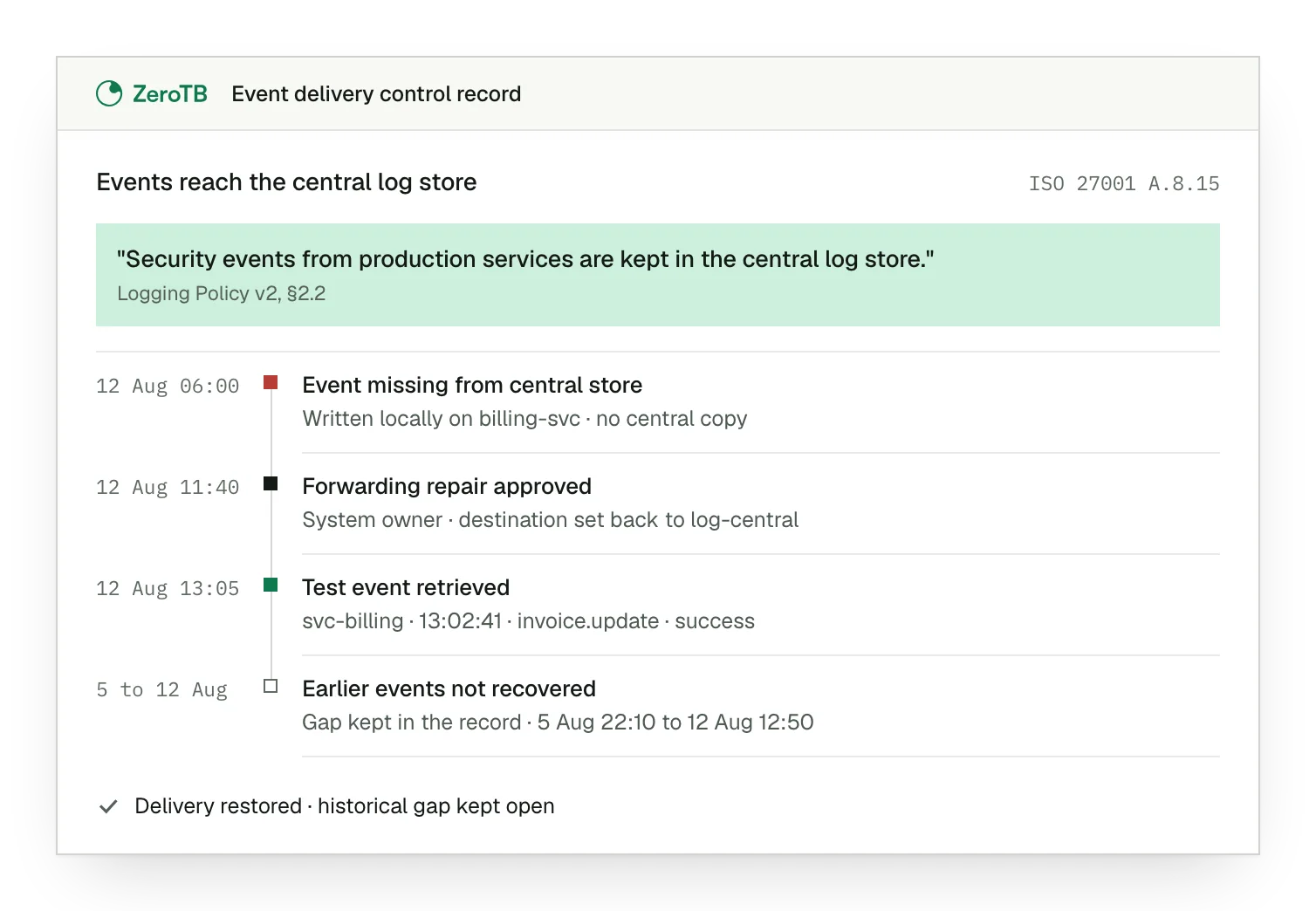
Missing central events. The expected event exists on the service, with no corresponding record in central storage.
Approved forwarding repair. The system owner authorizes a configuration change to send events to the intended destination again.
Successful retrieval test. The reviewer retrieves a new event and checks its identity, time, action and result.
Historical gap retained. The earlier period remains in the record, showing which history the repair could not recover.
Logging review checklist
Read the commitment alongside the system inventory and identify the activity that must leave a record.
Find the same test event in both places and check whether its details explain what happened.
Have the affected system's owner approve the repair and the test used to judge its result.
After the change, perform a safe action and retrieve the corresponding event with its required details.
Keep the approval, test and missing history together, with the owner and arrangements for checking subsequent changes.
Sources
- ISO/IEC, ISO/IEC 27002:2022 control guidance, 2022.
- NIST, SP 800-53 Rev. 5, audit and accountability controls, 2020, with December 2020 updates.
- NIST, SP 800-92, Guide to computer security log management, 2006.
- AWS, CloudTrail user guide, accessed November 2026.
- HHS, HIPAA audit protocol, audit controls, 2018 update.
Related pages
Technological controls
Explore the other ISO 27001 control guides for the systems that generate and store events.
ISO 27001
Read how individual controls fit within the organization's wider information security management system.
Compliance frameworks
Find guidance on related requirements across the frameworks that apply to the same systems.
Start with the Pilot
Talk with our team about logging gaps and the eight-week Pilot. We map up to 25 commitments and take two real control gaps through approved correction and verified restoration, with evidence of the changes and results.