Under SOC 2 CC5.3, policies and procedures need to produce controls that people actually perform. Procedures explain responsibilities, timing and the response to failures. To assess one, follow completed work through its required steps and check that any correction has been approved and tested.
The approval rule is written down, but the onboarding tool grants access before a manager sees the request. That gap is the concern behind CC5.3 in SOC 2 CC5. The useful question is whether work follows the approved procedure as it passes between people and systems.
Policy and procedure
A policy states the rule that the company has agreed to follow. The procedure describes the work that makes that rule effective. A requirement for manager approval, for instance, needs a way to request the decision and pass it to whoever grants access.
Someone following the procedure should be able to complete the task without guessing which steps matter. The instructions need enough detail to explain where work begins, which decisions must happen and what the person completing it should leave for a reviewer to examine.
Scope of the procedure
The procedure needs to cover the work to which the policy applies. Several teams may grant access through separate applications. A common approval rule can apply across those applications even when each team uses a different request form or route to complete the task.
That difference matters when reviewing completed work. A request that followed the rule in one application cannot establish what happened elsewhere. Compare the procedure's coverage with the systems and routes actually in use, including any added since the procedure was last approved for use.
Responsibility and authority
A procedure has to reach a person who knows how to do the work and can make the decisions it requires. Naming a department leaves room for confusion about who acts. Responsibility should extend to dealing with failures discovered while the procedure is being performed.
Repairing a failure may require another team. The compliance owner who spots a missing approval may have no permission to change the application. The procedure should make the application owner's role clear, so the finding reaches someone who can decide and carry out the correction.
Timing and escalation
The timing of a control is part of what makes it work. If a policy requires approval before access, an approval added afterward cannot establish that the rule was followed. The account already had access during the interval before the manager made a decision.
Procedures need to reflect that timing, whether work begins with an event or follows a schedule. They also need a response when a step is late. The response should identify who receives the issue and who can decide what to do about the exposure.
Evidence of completed work
Completed work shows whether a procedure operates as described. A reviewer can follow a request from its creation through the required decision to the resulting action. Dates and linked records help establish whether the steps occurred in the order the procedure requires, for the work it covers.
A current setting adds useful context, but the performed task explains how that setting came about. The review should account for missing approvals, incomplete records and unresolved tasks. An absent record leaves a question about execution that a copy of the policy cannot answer.
Changes after the audit
Procedures can fall behind changes in the systems they describe. A policy may continue to require approval even after a replacement onboarding tool removes that step. The document still describes the intended process, but requests now pass through a workflow that behaves differently.
Staff changes can also interrupt the process. Requests may keep going to a former owner, leaving the next person unable to complete the task. Checking a recent task against the instructions, system behavior and assigned duties helps expose these differences before they become the accepted routine.
Correction and policy changes
A gap calls for a decision about what should change. Where the policy still requires manager approval, the workflow needs that step restored. Editing the procedure to match the faulty workflow would leave the company granting access without the decision it had committed to require.
Sometimes the company has deliberately changed the intended process. In that case, approval of the new procedure should explain the arrangement and its effect on the control. The people doing the work need the revised instructions, while the record retains what happened under the earlier procedure.
Approved exceptions
A departure from a procedure needs an explicit decision if it is to count as an exception. The decision should explain the reason, the work affected and the conditions that apply. Those details give a reviewer a basis for understanding the different treatment.
An exception also needs a review point so its justification can be reconsidered. Until the responsible person makes the decision, an incomplete approval remains unresolved work. Recording it as an exception merely because the task has already happened would conceal the missing decision from later review.
Verification of the procedure
Testing the corrected procedure establishes whether its steps work together. For a restored approval step, that means checking what happens to a request while approval is pending and after approval arrives. The first request should remain blocked; the second should be able to proceed.
ZeroTB keeps the results of this testing with the approved repair in a Verified Control Record. A reviewer can follow the commitment through the observed gap, action and approval to verification. Failed tests or unavailable results leave the gap open for further investigation.
Procedure history
Evidence needs the procedure version that applied when the work happened. A later revision can explain the current process while leaving earlier tasks difficult to assess. Keeping effective dates with policy versions, procedure changes and completed work allows a reviewer to reconstruct the relevant sequence.
The same distinction applies to repairs. A successful test establishes the result of the correction; earlier failures remain part of the history. Keeping both helps the next review identify recurring problems and understand which change addressed them, without treating a new result as evidence of earlier operation.
Evidence for CC5.3
The records below help a reviewer trace a procedure from approval through completed work and any subsequent correction.
| Requirement | What an auditor asks for | Where it comes from |
|---|---|---|
| Defined procedure | What the procedure requires and which activities it covers | Policy approvals and the procedure followed during the work |
| Assigned responsibility | Responsibility for completing the activity and handling failures | Assigned duties and the procedure’s approval responsibilities |
| Timely execution | When the required decisions and actions occurred | Requests and approvals linked to dated task completion |
| Corrected deviations | The departure, decision to correct it and tested result | Approved exceptions, authorized changes and their verification records |
| Current instructions | Which instructions applied when a task was performed | Dated procedure versions and communications about the revision |
Related framework requirements
| Framework | Control | What it covers |
|---|---|---|
| SOC 2 | CC5.3 | Use of procedures to perform the activities established by approved policies |
| ISO 27001 | A.5.37 | Operating procedures documented and made available wherever people need them |
| HIPAA | 164.308(a)(1) | Policies and procedures addressing security risks and violations that affect electronic protected health information |
Example of restoring an approval step
In this example, the onboarding tool has granted access while manager approval is pending. The owner approves a change to the workflow. After the repair, a pending request remains blocked and an approved request proceeds, providing the results needed to verify the correction.
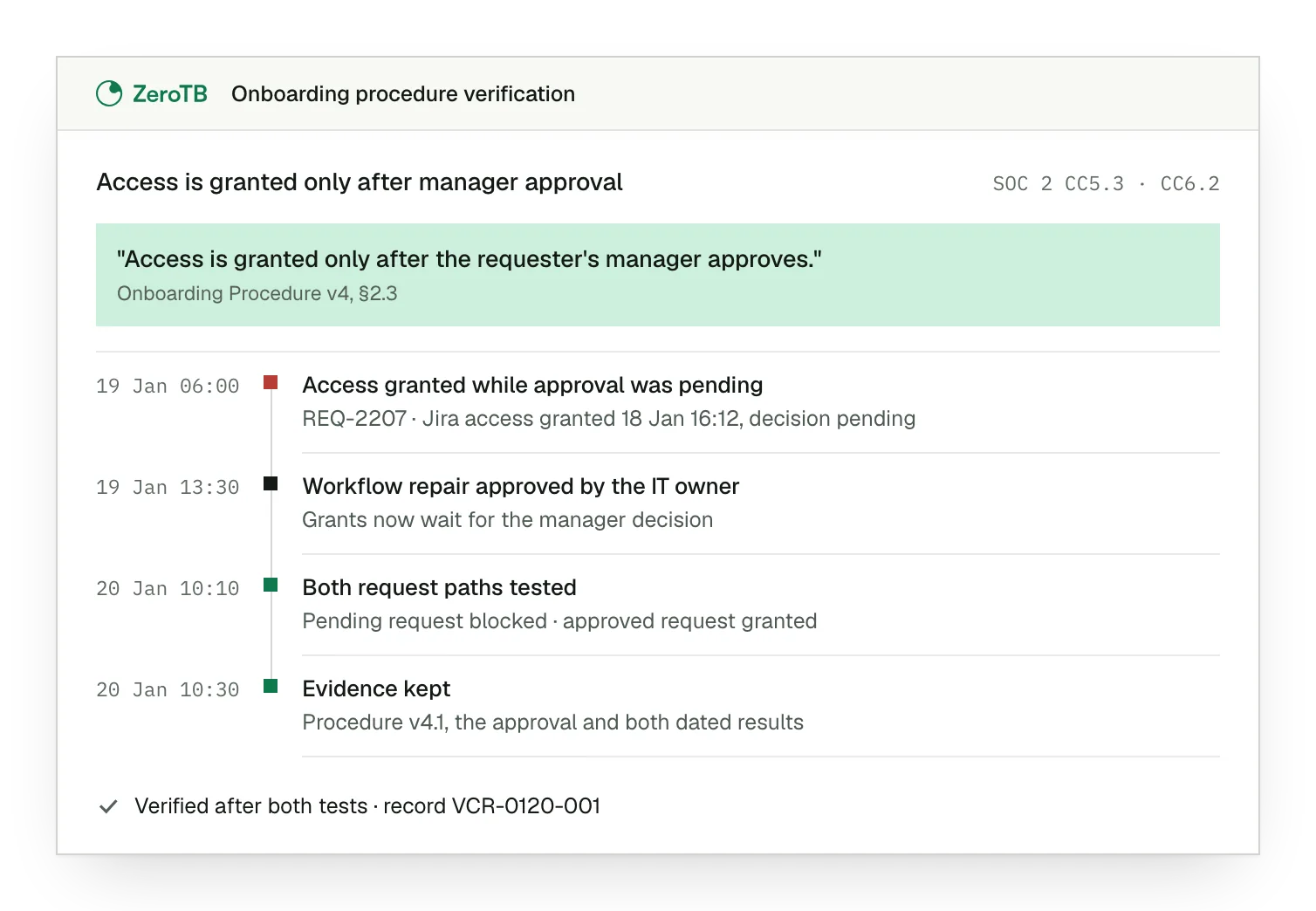
Access granted early. The request history shows that access was granted while the manager decision was pending.
Workflow repair approved. The owner has approved a repair requiring the manager decision before access can be granted.
Request paths checked. One test leaves access blocked; the other allows the grant after the manager approves it.
Procedure evidence retained. The repair record links the relevant procedure version with approval and dated results of both tests.
Procedure review checklist
Identify the approved policy requirement and the decision or action that makes it happen in practice.
Follow a recent task across its systems and owners, checking the order of required steps.
Decide whether the gap needs a workflow repair, a procedure revision or an explicitly approved exception.
Check that required decisions prevent premature action and that work proceeds when those decisions are complete.
Keep the applicable procedure version with the task, correction, approval and dated verification result for review.
Sources
- AICPA & CIMA, 2017 Trust Services Criteria with revised points of focus, 2022 revision.
- HHS, HIPAA audit protocol, 2018 update.
- ZeroTB, SOC 2 compliance automation with human approval, 2026.
Related pages
SOC 2 criteria
Read the wider criteria that connect policy decisions with controls across the organization.
Compliance frameworks
Explore related requirements across SOC 2, ISO 27001 and HIPAA within their respective scopes.
Compliance controls
See how a written commitment becomes a control with an owner and a verifiable result.
Start with the Pilot
Talk with our team about keeping procedures effective as systems change. The eight-week Pilot maps up to 25 commitments and takes two real control gaps through approved correction and verified restoration, with a record of each result.