SOC 2 CC4.2 requires timely assessment and communication of control deficiencies to those responsible for correcting them. That includes senior management and the board where appropriate. In practice, the finding needs to reach an owner with enough information to act, and its progress needs to remain visible through correction.
A completed ticket can leave a compliance reviewer with an unanswered question: did the control actually change? The fix might still await deployment. Within SOC 2 CC4, CC4.2 addresses how deficiencies are assessed and communicated so the people responsible can take corrective action.
Deficiency assessment
A useful deficiency report explains which commitment failed and what that failure could affect. Connect the policy or report commitment to the observed condition, then describe the affected system or process. This gives the person assessing severity a concrete basis for the decision.
The assessment should distinguish a failed control from an unclear requirement or missing observation. Each needs a different response. An owner may need to clarify the expected condition before anyone can select a correction or decide whether the evidence shows a failure.
Corrective responsibility
The person receiving a finding must be able to arrange its correction. Compliance may identify a gap in an application but depend on the application owner to approve a change. Both teams need to know who makes that decision and who reviews the result.
When work moves between teams, the reason for the correction must move with it. A new owner needs the expected result and current status, including unfinished decisions. Without that context, an assigned ticket can sit with someone who cannot take the next action.
Response deadlines
Response times should reflect the effect of the deficiency and the time available to correct it. An agreed deadline gives the owner and reviewer a shared point for checking progress. Its basis should remain visible when the severity or affected scope changes.
Approval, deployment and verification may finish at different times. Tracking the next unresolved action makes a delay easier to address. If a correction cannot meet the agreed response window, the record should show the obstacle and the decision needed to move the work forward.
Management escalation
Management needs enough information to resolve significant or delayed corrective work. An escalation should explain the remaining effect on objectives, the action already taken and the decision required. Senior management and the board receive relevant deficiencies according to their oversight responsibilities.
Escalation may be needed because the owner lacks authority, teams disagree about the response, or the correction has stalled. Repeating the original alert gives management little new information. A clear account of the unresolved decision helps the appropriate person authorize the next action.
Handoffs after the audit
The audit task can end before the control works again. An engineer submits a corrective pull request, marks the ticket complete and returns to other work. If the change still awaits deployment, production continues to run with the condition that caused the finding.
A similar gap appears when audit follow-up ends without an owner for continuing checks. The reviewer then has a completion date but no current observation. Keeping the finding connected to the system owner makes it possible to ask what remains unfinished and obtain a usable answer.
Closure conditions
A closure condition gives the owner a result to aim for and the reviewer a result to test. Agree on that condition before work begins. It must describe something observable in the affected system or process, so everyone can recognize whether the correction succeeded.
Some findings end in an approved exception. In that case, the owner decides whether to accept the remaining risk and when to review it again. The record must explain the exception and its actual condition, allowing a later reviewer to understand why it remains.
Approved correction
An approver needs to understand what the proposed change will do to the affected control. Put the failed condition beside the action and expected result. The owner can then judge whether the repair addresses the finding and whether it could stop necessary work elsewhere.
ZeroTB reads the commitment and checks it against the current state, then drafts the correction. People approve the action before it proceeds. Verification follows the approved work, with the result retained in the record; people continue to decide what the requirement means and which exceptions to accept.
Verification in production
A test in the affected environment supplies the evidence for closure. Testing before deployment has a different purpose: it helps the owner decide whether a proposed change can proceed. Once deployed, the correction needs another check against the condition agreed for the finding.
A failed result means the owner has more work to do on the correction. A missing or stale observation leaves a different question unanswered. The reviewer needs current information before deciding whether the repair worked, so that information gap remains visible until it is resolved.
Recurring findings
When a finding returns, the earlier evidence helps explain what happened. A correction may have worked until another change reversed it. Or the earlier ticket may have closed before the fix reached production. Both leave a gap, but they call for different follow-up.
The first case requires attention to ownership and checks after the repair. The second requires someone to finish the original work. A review of recurring findings should preserve that distinction, so the team addresses the reason for repetition when it decides the next action.
A reviewable history
A reviewer needs to follow the response from the moment the deficiency became known. Dates on assessments, communications and escalations show where the work moved and where it waited. They explain a delay more usefully than a final ticket status viewed on its own.
The Verified Control Record holds the commitment, before-and-after state, action, approval and verification. Alongside the communication history, it gives the reviewer a way to trace the closure decision to the work. The reviewer can examine that evidence without asking separate teams to reconstruct the repair.
Evidence for CC4.2
The evidence should let an auditor follow what happened to the finding, including decisions made while the correction remained open.
| Requirement | What an auditor asks for | Where it comes from |
|---|---|---|
| Deficiency assessment | The condition that failed and the team's assessment of its effect on objectives | The finding and its observations, with a reference to the policy or report commitment |
| Ownership and timing | The person responsible for correction, when they received the finding and the agreed response window | The assignment history and communications that established the owner and deadline |
| Appropriate escalation | The unresolved matter brought to management and the decision management made | Messages or review records showing the issue, its recipients and their response |
| Approved correction | The work authorized to correct the condition, together with any accepted exception | The approved change request or runbook, and the owner's recorded decision about remaining exceptions |
| Verified closure | The result observed after the change and the basis for accepting it | The deployment record and dated verification, linked to the finding they resolve |
Related framework requirements
| Framework | Control | What it covers |
|---|---|---|
| SOC 2 | CC4.2 | Assessment and timely reporting of control deficiencies to people responsible for corrective action |
| ISO 27001 | A.5.36 | Review of whether the organization's information security policies, rules and standards are followed |
| HIPAA | 164.308(a)(1) | Security management processes for preventing, detecting and correcting security violations involving electronic protected health information |
Example of verified finding closure
This example shows why a finding can remain open after the engineering ticket closes. The repository review rule is still disabled because the repair has yet to reach production. Closure follows the approved deployment and a check that the rule now works.
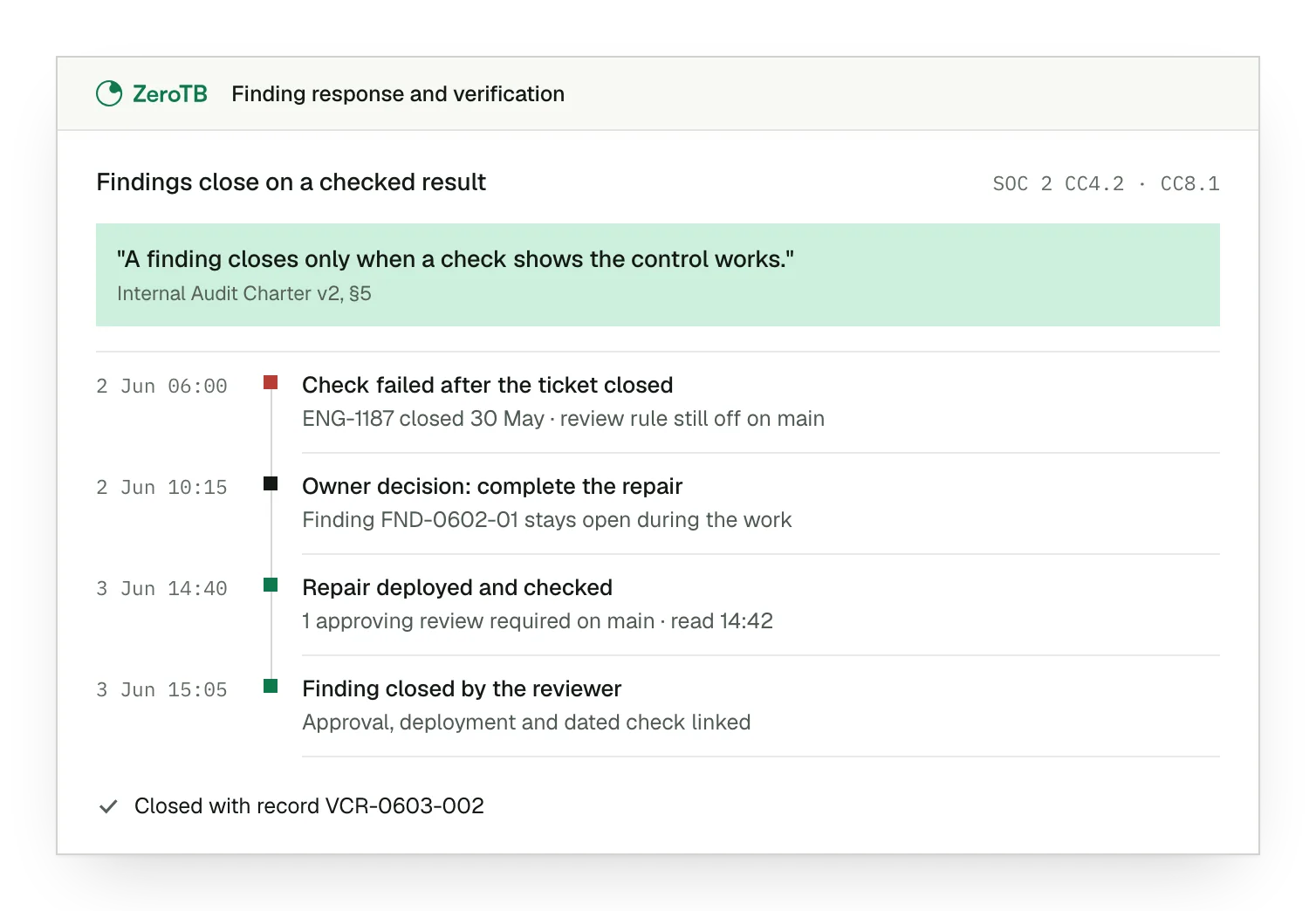
Open control gap. A repository check finds the required review rule disabled after the repair ticket was closed.
Owner decision. The owner agrees to complete the earlier repair, with the finding open during the work.
Verified repository state. The repair has reached the repository, and the new check confirms that required review works.
Supported closure. The recorded approval and deployment lead to a dated result the reviewer can use for closure.
Control deficiency review checklist
Compare the reported deficiency with its source commitment, then examine the observation and the assessment of its effect.
Identify the person authorized to approve the repair and the recipients responsible for oversight when escalation is needed.
For an overdue finding, establish which decision or action remains unfinished and who can resolve the delay.
Read the check performed after the change and assess whether its result supports the recorded closure decision.
Check the arrangements for future observations, including who receives a repeat failure and decides how to respond.
Sources
- AICPA & CIMA, 2017 Trust Services Criteria with revised points of focus, 2022 revision.
- HHS, HIPAA audit protocol, 2018 update.
- ZeroTB, How to stop recurring SOC 2 findings.
- ZeroTB, SOC 2 compliance automation with human approval.
Related pages
SOC 2 criteria
Read the wider set of criteria that a SOC 2 assessment applies to controls.
Compliance frameworks
Browse the framework libraries for requirements relevant to the systems and processes in scope.
Recurring SOC 2 findings
Follow the practical review of ownership and checks after a previously corrected gap returns.
Start with the Pilot
Talk with our team about the eight-week Pilot. We map up to 25 commitments from your report and take two real control gaps through verified restoration, leaving records of the approved work and its results for review.