A SOC report records an independent CPA firm's examination of a service organization's controls. In a SOC 2 report, the auditor evaluates those controls against the applicable Trust Services Criteria. Start with the scope and dates, read the opinion beside the test results, and trace each relevant finding to its current status.
A customer wants to know whether the report covers the service it uses. The provider also needs to know which findings still call for action. Reading the document for both purposes helps connect the auditor's conclusions to the controls that people rely on today.
SOC report types
SOC 1 concerns controls that affect a customer's financial reporting. SOC 2 concerns controls within the applicable categories of security, availability, processing integrity, confidentiality and privacy. Both belong to the AICPA SOC framework, which provides different reports for different assurance needs.
SOC 3 offers a general-use report on Trust Services controls, with less detail than SOC 2. The detailed SOC 2 report has restricted-use terms. A provider sharing it needs to follow those terms and control access to the document for its intended recipients.
SOC 2 report contents
Management's assertion, the system description and the auditor's report explain the system from different positions. Management describes the system and makes the assertion. The independent auditor states what the examination covered and gives an opinion. Reading all three connects the claims to the examination.
In a Type 2 report, the tests and results show how the auditor examined the controls. A finding may also have a response from management. Check where that response appears and whether the auditor examined it before treating a reported correction as tested.
Scope and covered dates
The report is useful only to the extent that its system and dates match the decision you need to make. Confirm the service, locations and criteria covered. A familiar company name on the cover does not establish that the product you use falls within scope.
An examination at a specified date addresses control design at that date. A SOC 2 Type 2 examination also addresses operating effectiveness over a stated period. The report's issue date can be later than that period, so read both dates before judging how recent the evidence is.
Customer responsibilities
A provider's report can identify controls that depend on its customers. Where stated, complementary user entity controls describe actions the customer must perform for the provider's service commitments or system requirements to be met. Those dependencies need a corresponding control in the customer's own environment.
The report may also describe ordinary user responsibilities needed to use the service successfully. These have a different role from complementary controls. The AICPA review checklist separates them, helping a reviewer identify which responsibilities affect the assurance they take from the report.
Supporting service providers
A supplier can support the service without having its controls tested in the provider's SOC 2 examination. Look for the treatment of subservice organizations in the system description. A carve-out excludes the relevant supplier controls from the examination, leaving a boundary for the reader to assess.
What matters is the excluded controls' role in the service being reviewed. The provider's monitoring of its supplier may answer the concern; some dependencies call for additional assurance. Keep the dependency and the reviewer's conclusion together so a later review can reconsider that decision.
Attestation and audit opinions
In a SOC 2 attestation examination, a CPA firm evaluates evidence about matters management has asserted and issues an independent opinion. AICPA supplies the reporting framework. The opinion applies within the scope and dates stated in the report, which determine how the reader can use it.
An unmodified opinion supports the examined matters in all material respects. A qualification concerns a material issue whose effects are limited. Material and pervasive problems lead to an adverse opinion; a disclaimer provides no opinion. ISACA's explanation helps readers distinguish the outcomes and assess their basis.
Control tests and exceptions
An exception describes a test result that needs attention, while the opinion states the auditor's overall conclusion. One exception does not automatically produce a qualified opinion. Its meaning depends on the affected control, the circumstances and the other evidence considered during the examination.
For each relevant exception, connect the observed failure to the service and risk it affects. Read management's response for the proposed correction and its status. A promise to repair something still needs a later observation that shows what changed and whether the control works.
Priorities after a qualified report
The basis for qualification is the starting point when a SOC 2 report comes back qualified. It identifies the matter behind the auditor's conclusion. Check the affected system now: a control that still permits unwanted access needs action on the exposure that remains.
Address the greatest remaining risk first. A historical evidence gap calls for investigation into what happened during the examined period; an operating failure calls for correction. The control owner decides the action. Questions about the opinion and its reporting implications belong with the auditor.
Evidence of completed repairs
A completed change needs a check against the control's expected result. Disabling an account, for example, should end the unwanted access while preserving access that remains necessary. Keep the observed gap and the approved change with the dated result of that check.
A reviewer should be able to follow the record from the original finding to the later condition. The repair date explains when the condition changed. It also lets compliance answer customer questions about the current state while retaining the report's conclusion about the earlier period.
Bridge letters
A bridge letter describes the interval after the most recent SOC report ends. Management provides this account of material changes or issues, sometimes called a bridging letter. Google Cloud documents its use alongside both SOC 1 and SOC 2 reports for customers reviewing a later period.
Read the letter for its dates and what management says happened during that interval. The auditor's opinion still covers the original report period. Where a relevant system or control has changed, evidence of its present condition can help the customer assess the later risk.
Controls between examinations
Accounts and systems keep changing after the examination, so the report's commitments need continuing checks. Each check needs an expected result and a system to inspect. It also needs an owner who can investigate a failure and decide what should happen next.
ZeroTB checks systems against approved commitments and drafts fixes for people to authorize, then verifies the resulting state. The Verified Control Record keeps the commitment, before-and-after state, action, approval and verification together. Teams can use that repair history in their SOC 2 program between examinations.
Example of resolving a retained account
In this example, the report identifies a departed contractor's account that still allows application access. Removing it closes the current access gap once the result is checked. The record keeps that later correction beside the original finding, with dates that distinguish the two.
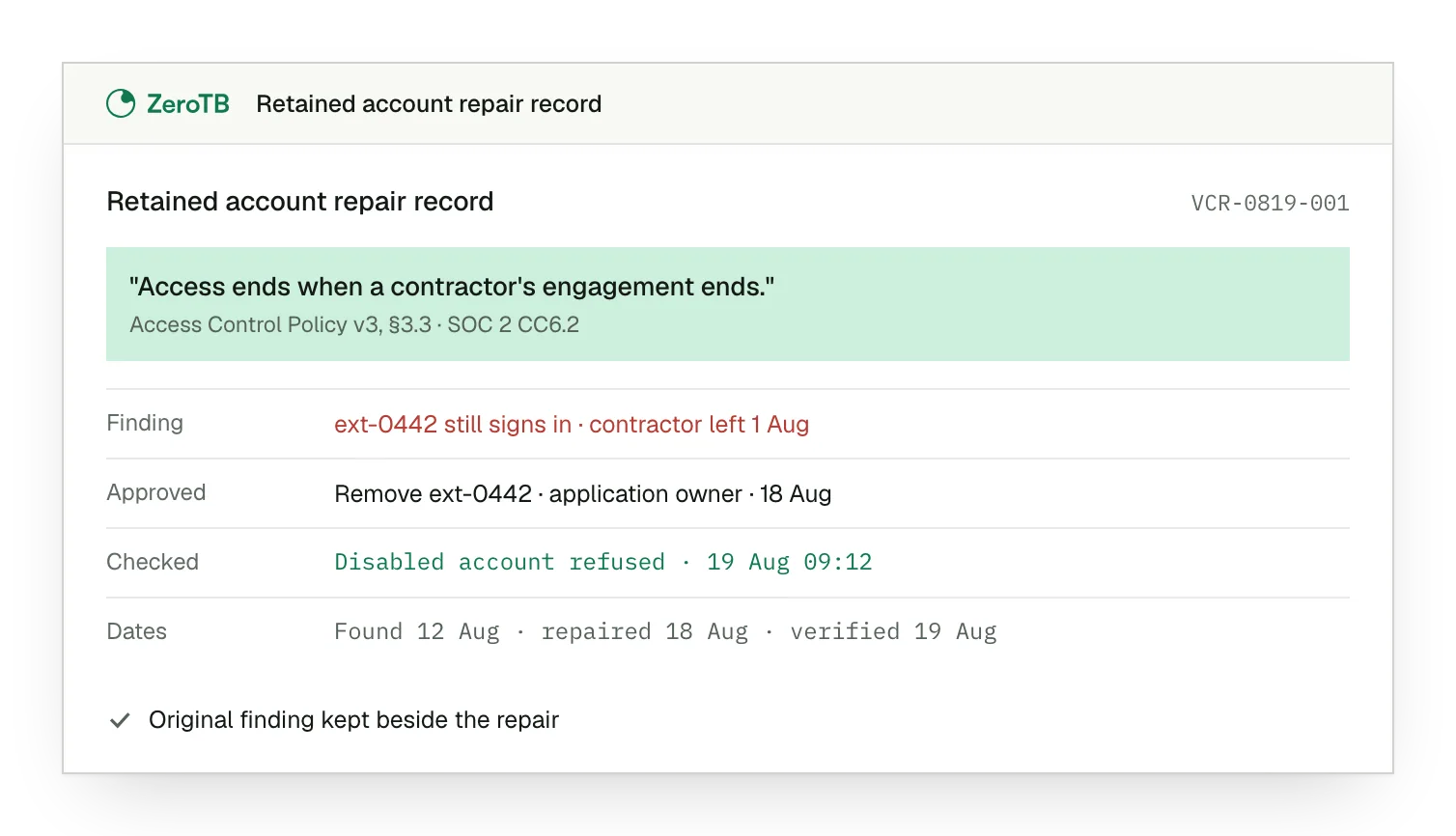
Observed access gap. The account belongs to a departed contractor, but the application still accepts its access.
Owner decision recorded. The owner confirms that the account has no remaining purpose and approves its removal.
Removal result checked. After the change, the access check shows that the disabled account cannot enter the application.
Separate dates retained. The original finding remains in the record alongside separate dates for the approval, repair and verification.
SOC report review checklist
Identify the covered service, criteria and dates before applying the report's conclusions to a customer or provider decision.
Read the opinion, its basis and relevant test exceptions together to understand the risk the report describes.
Compare each material finding with the current system state, then assign the decision to the owner of the affected control.
Retain the approval and dated verification with the original finding so a reviewer can distinguish historical and current conditions.
Connect the restored control to an owner and continuing checks so later changes receive investigation and a recorded response.
Sources
- AICPA & CIMA, System and Organization Controls: SOC suite of services, undated; accessed November 2026.
- AICPA, SOC 2 Report Review checklist, undated; accessed November 2026.
- ISACA, How to Properly Review an SOC Report, 2019.
- Google Cloud, SOC 1: bridge letters, undated; accessed November 2026.
- AICPA, Journal of Accountancy, Explaining the 3 faces of SOC, 2016.
Start with the Pilot
Talk with our team about the controls behind your report. The eight-week Pilot maps up to 25 commitments and takes two real control gaps through approved correction and verified restoration, with a record of the work.