SOC 2 CC1.3 addresses reporting lines, authority and responsibility: how a company organizes work to meet its objectives. Control duties need an accountable owner, people to perform them and appropriate approval authority. After a change of owner, verify that the successor receives the work and can make the decisions their role requires.
A manager leaves with a policy review still pending. Their replacement appears on the organization chart, yet reminders keep reaching the old mailbox. SOC 2 CC1 includes the organizational responsibilities behind this kind of failure. CC1.3 is the criterion to examine when the assignment itself has stopped working.
Control scope
CC1.3 concerns how the organization assigns and supports the work needed to meet its objectives. The assignment needs a defined scope. Read the relevant policy or report commitment to establish which process the owner is responsible for and what that process is intended to achieve.
A policy review, for instance, might pass from a department lead to a security reviewer before management approves it. Describe each person's part in that work. Include the response each person owes to the next, so the assignment explains more than a job title.
Reporting lines
A reporting line should show where a control owner takes a decision they cannot resolve. The organization chart identifies management relationships, but a task can cross several departments. The procedure needs to explain who resolves disagreements or delays along that route.
An administrator waiting for a department manager to approve a change needs a clear next step if the request goes unanswered. Identify the role that can resolve the delay and the circumstances for involving it. That makes the reporting line useful during the work.
Decision authority
An owner needs authority that matches the decisions the control requires. Distinguish accountability for the outcome from responsibility for individual tasks and authority to approve them. A senior role in an organization chart can still leave these duties unclear in the procedure people follow.
Delegated authority should explain what a person may decide and when another approver must become involved. In a small team, one person may hold several duties. Make each duty explicit and retain the review arrangements the company has approved for decisions that need further oversight.
Changes in responsibility
A departure or team move can leave control work assigned to someone who no longer handles it. The staffing change may be complete while task assignments remain untouched. Compare the control register with current responsibilities and the recipients recorded in the task queue.
Include temporary cover in that comparison: someone may still be doing a task they accepted during a colleague's absence. Trace an active review to the person receiving it. Where the assignment is stale, record the affected work and ask management to approve the appropriate successor.
Work in progress
A handover includes the unresolved work that the previous owner leaves behind. The incoming owner needs to review overdue tasks, open exceptions and decisions awaiting approval. Otherwise, updating the assignment can make the register look current while the same unfinished work continues to wait.
Keep original due dates and the reasons for delay with each item. Record which matters the successor accepts, which require another decision and where those decisions will go. The successor can then see what they now own and what still needs to be completed.
Supplier responsibilities
Outsourced work still needs an internal owner who can review the supplier's response. The service agreement helps establish which tasks the supplier performs and which decisions the company retains. Compare that division with the operating procedure, including the contacts responsible for unresolved requests.
For example, a provider may review a policy and recommend revisions while an internal manager authorizes them. A change of contact on either side can interrupt the review. Confirm the revised arrangement with both parties and trace pending requests to someone who can answer them.
Response paths
The replacement owner must be able to receive the task, inspect the evidence and reach the required approver. Follow the route from notification to decision. A message can arrive successfully even when the document it links to is inaccessible or the approval request goes to an old contact.
This is where ZeroTB's people and process controls support the work through assigned tasks, escalation and completion checks. The responsibility itself remains a management decision. Once that decision is made, inspect the successor's response to see whether the arrangement allows them to perform the duty.
Handover verification
The first action under the new assignment provides evidence that the handover works. Review whether the successor received the task, had enough information to decide and used the agreed approval route. An acknowledgment establishes acceptance; the subsequent action shows how the responsibility operates in practice.
Judge the ownership change separately from the underlying control result. A successor may correctly escalate an overdue review that still needs management approval. That response can demonstrate a working handover while the review remains open. Preserve both statuses so a successful transfer cannot conceal unfinished control work.
Evidence across the period
Dated responsibility records explain who held each duty before and after the change. Keep the approval and effective date of the transfer with the successor's acceptance. The first action under that assignment adds evidence that the revised arrangement became part of the operating process.
The Verified Control Record connects a commitment to the observed gap, approved action and verified result. Keep the earlier ownership gap visible in that history. A reviewer needs to understand both the correction and the period when the work had no effective owner.
Continuing ownership
Ownership needs another review when the work or the people responsible for it change. Staff departures, reorganizations and revised supplier duties can each affect an established assignment. Include these changes in the review process, alongside the schedule agreed for the control's continuing operation.
The review should establish whether the assigned people can still complete the work and resolve exceptions. Where authority remains unclear, management must settle the decision. This connects CC1.3 to the wider governance, risk and compliance process, with unresolved ownership visible until the company establishes a workable arrangement.
Evidence for responsibility assignments
A reviewer should be able to use these records to establish who was responsible and what happened after the assignment changed.
| Requirement | What an auditor asks for | Where it comes from |
|---|---|---|
| Reporting structure | Reporting relationships and the person responsible for resolving a delay | Organization chart, with the control procedure showing how work is escalated |
| Delegated authority | Tasks and decisions assigned to each role | Role descriptions, approval limits and management delegations |
| Responsibility transfer | The transfer date, management approval and successor acceptance | Handover record showing the work still open at the transfer |
| Supplier responsibilities | The provider's part in the control and the internal owner | Service agreement and the procedure followed by both parties |
| Working assignment | The successor's action and the result of checking the handover | Task history, relevant approvals and a dated verification record |
Related framework requirements
| Framework | Control | What it covers |
|---|---|---|
| SOC 2 | CC1.3 | Reporting lines, authority and responsibilities supporting the organization's objectives |
| ISO 27001 | A.5.2 | Assignment of information security duties within the organization's scope |
| HIPAA | 164.308(a)(2) | Designation of a security official responsible for developing and implementing Security Rule policies and procedures |
Example of restoring policy review ownership
A policy review can remain overdue after its owner leaves, even when a replacement appears in the control register. This example follows the pending task to its successor. Their response verifies that the transfer works; the separate review status shows the approval still needed.
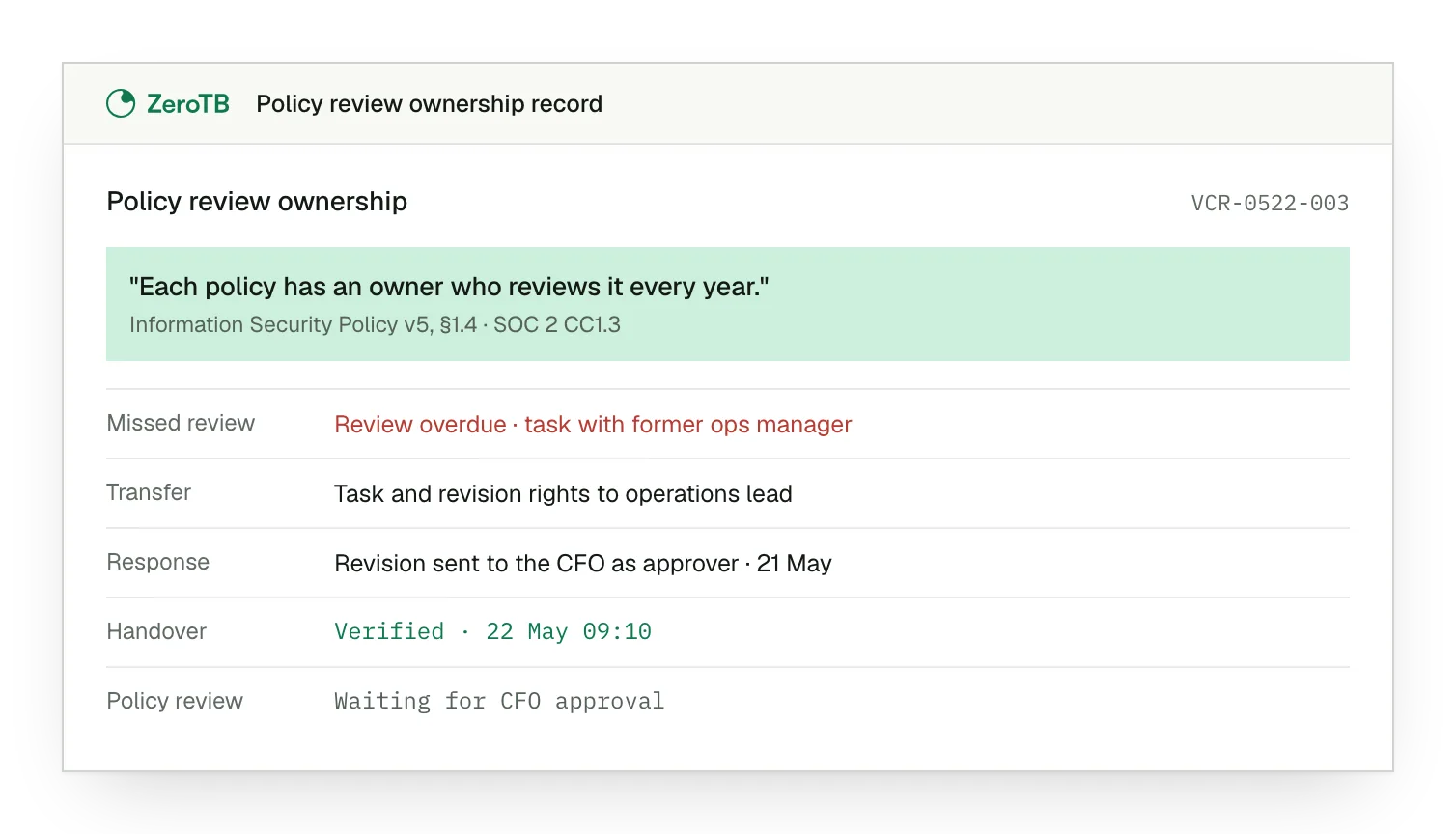
Missed review. The former operations manager remains the task recipient, although the policy review is overdue.
Approved transfer. The approved assignment includes the pending task and authority to propose a policy revision.
Working response. The new owner submits the revised policy to the approver specified in the updated procedure.
Separate statuses. The handover check passes, with management approval still outstanding on the policy review itself.
Responsibility review checklist
Confirm which role owns the outcome and which roles perform, approve and receive escalated work.
Decide who accepts overdue tasks and open exceptions, preserving their history and any decisions still required.
Check whether the successor's first action demonstrates the agreed authority, working access and correct approval route.
Decide when ownership needs another review and who resolves gaps after staff, process or supplier changes.
Sources
- AICPA & CIMA, 2017 Trust Services Criteria with revised points of focus, 2022 revision.
- HHS, Summary of the HIPAA Security Rule, current-rule summary accessed November 4, 2026.
- ZeroTB, How to stop recurring SOC 2 findings, 2026.
Related pages
SOC 2 framework
Read the wider criteria to place reporting responsibilities alongside the other parts of a SOC 2 program.
Compliance frameworks
Browse the control library for related requirements in SOC 2, ISO 27001 and HIPAA.
Governance, risk and compliance
See how responsibility for controls connects with governance decisions, risk management and the work between audits.
Start with the Pilot
Talk with our team about keeping control work assigned as people change roles. In the eight-week Pilot, we map up to 25 commitments and carry two real control gaps through approved correction and verified restoration. The resulting records document the work.