SOC 2 CC8.1 requires a managed process for changing infrastructure, data, software and procedures. That process includes assessing the change, approving it, testing it and putting it into use. Effective SOC 2 change management controls keep those decisions attached to the change through every route into production.
A team can have a change policy and still deploy work that never received its required review. The gap is often in the route to production. Under CC8 change management, the process needs to reach that route, including the credentials and automation that use it.
Change scope
A change process covers the parts of the system that can affect its agreed operation. Code is only one of them. A data migration can change stored information, while an infrastructure setting or revised procedure can change how the service operates.
The scope therefore needs to include infrastructure, data, software and procedures, with an owner for each route used to change them. Coding agents can produce changes in several of these areas. Their work needs the reviews required for any other change with the same effect.
Change risk
A reviewer needs to understand what a change will do before deciding whether to approve it. The request gives that context: the intended result, the systems affected and what could go wrong. Those details also explain why particular tests are needed.
Different changes can justify different amounts of review. A routine adjustment may need fewer checks than a change to the handling of sensitive information. The approved process should explain the difference, so the decision follows the change's risk even when the work is urgent.
Release identity
An approval is useful only when it identifies the change that reaches production. Connect the request and review to the version tested and released. A record that names only the application leaves the reviewer unable to distinguish one release from another.
Later edits can invalidate the basis of an earlier approval. GitHub can dismiss stale approvals when a pull request's reviewed changes are modified. That setting helps preserve the connection between a review and the work it authorizes. GitHub documents the available review settings.
Testing and information protection
Tests should establish whether the proposed change preserves the behavior and protections the system needs. Their scope follows the change's effect. A successful build answers a different question from a test of whether an altered permission still restricts access as intended.
Confidential and personal information also needs protection during development, testing and deployment. A test process can itself expose information if its data or access is poorly controlled. Review those protections alongside the expected application behavior, and retain the relevant results with the change.
Configuration baselines
The baseline is the approved configuration against which the system is checked. It gives a reviewer somewhere to start when a setting changes. The reviewer can compare the observed state with that reference and investigate differences that have no recorded approval.
An approved change may also require a new baseline. Keeping the old reference would make the next check compare production with an obsolete decision. Retain the approval for the updated configuration, including the settings it changes, so later reviews can explain why that state is expected.
Deployment bypasses
Repository protection reaches only the changes that pass through it. Production may also accept a deployment credential, a separate workflow or a direct configuration change. A review of branch settings can therefore look correct while another route still allows work to proceed without approval.
GitHub excludes administrators and certain bypass roles from branch protection restrictions by default. Review the rule's coverage of those actors, then examine access to deployment itself. Repository checks cannot govern a separate route that avoids them. GitHub explains these defaults.
Emergency changes
An emergency process must let the team act during an incident and preserve a record of the decision. It identifies the person who can approve urgent work, the testing needed before deployment and the follow-up needed after the immediate problem is resolved.
The resulting record should explain why the urgent route was used and what happened after deployment. Temporary permissions need attention during that follow-up. The owner decides when to remove them, since an emergency bypass left in place can become a routine way around review.
Approved corrections
A repair needs to satisfy the change rule without removing a release path the system still needs. ZeroTB reads the commitment, compares it with the observed state and drafts a fix for the owner's approval. That decision covers the proposed action and any necessary exception.
The approved fix is followed by a check of the resulting state before closure. Its Verified Control Record retains the commitment, the observations before and after, the action, approval and verification. The owner can see what changed and which result supported closing the gap.
Verification before closure
Verification tests both sides of the release rule: work without the required approval must be blocked, and properly approved work must still be deployable. A controlled test of the corrected route can establish those results without introducing an unintended change into production.
Saving the new setting is only part of the repair. The test results need to show how the route behaved and identify the change used to test it. A failed test or missing observation leaves the gap open until the team can establish the result.
Evidence between audits
A useful change record lets a reviewer follow one release from its request to the observed result. The request, approval, test results and deployment should identify the same change. Emergency decisions and exceptions belong with that history, where their effect on the release is visible.
Someone must own the continuing checks and act when deployment methods change. A new workflow or credential can reopen a previously corrected gap. Retaining dated observations in the evidence record helps the reviewer distinguish a past repair from evidence that the control continues to operate.
Change management evidence
The evidence should let an auditor select a change and follow the decisions, tests and deployment associated with it.
| Requirement | What an auditor asks for | Where it comes from |
|---|---|---|
| Defined change process | Which systems and changes the process covers, and who decides | Change policy checked against the system inventory |
| Authorized release | Who approved the change and which version the approval covered | Request and review linked to the released version |
| Relevant testing | What was tested and whether the relevant tests passed | Test results for the version reviewed |
| Controlled deployment | Which route and identity deployed the change to production | Deployment logs and access settings for that route |
| Managed emergencies | Why urgent access was used and what happened to it afterward | Incident history with the urgent approval and follow-up |
| Verified restoration | What failed, what was corrected and how the repaired route behaved | Dated observations and test results in the control record |
Related requirements across frameworks
| Framework | Control | What it covers |
|---|---|---|
| SOC 2 | CC8.1 | The process used to assess, approve, test and implement changes across the system |
| ISO 27001 | A.8.32 | Control of changes affecting information systems and the facilities that process information |
| HIPAA | 164.312(c)(1) | Safeguards against improper changes to, or destruction of, electronic protected health information |
Example of restoring release reviews
In this example, a deployment credential permits releases without the required review. The owner approves removing that bypass. The record shows the result of two tests: an unreviewed release fails, and a release with the required review and tests succeeds.
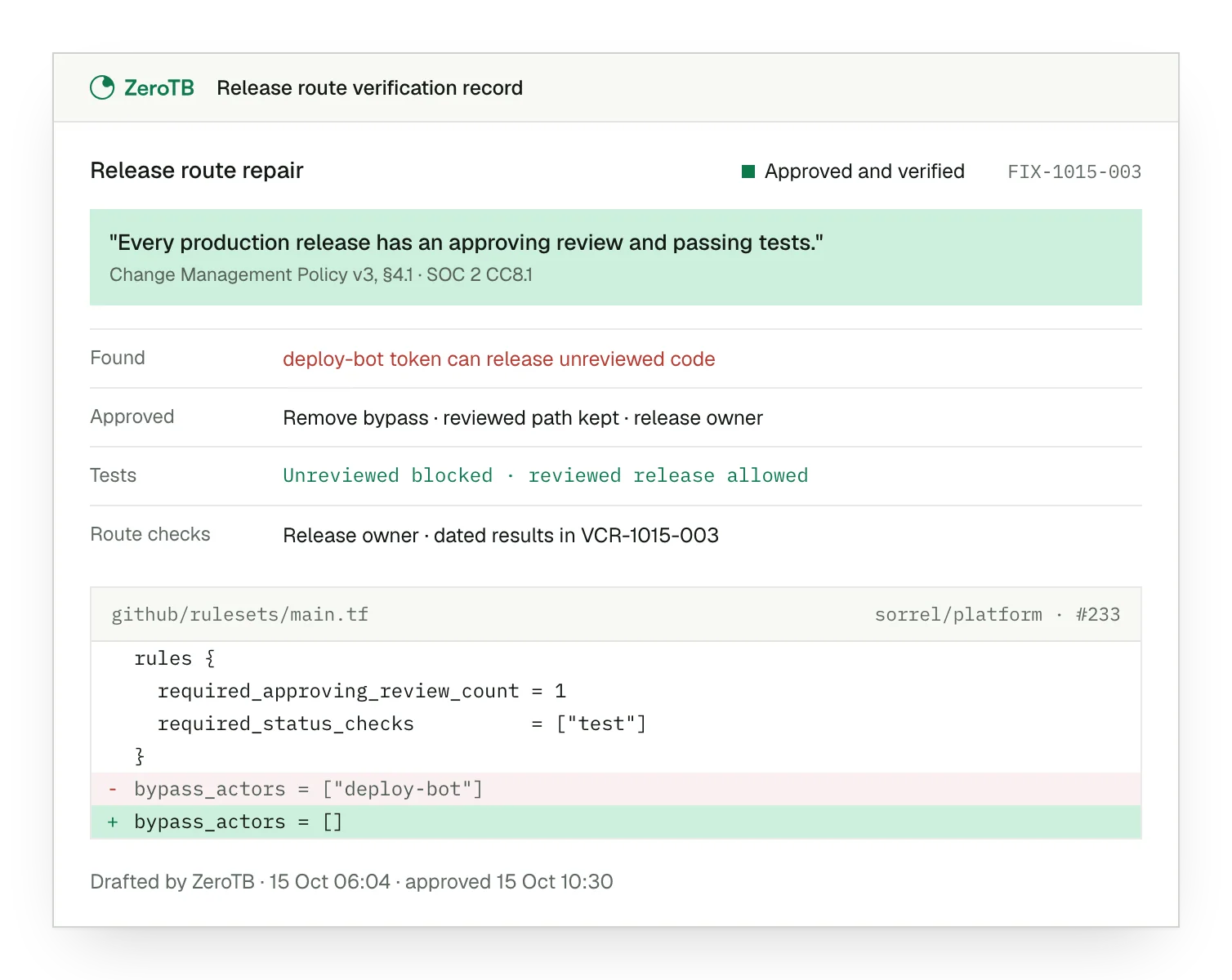
Unreviewed release path. The credential can deploy a change even though its required review has not happened.
Approved route correction. The owner approves the repair after checking that the reviewed release path will remain available.
Paired test results. One test confirms that unreviewed work is blocked; the other confirms that an approved release succeeds.
Continuing route checks. Dated observations stay with the repair, alongside the owner responsible for investigating later route changes.
Change control checklist
Select a release and identify how it reached production, including the workflow and credential used to deploy it.
Check that the approval and test results refer to the deployed version, accounting for edits after review.
Identify accounts that can skip a required review, then check the purpose and owner of each exception.
Test an approved repair with both an unreviewed change and a release that meets the required checks.
Retain the approval with the test results and record who will check the route as it changes.
Sources
- AICPA & CIMA, 2017 Trust Services Criteria with revised points of focus, 2022 revision.
- GitHub, About protected branches, accessed November 4, 2026.
- ISO, ISO/IEC 27002:2022, 2022.
- HHS, HIPAA audit protocol, updated July 2018.
- ZeroTB, SOC 2 compliance automation with human approval, 2026.
Related pages
SOC 2 controls
Read the wider criteria to see where change management fits in the SOC 2 program.
Compliance frameworks
Browse the framework guides and follow the requirements relevant to the systems under review.
Change and development
See how checks of development and release processes lead to approved fixes when controls fail.
Start with the Pilot
Talk with our team about the Pilot and where change controls need attention. Over eight weeks, we map up to 25 commitments and take two real gaps through verified restoration, keeping the approvals and results with each correction.